USDA Data Shows Grains Production Falling Below Consumption in 2026/27 for First Time Since 2020/21
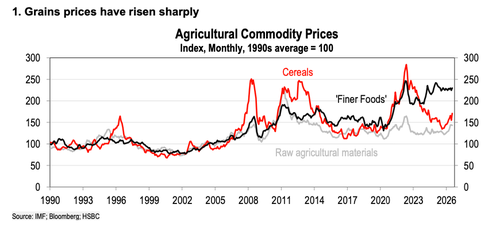
HSBC flags eroding grain buffers as USDA projects the first major production shortfall since 2020/21. Supply shocks from Black Sea and Hormuz disruptions intersect with weather risks, prompting export controls by multiple states. This tightens global stock-to-use ratios and raises price volatility without coordinated policy shifts.
HSBC economist Jamie Culling's note documented cereal prices rising 22% year-over-year through July amid supply shocks from the Russia-Ukraine escalation and Middle East conflict. The analysis cited USDA forecasts showing the first production shortfall since 2020/21, with Northern Hemisphere heatwaves and strengthening El Niño reducing yields across wheat, corn, and rice. Export curbs by multiple states have compounded input cost pressures from fertilizer constraints via the Strait of Hormuz.
Primary records from the USDA World Agricultural Supply and Demand Estimates confirm stock-to-use ratios declining alongside crop yield drops, reversing prior buffer accumulation. Russia-Ukraine tensions have cut Black Sea wheat shipments, which account for nearly one-third of global trade, while diesel price spikes from refinery damage add further costs. These developments align with documented state responses to scarcity rather than stated humanitarian rationales.
Competing interests center on food security for importers versus export controls by producers seeking domestic stability. India's prior rice export restrictions and similar moves by other economies illustrate policy tools deployed when buffers erode. The Russia-Ukraine conflict simultaneously disrupts fertilizer trade representing one-fifth of global volumes, creating cross-commodity linkages.
Forward risks include non-linear price volatility if El Niño intensifies yield losses in key regions. States face incentives to prioritize internal supply, potentially accelerating further trade restrictions absent new production offsets or conflict de-escalation.
FAO: At least 12 countries enact new grain export restrictions by Q3 2025 if cereal prices exceed 25% YoY gains.
Sources (2)
- [1]USDA World Agricultural Supply and Demand Estimates(https://www.usda.gov/oce/commodity/wasde)
- [2]FAO Global Food Price Monitoring(https://www.fao.org/giews/food-prices/en/)