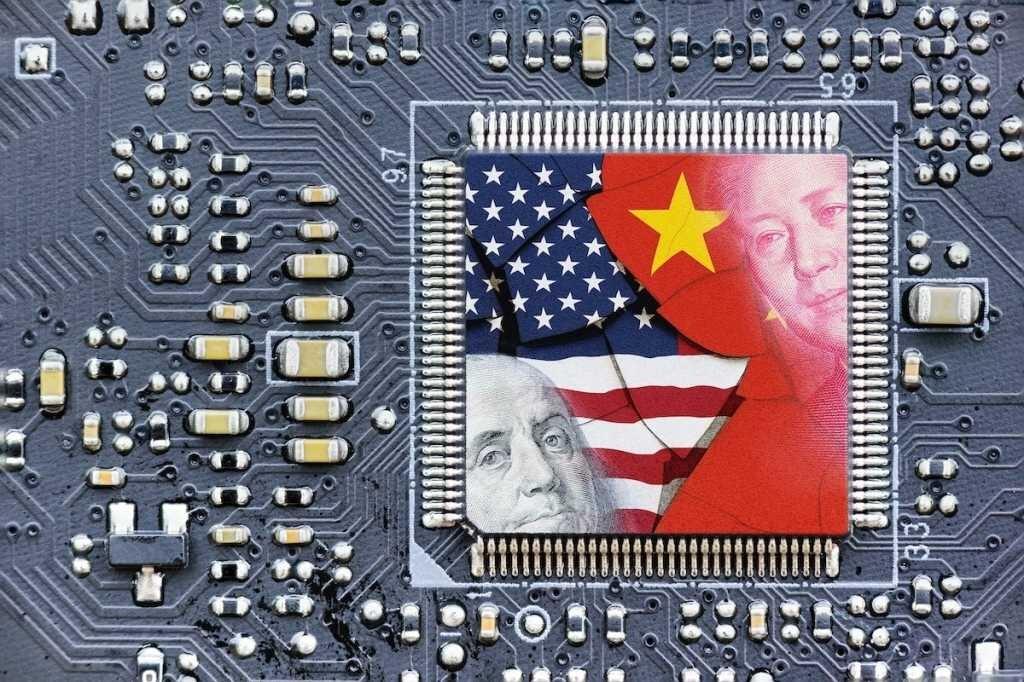
House panel discloses Commerce approved 879,868 Nvidia and AMD AI chips for China, including Pentagon-listed firms
House Foreign Affairs Committee records show BIS approved 879,868 Nvidia H200 and AMD MI325X chips for Chinese buyers as of May 11, 2026, including 272,000 for Alibaba, Tencent, Baidu, and BYD, firms on the Pentagon’s June 2026 military-companies list. Licenses were marked not yet shipped; actual deliveries remain uncounted.
Documented: On November 19, 2026, House Foreign Affairs Committee Chairman Brian Mast used authority under the Export Control Reform Act to release Bureau of Industry and Security license information, calling it the most detailed public disclosure in the statute’s history. A BIS summary dated May 11, 2026, showed applications to sell 3,444,160 covered integrated circuits—Nvidia H200s and AMD MI325X equivalents—to PRC companies, and approvals of 879,868 chips across 21 license applications. Within those approvals, the committee’s figures list 150,000 for Tencent and subsidiaries, 75,000 for Alibaba, 43,000 for Baidu, and 4,000 for BYD. Those four groups together account for 272,000 approved chips, about 31 percent of the approved total. The committee’s summary identifies the same four as appearing on the Department of Defense’s June 2026 Chinese military companies list (the panel refers to the department as the Department of War). A status table accompanying the release marked approved entries “Approved, not shipped” as of May 11. Reuters, CNBC, and The Hill independently reported the same headline totals and the same four-company breakdown.
Documented with a timing caveat: the June 2026 military-companies designation postdates the May 11 licensing snapshot. The records therefore show licenses approved for firms that the Pentagon later listed, not that every recipient was already on that list when BIS signed off. The committee also holds applications not fully reflected in the May summary, including a December 19, 2025, Nvidia application to export 445,000 H200s to Tencent. Requests highlighted for the four groups were larger than approvals in at least one case: 948,950 sought for Alibaba and subsidiaries versus 75,000 approved.
Claimed, and partly corroborated by separate reporting: Mast said Nvidia applications listed Maginfra and Beijing New Matrix as firms that might install the systems, and he called both “fake companies” and possible smuggling fronts. A November New York Times-linked account, summarized in secondary reporting, described empty offices at listed addresses and ownership ties toward U.S.-sanctioned entities. That is a documented congressional allegation plus journalistic address checks, not a finding that BIS knowingly licensed diversion. Nvidia told CNBC and The Hill that review spanned more than half a year, that approvals carried strict conditions and limited volumes, and that the company has since stopped shipping H200s to China. AMD said it complies with export rules. How many of the 879,868 approved chips were later delivered is not established by the released records.
The policy contradiction is in the documents, not in inference. Washington’s stated export-control purpose is to keep advanced compute away from China’s military-civil fusion system. The same Commerce process that implements that purpose approved nearly 880,000 high-end accelerators for Chinese buyers, including large volumes for companies the Pentagon has designated as military companies. Congress had already moved, earlier in 2026, to reclaim a veto: the Foreign Affairs Committee advanced the AI Overwatch Act after President Trump’s December 2025 decision to allow H200 sales to approved Chinese customers, a decision he publicly tied to a 25 percent payment to the United States. Ranking member Gregory Meeks said the administration’s handling put the technology edge at risk and that BIS had failed to enforce the rules.
What is not documented here is a completed diversion, a count of chips that physically entered mainland China, or a proven quid pro quo between Nvidia lobbying and specific license outcomes. Separate reporting this month describes Jensen Huang’s resignation amid an alleged relationship with a former Megaspeed executive whom U.S. officials suspect of Chinese intelligence ties, and stalled Commerce scrutiny of Megaspeed after contact from Nvidia’s general counsel. Those are adjacent claims under investigation and congressional request for testimony; they are not established by the license tables Mast released. The tables do establish something narrower and harder to dismiss: as of May 2026, the front door of the licensing system had already authorized a volume of advanced AI chips for Pentagon-listed Chinese firms that later political rhetoric treated as unacceptable.
The released licenses show U.S. regulators authorized nearly 880,000 advanced AI chips for Chinese companies, including hundreds of thousands for firms the Pentagon lists as military companies, while Congress was still trying to gain a veto over those same sales. The records do not show how many chips were delivered, but they do show the gap between the stated national-security rule and what Commerce approved.
Sources (6)
- [1]Chairman Brian Mast Exercises Legislative Authority to Publicly Release AI Chip License Information for China(http://foreignaffairs.house.gov/news/press-releases/chairman-brian-mast-exercises-legislative-authority-to-publicly-release-ai-chip-license-information-for-china)
- [2]Commerce approved sales of more than 879,000 AI chips to Chinese companies, Rep. Mast says(https://www.cnbc.com/2026/11/19/nvidia-amd-china-chip-sales-congress.html)
- [3]Trump administration approved shipment of 900,000 AI chips to China(https://thehill.com/policy/technology/6231677-trump-approves-ai-chip-sales/)
- [4]License information for AI chips sent to China released by US House committee (Reuters)(https://www.forth.news/articles/ChCu3JZQ3MWKKwA3iDXKw)
- [5]US Congress releases list of Chinese firms seeking Nvidia chips(https://www.scmp.com/news/china/diplomacy/article/3375135/us-congress-releases-list-chinese-firms-seeking-nvidia-chips)
- [6]US House panel advances bill to give Congress authority over AI chip exports(https://www.reuters.com/legal/litigation/us-house-panel-vote-bill-give-congress-authority-over-ai-chip-exports-2026-01-21/)