Curiosity's Molecular Mosaic: New Organics on Mars Illuminate Prebiotic Pathways and Ancient Habitability
Peer-reviewed analysis of one clay-rich rock drilled by Curiosity in 2020 uncovered 21 organics including seven new to Mars, such as nitrogen heterocycles that could precede RNA. Using SAM’s pyrolysis and TMAH wet chemistry (validated on Murchison meteorite), the study confirms complex carbon chemistry in an ancient lake environment but cannot determine biological origin. It builds on 2023 long-chain hydrocarbon findings and meteorite data, highlighting prebiotic potential while underscoring preservation biases and limited sample size.
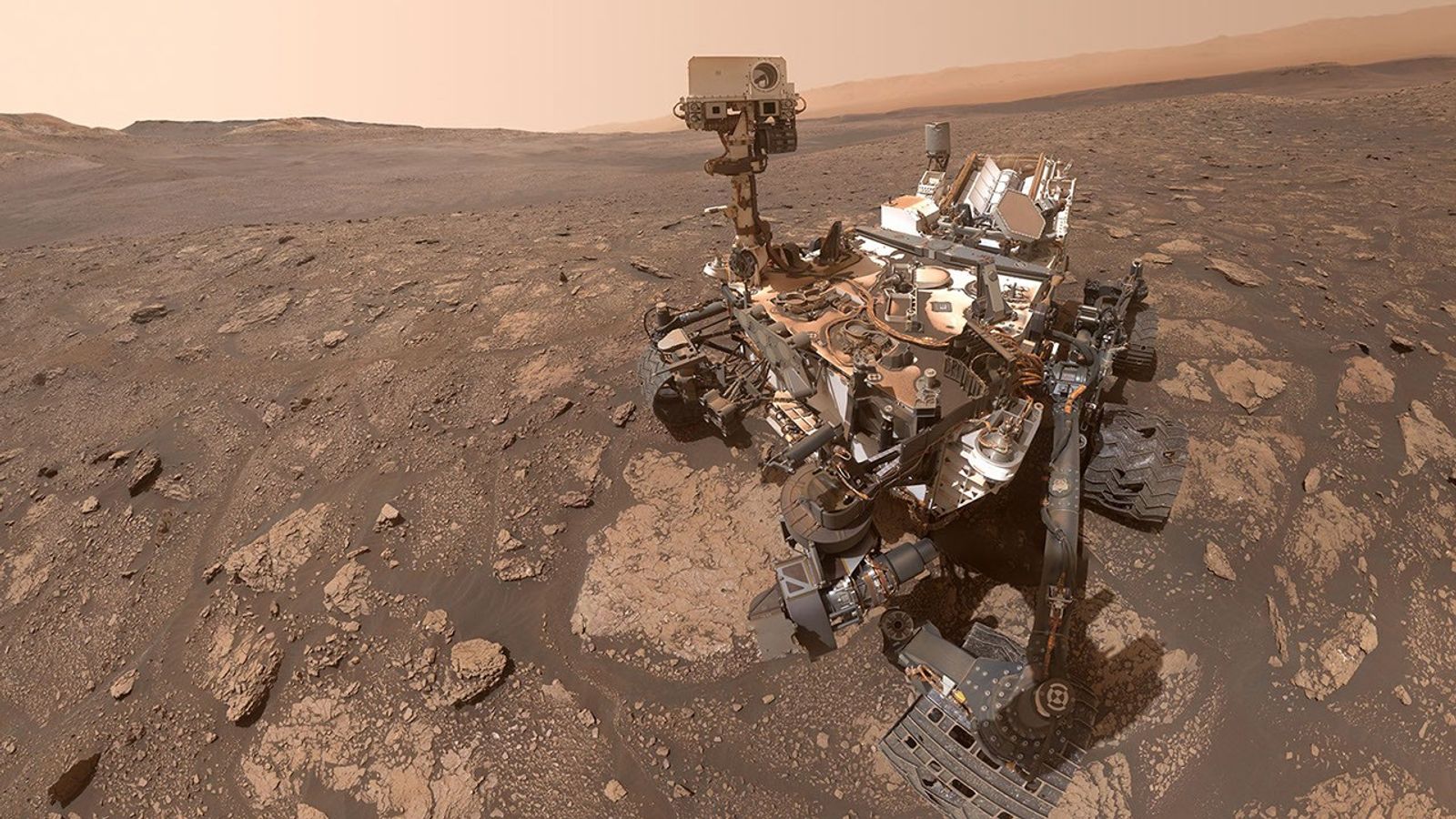
NASA’s Curiosity rover has delivered what may be its most chemically rich dataset yet from a single rock. In a peer-reviewed study published in Nature Communications (Williams et al., 2024), researchers report identifying 21 carbon-based molecules in a sample drilled from the “Mary Anning 3” outcrop in Gale Crater. Seven of these—most notably a nitrogen heterocycle and benzothiophene—had never been confirmed on Mars before. The work synthesizes data from Curiosity’s Sample Analysis at Mars (SAM) instrument with prior detections of long-chain hydrocarbons (decane, undecane, dodecane) reported in a 2023 Nature Astronomy paper by Millan et al., and with decades of laboratory studies of the Murchison meteorite.
Methodology note: The analysis rests on one drilled rock sample collected in 2020 from a clay-rich layer formed in an ancient lake that repeatedly filled and dried. Powder was processed in SAM using both high-temperature pyrolysis and, for the first time on Mars, wet chemistry with tetramethylammonium hydroxide (TMAH). This solvent breaks large molecules into detectable fragments. The team validated the TMAH approach on a fragment of the Murchison meteorite, a carbonaceous chondrite whose organic inventory is considered representative of material that rained onto early planets. Sample size is therefore limited—one rock, two TMAH cups reserved for high-priority targets—but the mission context includes more than a dozen prior organic detections across Gale Crater using different techniques.
The original NASA coverage and most mainstream reports emphasized excitement and “building blocks of life” while underplaying two critical limitations. First, the study cannot distinguish biotic from abiotic origins; every detected molecule can form through purely geochemical processes such as serpentinization or Fischer-Tropsch-type synthesis in hydrothermal systems. Second, surface radiation over billions of years destroys complex organics, meaning the preserved molecules likely represent only the most stable fraction of what once existed.
What sets this finding apart is the specific chemistry. The nitrogen heterocycle belongs to a family considered plausible precursors to nucleobases in RNA and DNA. Its presence directly ties Martian carbon chemistry to the “RNA world” hypothesis that dominates origin-of-life research on Earth. Benzothiophene, a sulfur-containing aromatic, mirrors compounds found in terrestrial hydrothermal vents and in meteorites thought to have seeded the inner solar system. When viewed alongside the 2023 long-chain hydrocarbon detection, a pattern emerges: Mars hosted diverse carbon reservoirs—atmospheric, igneous, and extraterrestrial—that interacted in a fluctuating lacustrine environment rich in clay minerals. Clays are exceptional at trapping organics, a fact exploited by paleontologists on Earth and now by planetary scientists on Mars.
This connects to broader astrobiological context. Similar suites of organics appear in Enceladus’ plumes and in laboratory simulations of early Earth. The growing inventory from Curiosity and the parallel sample cache being assembled by Perseverance suggest that prebiotic evolution may have reached comparable stages on multiple worlds. Yet the absence of chirality measurements or isotopic fractionation patterns typical of biology keeps the question open. The real advance is not “life on Mars” but a clearer map of the chemical landscape that would have been available to it.
Limitations remain. All data come from surface-accessible rocks; we have no deep subsurface samples. SAM’s heating can also create secondary reaction products, requiring careful laboratory analogs. Still, the combination of wet chemistry, meteorite cross-checks, and stratigraphic context makes this one of the most robust organic characterizations yet achieved on another planet. The detection raises the stakes for Mars Sample Return: laboratory instruments on Earth could reveal isotopic ratios, chirality, and polymer complexity that SAM cannot.
In the end, Curiosity has shown that ancient Mars possessed not just water and minerals but a sophisticated organic toolkit. Whether that toolkit was ever used by biology is the next chapter—one that future missions and returned samples are now better equipped to read.
HELIX: These newly detected nitrogen heterocycles and sulfur aromatics show ancient Mars had a richer, more varied carbon chemistry than previously mapped, mirroring the prebiotic environments where life likely started on Earth and raising the value of every future sample return.
Sources (3)
- [1]NASA’s Curiosity Finds Organic Molecules Never Seen Before on Mars(https://www.nasa.gov/missions/mars-science-laboratory/curiosity-rover/nasas-curiosity-finds-organic-molecules-never-seen-before-on-mars/)
- [2]Diverse organic molecules detected on Mars by Curiosity’s SAM instrument(https://www.nature.com/articles/s41467-024-46373-5)
- [3]Organic molecules in Martian lacustrine mudstones: insights from wet chemistry(https://www.nature.com/articles/s41550-023-01970-4)
Corrections (1)
Prior detections of long-chain hydrocarbons (decane, undecane, dodecane) were reported in a 2023 Nature Astronomy paper by Millan et al.
Decane, undecane, and dodecane detections from Cumberland sample reported in 2025 PNAS paper (Freissinet lead author, Millan co-author). Millan et al. 2022 Nature Astronomy paper covers TMAH derivatization in Bagnold Dunes detecting other organics (e.g. benzoic acid), not these hydrocarbons. No 2023 Nature Astronomy paper by Millan et al. on this topic exists.