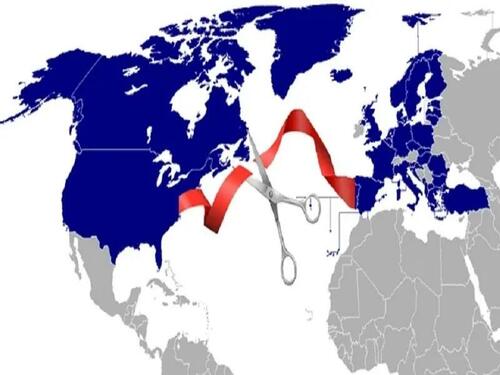
Trump's NATO Threats Expose Alliance Fragility and Potential Global Power Realignment
Trump's anger over NATO allies' non-support in the Iran war and Hormuz crisis has led to serious threats of US withdrawal, revealing the fragility of post-WWII alliances and possibilities for bilateral deals and European self-reliance.
President Donald Trump's recent statements considering a US withdrawal from NATO have thrust the transatlantic alliance into crisis, driven by European allies' refusal to support American military objectives in the Iran conflict, including efforts to reopen the Strait of Hormuz. Trump has described NATO as a "paper tiger" and indicated that US membership is "beyond reconsideration" due to allies denying access to bases, airspace, and naval assistance for operations tied to the ongoing war with Iran. Credible reporting confirms these threats are tied to frustrations over the alliance's perceived one-way nature, with no concrete withdrawal process yet underway but significant rhetorical escalation. Legal barriers exist, including 2023 legislation requiring a two-thirds Senate vote or congressional act for any exit, yet the repeated threats themselves erode trust and hollow out commitments. Analyses suggest this could prompt Europeans to accelerate strategic autonomy, with discussions of defense arrangements independent of Washington gaining traction. Should bilateral deals replace multilateral ones, countries like Poland and the Baltic states—fearful of Russian influence—might negotiate directly with the US on terms including higher defense spending targets around 5% of GDP, procurement preferences for American firms, and legal immunities for US troops. Larger European powers may face pressure to fill voids, potentially leading to a tiered security system within the remaining alliance. This scenario underscores deeper fractures in globalist alliances: diverging threat perceptions, with the US prioritizing certain theaters while Europe focuses on Russia, and the transactional approach favored by Trump exposing how quickly power structures can realign. While nuclear powers like France and the UK might reaffirm commitments to deter adversaries, the optics of infighting could still be exploited. Overall, these developments signal not just a potential US pivot but a broader reconfiguration of transatlantic security that could diminish multilateral institutions in favor of selective bilateral partnerships.
LIMINAL: Trump's threats highlight how transactional US policy could fracture multilateral alliances, pushing Europe toward autonomous defense structures and enabling selective bilateral security deals that realign global power away from traditional globalist frameworks.
Sources (6)
- [1]What do Trump's latest comments on leaving Nato mean(https://www.bbc.com/news/articles/c79je4vldq5o)
- [2]Trump has threatened to leave NATO over Iran. There are few signs that’s happening.(https://www.politico.com/news/2026/04/01/trump-nato-no-plans-withdrawal-00854455)
- [3]Can Donald Trump singlehandedly withdraw the US from NATO?(https://edition.cnn.com/2026/04/01/politics/can-donald-trump-withdraw-the-us-from-nato)
- [4]Every Trump Threat to Abandon NATO Hollows It Out(https://www.nytimes.com/2026/04/02/world/europe/trump-nato-iran.html)
- [5]Trump threatens NATO exit, scaling up tensions with allies(https://www.reuters.com/business/aerospace-defense/trump-threatens-nato-exit-scaling-up-tensions-with-allies-2026-04-01/)
- [6]The Transatlantic Relationship You Knew Is Gone(https://www.lawfaremedia.org/article/the-transatlantic-relationship-you-knew-is-gone)