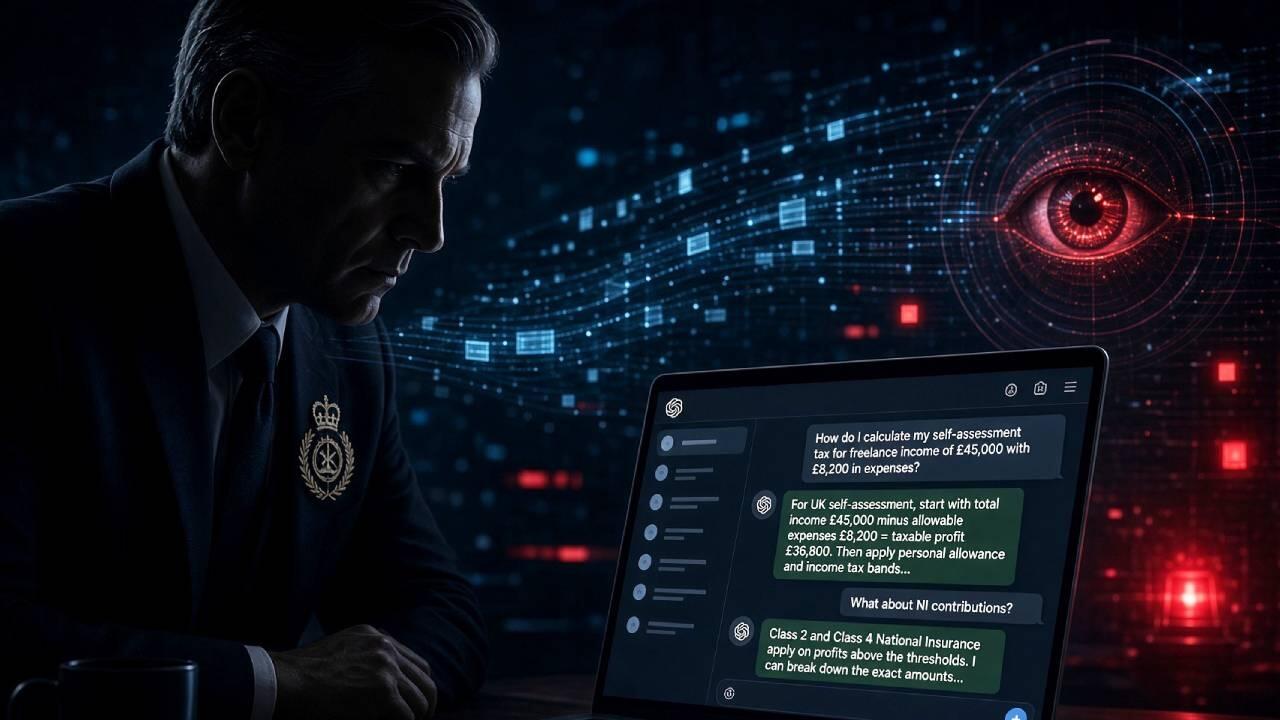
HMRC proposals could let tax officers request AI chats used to work out tax figures
Draft UK Finance Bill changes would let HMRC, under existing lawful checks, obtain digital material showing how tax figures were produced, including from software intermediaries. Advisers and several news outlets say that could include AI chat logs used in tax prep; HMRC says it is not a general search of chatbot use.
Documented: On 13 July 2026 HMRC published draft Finance Bill 2026-27 measures to modernise Schedule 36 information powers and section 114 of the Finance Act 2008, the provision that treats electronic material as documents. The official tax information and impact note says the rewrite is meant to reflect how tax information is now created, stored and processed with software, automated systems and cloud services. Where HMRC already has a lawful basis to require information, the changes would let officers obtain material needed to understand how relevant tax figures were produced, including from third parties and intermediaries such as software providers. The note is explicit that section 114 remains a supporting provision, not a new standalone power, and that the existing test — information reasonably required to check a tax position — still applies. The measure takes effect on and after Royal Assent. HMRC’s later public line matches that framing: the update is about digital record-keeping, not a trawl through everyone’s use of large language models, and requests still need a lawful basis.
Claimed: Reporting that began in The Telegraph on 11 November 2026, and was followed by The Independent, the i Paper and others, says the drafting expands what can be demanded from computer “records” to any “relevant thing,” and that third parties including AI platforms could be served with Schedule 36 notices. Tax advisers quoted in those reports treat that wording as wide enough to reach prompt histories, AI working papers and full conversations on tools such as ChatGPT, Microsoft Copilot and Claude if those exchanges formed part of a tax calculation. Nimesh Shah of Blick Rothenberg pointed to HMRC’s stated interest in how figures were produced by software or automated processes. Seb Maley of Qdos said the authority wants the method, not only the number. Anne Strickland of the TaxPayers’ Alliance called compelled disclosure of private AI conversations a deeply intrusive overreach. David Stirling of Mint Wealth advised people who used a chatbot for tax work to assume the workings could later be examined. Failure to comply with an information notice already carries an initial £300 penalty, with further penalties of up to £3,000 where inaccuracies are not corrected — figures the press reporting attaches to this regime, and which sit inside long-standing Schedule 36 practice rather than a chatbot-specific fine.
The gap between those two layers is the story. Documented law reform is about making existing compliance powers work on digital systems and on the logic of automated calculations, including material held by intermediaries. Claimed reach into ordinary chatbot transcripts is an inference by practitioners and journalists from that broader wording, not a sentence in the published impact note that names ChatGPT or private cognition. HMRC has denied any intention to review everyone’s model use. Whether a particular prompt log is “reasonably required,” and whether an AI company can be compelled to produce it, is not settled by the consultation text now on the record.
Context that is documented, and that explains why the inference landed: HMRC’s own estimate puts the 2024–25 tax gap at £59.2 billion, or 6.4% of theoretical liabilities. Separately, Lloyds Banking Group’s Consumer Digital Index, reported in November 2025, found more than 28 million UK adults had used AI for personal-finance help in the previous year, with ChatGPT the most used tool among them. The reform therefore meets a population that already treats chatbots as informal tax clerks, while the statute still speaks the language of records, software and automated processes.
Speculated, and not established by the sources: that the measure is a general warrant on private thought, a template other agencies will copy for non-tax policing of AI use, or a step toward routine collection of unrelated chat history. Those readings go beyond both the impact note and the adviser comments. What is on the page is narrower and still unsettled — a compliance power aimed at the workings behind a figure, drafted broadly enough that tax specialists think a tax-related chatbot log could be inside it, and officially denied as a blanket surveillance tool.
People and businesses who use chatbots or tax software to work out figures, and the firms that hold those records, could be asked for that material in a lawful HMRC check once the Finance Bill changes take effect. The published reform does not itself authorise a general read of private AI chats.
Sources (6)
- [1]Reforming civil tax information and inspection powers — GOV.UK(https://www.gov.uk/government/publications/reforming-information-powers-and-modernising-computer-records-law/reforming-civil-tax-information-and-inspection-powers-schedule-36-finance-act-2008andmodernisingthe-definitions-about-computer-records-s114-fina)
- [2]HMRC to probe taxpayers’ AI chat history in latest crackdown — The Telegraph(https://www.telegraph.co.uk/money/tax/news/hmrc-to-probe-taxpayers-ai-chat-history-in-latest-crackdown/)
- [3]Can HMRC read your ChatGPT history? — The Independent(https://www.independent.co.uk/news/uk/home-news/hmrc-tax-ai-chatgpt-claude-copilot-chat-history-b3084692.html)
- [4]New rule lets HMRC snoop on taxpayers’ AI chat history — i Paper(https://inews.co.uk/inews-lifestyle/money/rule-hmrc-snoop-taxpayers-ai-chat-history-4890354)
- [5]Tax Gap 2024-25 estimated at 6.4% — GOV.UK(https://www.gov.uk/government/news/tax-gap-2024-25-estimated-at-64)
- [6]28 million Brits using AI for personal finance, finds Lloyds Bank — Digit(https://www.digit.fyi/ai-for-personal-finance/)