Breakthrough Water-Based EV Battery Recycling Method Could Reshape Supply Chains and Green Transition
Rice University’s water-based method for recovering 65% of EV battery metals in one minute at room temperature offers a sustainable alternative to traditional recycling, potentially easing supply chain bottlenecks and lowering costs. However, scalability challenges and environmental unknowns remain, while geopolitical and market impacts could reshape the green transition.
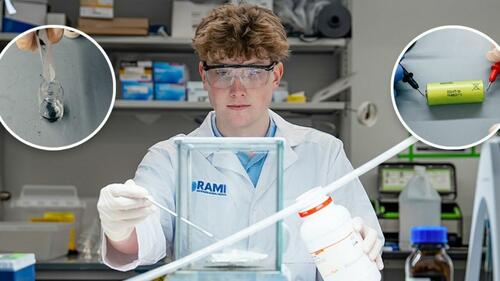
A recent study from Rice University, published in the journal Small, introduces a groundbreaking water-based method for recovering metals from spent lithium-ion batteries, achieving a 65% extraction rate in just one minute at room temperature using hydroxylammonium chloride (HACl). This innovation, led by researchers Simon M. King and Sohini Bhattacharyya, leverages a redox-active nitrogen center in HACl to accelerate metal dissolution, offering a faster, less energy-intensive, and potentially more environmentally friendly alternative to traditional hydrometallurgical processes that often rely on harsh acids and high temperatures. While the original coverage by Interesting Engineering (via ZeroHedge) highlights the speed and efficiency of the method, it misses critical geopolitical and economic implications, as well as scalability challenges that could temper its immediate impact.
Firstly, this method addresses a pressing bottleneck in the electric vehicle (EV) supply chain: the scarcity and geopolitical concentration of critical battery metals like lithium, cobalt, nickel, and manganese. The International Energy Agency (IEA) notes in its 2023 Critical Minerals Market Review that global demand for these materials could quadruple by 2030 under net-zero scenarios, with over 60% of cobalt production currently concentrated in the Democratic Republic of Congo, a region plagued by conflict and labor issues. By enabling rapid recovery of these metals from spent batteries, the Rice University method could reduce dependence on volatile mining regions, potentially stabilizing prices and enhancing energy security for nations like the United States and members of the European Union, which have set ambitious EV adoption targets under policies like the EU’s Green Deal and the U.S. Inflation Reduction Act.
Secondly, the environmental angle of this water-based approach aligns with global sustainability goals but raises unaddressed questions about waste management and scalability. While the study emphasizes reduced toxicity compared to acid-based solvents, it does not discuss the lifecycle environmental impact of producing HACl or handling post-extraction waste. A 2022 report by the United Nations Environment Programme (UNEP) on battery recycling highlights that even 'green' recycling methods can generate secondary pollution if not paired with robust waste treatment systems. Without clarity on industrial-scale application, the method’s real-world environmental benefits remain speculative.
Lastly, the economic ripple effects of this technology could be profound, yet the original coverage overlooks its potential to disrupt commodity markets. If scaled, this recycling innovation could decrease demand for newly mined metals, pressuring prices and affecting economies reliant on mineral exports, such as Chile (lithium) and Indonesia (nickel). Conversely, it could lower EV production costs, accelerating adoption in price-sensitive markets like India and Southeast Asia, where cost remains a barrier to electrification, as noted in the IEA’s 2023 Global EV Outlook.
In synthesizing these perspectives, it’s clear that while the Rice University method marks a technical leap, its broader impact hinges on scalability, regulatory support, and integration into existing recycling infrastructures. The interplay between supply chain dynamics, environmental policy, and market forces will determine whether this innovation becomes a cornerstone of the green energy transition or remains a promising lab result.
MERIDIAN: This water-based recycling method could significantly reduce reliance on conflict-prone mineral sources if scaled effectively, but industrial adoption and waste management hurdles may delay its impact on the EV market by 3-5 years.
Sources (3)
- [1]Water-Based Method Recovers 65% Of EV Battery Metals In One Minute At Room Temperature(https://www.zerohedge.com/energy/water-based-method-recovers-65-ev-battery-metals-one-minute-room-temperature)
- [2]IEA Critical Minerals Market Review 2023(https://www.iea.org/reports/critical-minerals-market-review-2023)
- [3]UNEP Global Battery Recycling Report 2022(https://www.unep.org/resources/report/recycling-batteries-sustainability-and-circular-economy)