DSCOVR EPIC Captures Three Simultaneous Pacific Cyclones Amid El Niño-Driven Activity
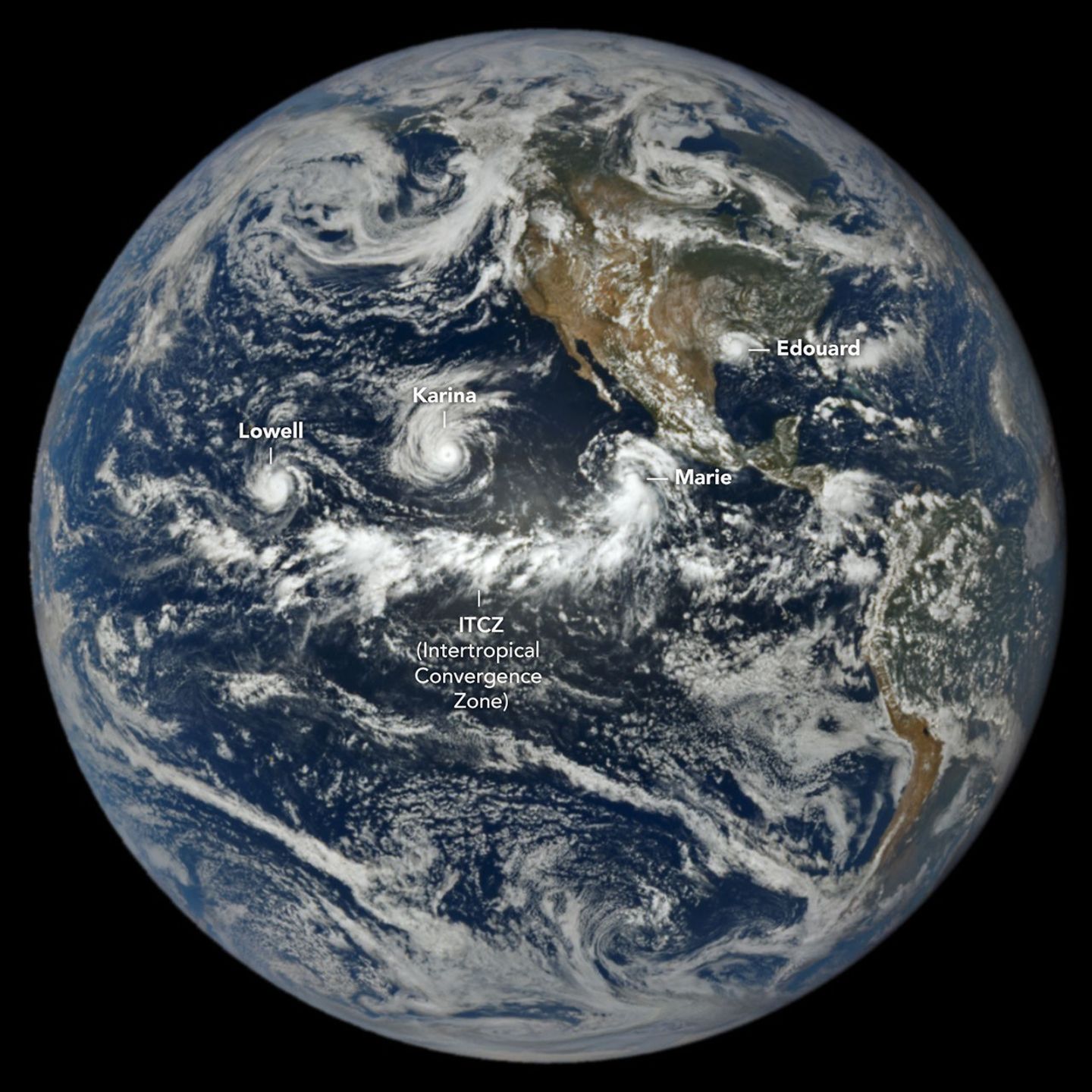
EPIC satellite imagery documented three concurrent Northeast Pacific cyclones under El Niño conditions while the Atlantic produced minimal activity. Observed ACE values matched seasonal forecasts. The contrast illustrates how basin-scale ocean and circulation anomalies redistribute tropical cyclone energy.
The image shows the three storms plus Tropical Storm Edouard over the Gulf Coast. Lowell briefly reached category 5 on September 2 while Karina hit category 4, an uncommon simultaneous pairing. Accumulated Cyclone Energy in the Northeast Pacific stood at 130, 50 percent above normal, versus the Atlantic’s 4.4, just 9 percent of normal. El Niño’s warmer Pacific waters and altered wind patterns explain the basin contrast.
NASA data from EPIC and other platforms support real-time tracking and post-storm damage assessment. The 2026 season aligns with spring outlooks that correctly anticipated elevated Pacific activity and suppressed Atlantic activity under El Niño conditions. Colorado State University statistics confirm the ACE disparity.
Continued monitoring through the peak season will test whether Pacific totals remain elevated or whether late-season Atlantic development can close the gap. Multi-platform NASA observations will remain central to both forecasting and impact evaluation.
Colorado State: Northeast Pacific ACE will finish 2026 at least 30 percent above the 1991-2020 average.
Sources (3)
- [1]Primary Source(https://science.nasa.gov/earth/earth-observatory/a-trio-of-tropical-cyclones-in-the-pacific/)
- [2]Supporting Source(https://tropical.colostate.edu/forecasting/)
- [3]Supporting Source(https://www.nhc.noaa.gov/)