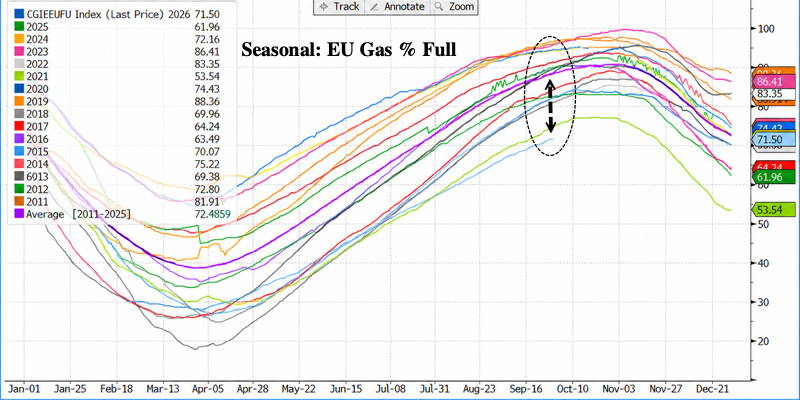
Europe Enters Winter with Record-Low Gas Storage Buffers Amid LNG Supply Disruptions
Credible data from GIE, S&P Global, FT, and analyst reports corroborate Europe's critically low gas storage (~71%) entering winter 2026, driven by LNG shortfalls and competition, raising price and shortage risks.
Multiple independent reports confirm Europe's natural gas storage levels are significantly depleted heading into the 2026-2027 winter, aligning with warnings of thin buffers and elevated price risks. As of early October 2026, EU gas storage stood at approximately 71-72% full, well below the five-year seasonal average of around 87-90% and prior years' levels (e.g., 82.5% in 2025 and 94.2% in 2024), according to data from Gas Infrastructure Europe (GIE) via StorageCurve and S&P Global Energy.[1][2]
This shortfall stems from slower injections, reduced LNG arrivals, and global supply constraints, including extended force majeure on Qatari shipments due to Middle East disruptions affecting the Strait of Hormuz. Qatar's exports have plummeted, with analysts noting minimal cargoes compared to previous periods, forcing Europe to compete with Asian buyers for spot LNG.[3][4] Weekly inflows to Asia have risen, widening the JKM-TTF premium and pressuring European prices higher.
Analysts from firms like Wood Mackenzie, Morgan Stanley, ING, and Columbia University's Center on Global Energy Policy highlight risks of storage reaching only 74-75% by winter start before potentially dropping to low levels by season's end, leaving little margin for cold snaps or further disruptions. Germany and the Netherlands show particularly low fills (around 58%), while Italy and France fare better.[5][6]
Broader context includes Europe's increased reliance on US LNG (accounting for ~62% of imports) and policy shifts, with the EU considering flexible storage targets around 80% rather than stricter prior mandates. No immediate supply crisis is declared by the European Commission, but volatility in prices and potential economic ripple effects worldwide remain concerns if demand spikes.[7]
The situation underscores systemic vulnerabilities in post-2022 energy markets, where diversified LNG supplies help but cannot fully offset thin storage buffers without sustained high prices or demand destruction elsewhere.
[Energy Market Analyst]: Thin storage and LNG competition could sustain elevated TTF prices through winter, amplifying costs for European industry and households while testing global supply chains if cold weather or new disruptions hit.
Sources (7)
- [1]Europe enters winter with gas storage at 71%, raising fears of supply shortages and higher prices(https://www.businesstoday.in/world/story/europe-enters-winter-with-gas-storage-at-71-raising-fears-of-supply-shortages-and-higher-prices-559334-2026-10-03)
- [2]EU Gas Storage Chart: 5-Year Average | StorageCurve(https://storagecurve.com/natural-gas/europe/storage/)
- [3]Gas Outlook | European gas prices hit multi-year high(https://gasoutlook.com/analysis/european-gas-prices-hit-multi-year-high/)
- [4]EU enters winter with lower gas storage levels, but Commission sees no immediate supply risk(https://2eu.brussels/en/news/eu-enters-winter-with-lower-gas-storage-levels-but-commission-sees-no-immediate-supply-risk)
- [5]The EU and UK’s Gas Forecasts Are Not an Energy Strategy(https://energynewsbeat.co/energy-crisis/the-eu-and-uks-gas-forecasts-are-not-an-energy-strategy/)
- [6]European Gas Storage: The World's Winter Buffer Is Dwindling(https://www.energypolicy.columbia.edu/european-gas-storage-the-worlds-winter-buffer-is-dwindling/)
- [7]LNG spot price surge deters Asian buyers, but saves Europe | Reuters(https://www.reuters.com/commentary/reuters-open-interest/lng-spot-price-surge-deters-asian-buyers-saves-europe-2026-09-17/)