OpenAI's Financial Woes Signal Broader Risks in AI Sector's Trillion-Dollar Gamble
OpenAI's failure to meet revenue and user targets, coupled with CFO concerns over $1.5 trillion in commitments, signals deeper financial risks in the AI sector. Beyond the company's woes, historical tech bubble patterns, supply chain constraints, and market over-reliance on AI spending suggest a looming industry-wide reckoning.
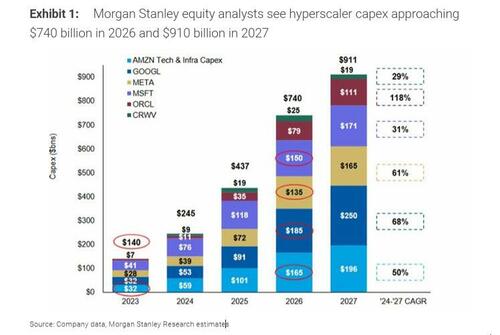
OpenAI, a frontrunner in the AI revolution, has recently stumbled in meeting its revenue and user growth targets, casting doubt on its ability to sustain $1.5 trillion in computing commitments, as reported by the Wall Street Journal. CFO Sarah Friar has expressed internal concerns over the company's capacity to fund future contracts if revenue fails to scale, a warning that reverberates beyond OpenAI to the broader tech and AI investment landscape. This development, initially covered by ZeroHedge, highlights a critical juncture for an industry riding high on speculative capital expenditure, with hyperscalers projecting capex of nearly $1 trillion by 2027. Yet, the original coverage misses deeper systemic risks and historical parallels that contextualize this moment as a potential inflection point for an AI bubble.
Firstly, OpenAI's predicament is not isolated but reflective of a pattern seen in tech booms past, such as the dot-com bubble of the late 1990s. Then, as now, unchecked optimism and massive capital commitments—often without clear revenue models—drove valuations to unsustainable heights before a sharp correction. OpenAI's $1.5 trillion in commitments, largely orchestrated by CEO Sam Altman with minimal external advisory input as noted by the Financial Times last October, mirrors the speculative fervor of that era. The lack of transparency in funding mechanisms and deal terms raises red flags about whether these investments are grounded in viable business outcomes or merely in the promise of future dominance.
Secondly, the original ZeroHedge piece underplays the geopolitical and supply chain dimensions exacerbating OpenAI's financial strain. The AI sector's reliance on cutting-edge semiconductors and data infrastructure is bottlenecked by global chip shortages and U.S.-China tech tensions, which have restricted access to cheaper alternatives like Chinese LLMs or RAM chips. A 2023 report from the U.S. Department of Commerce on semiconductor supply chains underscores the fragility of this ecosystem, with production delays and export controls inflating costs for companies like OpenAI that are locked into high-end, U.S.-centric tech stacks. This external pressure compounds internal missteps, suggesting that even if revenue targets were met, structural costs might still outpace income.
Lastly, the narrative of AI as the sole driver of market stability—countering stagflationary pressures from oil prices and geopolitical unrest as ZeroHedge suggests—ignores the risk of over-reliance on a single sector. If OpenAI's spending falters, the ripple effects could destabilize hyperscalers and chip manufacturers like NVIDIA, whose stock surges have been tethered to AI capex. This interconnectedness, while a strength in bullish times, becomes a liability when one key player falters, potentially triggering a broader tech sell-off. The missed targets are not just OpenAI's problem but a canary in the coal mine for investors who have poured trillions into AI without rigorous stress-testing of return timelines.
In synthesizing these perspectives, it becomes clear that OpenAI's challenges are symptomatic of a sector-wide gamble where hype has outpaced fundamentals. Historical tech bubbles, supply chain fragilities, and market over-dependence on AI spending form a triad of risks that the original coverage only superficially addresses. As the industry approaches a potential $1 trillion capex threshold by 2027, the question is not just whether OpenAI can pay its bills, but whether the AI boom itself is on the brink of a painful recalibration.
MERIDIAN: OpenAI's financial struggles may accelerate scrutiny of AI sector investments, potentially leading to a correction in tech valuations by late 2024 if revenue models remain unproven.
Sources (3)
- [1]OpenAI Misses Revenue, User Targets As CFO Fears $1.5 Trillion In Commitments Can't Be Paid(https://www.zerohedge.com/markets/openai-misses-revenue-user-targets-cfo-fears-15-trillion-commitments-cant-be-paid)
- [2]OpenAI’s Sam Altman Spearheads $1.5 Trillion Deals With Little Oversight(https://www.ft.com/content/openai-sam-altman-deals-oversight-2023)
- [3]U.S. Department of Commerce Semiconductor Supply Chain Report 2023(https://www.commerce.gov/news/press-releases/2023/01/commerce-department-releases-semiconductor-supply-chain-report)