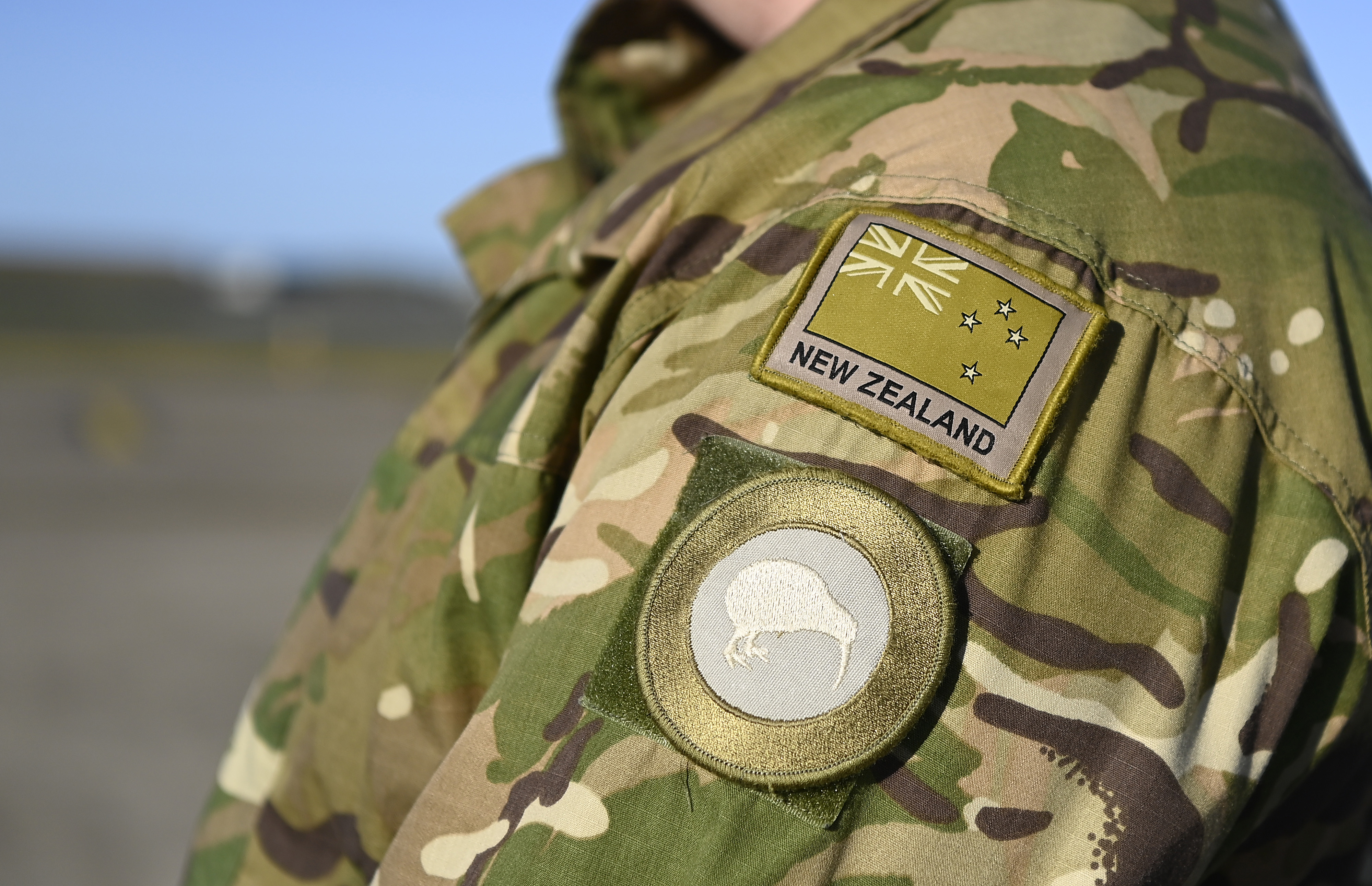
Beyond the AUKUS Headlines: Australia-New Zealand Force Integration Forms Quiet Backbone of Indo-Pacific Containment
New Zealand's new Defence Minister Chris Penk, with dual NZ-AU service experience, will accelerate 2035 military integration with Australia. This under-reported convergence creates interchangeable forces to counter China's Pacific expansion, forming a critical but overlooked pillar of Indo-Pacific containment that parallels yet sits outside AUKUS.
The elevation of Chris Penk to New Zealand Defence Minister is more than a personnel transition; it is a deliberate acceleration of a trans-Tasman convergence that mainstream coverage continues to treat as routine bilateral housekeeping. Penk, uniquely having served in both the Royal New Zealand Navy and alongside Australian units, assumes the role at the precise moment the NZDF and ADF have formalized plans to achieve an "interchangeable" joint force by 2035. This goes far beyond embedded liaison officers and shared call signs already visible in RAAF squadrons. It envisions synchronized doctrine, pooled sustainment pipelines, and senior officers exercising command authority across borders.
Original reporting correctly notes the personnel exchanges and recruitment reforms but misses the deeper strategic architecture and what it reveals about alliance patterns. This is not simply ANZAC nostalgia updated for the 21st century. It forms an under-appreciated layer of the Indo-Pacific's emerging minilateral latticework explicitly designed to counter Chinese expansion in the South Pacific. The 2022 China-Solomon Islands security pact, which granted Beijing potential dual-use access to facilities within striking distance of Australian approaches, acted as a decisive catalyst. Both Canberra and Wellington recognized that traditional diplomatic engagement and episodic patrols were insufficient against systematic gray-zone erosion.
Synthesizing the primary Defense News dispatch with analysis from the Australian Strategic Policy Institute's 2024 report on extended deterrence in the Pacific and a RAND Corporation study on Pacific Island security architecture (RR-A1535-1, 2023), a clearer picture emerges. The ASPI paper highlights how NZ-Australia integration creates "strategic depth" without requiring New Zealand to abandon its nuclear-free policy that fractured ANZUS in the 1980s. RAND's mapping of Chinese port and influence operations across Oceania demonstrates why the Pacific "family" concept is hardening into operational reality: Beijing's dual-use infrastructure projects and fisheries militia tactics require persistent maritime domain awareness and rapid response capacity that neither nation possesses independently at credible scale.
What much coverage gets wrong is portraying this as a purely regional, neighborly project disconnected from great-power competition. In truth, it subtly bridges New Zealand toward the technological and operational standards of AUKUS Pillar 2 without the political toxicity of formal membership. Shared development of uncrewed systems, AI-enabled intelligence fusion, and compatible C4ISR infrastructure are already being aligned. Penk's additional responsibility for the GCSB and NZSIS further tightens Five Eyes data flows that U.S. assessments have occasionally flagged New Zealand as lagging.
The operational tempo is accelerating. New Zealand has placed a defence advisor in New Delhi following last year's MoU with India, while simultaneously deepening ties with Pacific states wary of Chinese security overtures. Air Marshal Tony Davies' parliamentary warning that the NZDF must be able to "significantly and quickly" expand its force, paired with the commitment to lift defence spending from 1% to 2% of GDP, reflects recognition that current capacity is inadequate for the deteriorating environment. Recruitment timelines have improved, yet political caution ahead of the November election risks slowing momentum.
This integration reveals a mature strategic logic: while AUKUS dominates headlines with its nuclear submarines and hypersonic collaboration, the quieter Australia-New Zealand convergence delivers the day-to-day deterrent presence across the South Pacific that actually shapes Beijing's risk calculus. It reinforces a pattern seen in the Quad, trilateral U.S.-Japan-Australia logistics agreements, and emerging U.S.-Philippines access deals: flexible, capability-focused coalitions that avoid rigid treaty language while steadily raising the costs of Chinese revisionism. By 2030, the effective combat power generated by this "interchangeable" force may prove as decisive for regional stability as any single AUKUS platform. The era of symbolic Pacific diplomacy is ending; the age of fused operational architectures has begun.
SENTINEL: Expect accelerated joint procurement and fused maritime domain awareness systems between ADF and NZDF by 2028, quietly extending AUKUS Pillar 2 effects into the South Pacific and hardening collective response options to Chinese basing attempts.
Sources (3)
- [1]New Zealand defense minister to help shepherd military-integration push with Australia(https://www.defensenews.com/global/asia-pacific/2026/04/08/new-zealand-defense-minister-to-help-shepherd-military-integration-push-with-australia/)
- [2]The Australia–New Zealand defence relationship: a critical enabler of regional security(https://www.aspistrategist.org.au/the-australia-new-zealand-defence-relationship-a-critical-enabler-of-regional-security/)
- [3]Pacific Islands: China’s growing influence and implications for the US(https://www.rand.org/pubs/research_reports/RRA1535-1.html)