Pakistan's Troop and Jet Deployment to Saudi Arabia Signals Emerging Independent Muslim Defense Bloc Amid Iran Tensions
Pakistan's deployment of thousands of troops, Chinese-equipped fighters, drones, and air defenses to Saudi Arabia under their 2025 mutual defense pact—coupled with efforts to add Turkey and Qatar—signals the formation of a potent new regional security bloc. This development hedges against renewed Iran conflict, integrates Chinese technology, offers Pakistan economic relief, and may diminish reliance on U.S. security guarantees in the Gulf.
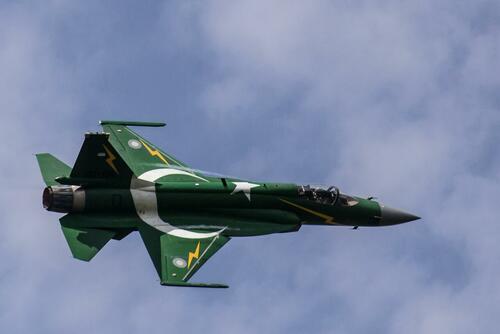
Pakistan has dispatched a substantial combat force—including 8,000 troops, a full squadron of approximately 16 JF-17 fighter jets (jointly developed with China), multiple drone squadrons, and a Chinese HQ-9 air defense battery—to Saudi Arabia under their 2025 Strategic Mutual Defense Agreement. According to Reuters reporting on May 18, 2026, this deployment is explicitly intended to defend the Kingdom against potential further attacks, even as Pakistan has simultaneously played a mediation role between the United States, Israel, and Iran following the April 2026 ceasefire. Saudi financing covers the operation while Pakistani personnel retain operational control of all assets.[1][2]
This move represents more than routine military cooperation. It activates a mutual defense pact signed in September 2025 that treats aggression against one party as aggression against both, raising the prospect of Pakistan's nuclear deterrent extending as a strategic umbrella over Saudi territory—a point previously hinted at by Pakistani officials. Analysis from the Georgetown Journal of International Affairs and Global Security Review frames the pact as both a signal to Washington (seeking greater U.S. commitments) and an institutionalization of decades-old ties rooted in Pakistan's battle-hardened military experience and Riyadh's financial leverage.[3][4]
What mainstream coverage has largely underreported is the broader realignment potential. Pakistani Defense Minister Khawaja Muhammad Asif stated in mid-May 2026 interviews that a deal to incorporate Turkey and Qatar into the Saudi-Pakistani framework is being finalized. This could evolve the bilateral pact into a multi-nation security architecture—sometimes described as an embryonic "Islamic NATO"—blending Pakistani nuclear and missile capabilities, Turkish operational expertise and defense industry, Qatari financial reserves, and Saudi political weight. Bloomberg and NDTV coverage of Asif's remarks highlight explicit goals of reducing "external dependence" and fostering economic-defense cooperation across the region.[5][6]
Connections often missed include China's quiet but tangible role through the provision of JF-17 platforms and HQ-9 systems, suggesting Beijing's growing indirect stake in Gulf security arrangements. The deployment also coincides with Saudi diplomatic overtures, reported elsewhere, for a Helsinki-style non-aggression pact among regional states to stabilize the post-Iran-war environment. While Riyadh appears to be de-escalating publicly, its simultaneous activation of Pakistani combat power reveals classic hedging behavior—preparing for renewed Iranian strikes on energy infrastructure or U.S./Israeli re-engagement. Pakistan gains critical foreign currency inflows for its debt-burdened economy, while Saudi Arabia acquires a large, experienced expeditionary partner less constrained by Western political sensitivities.
Collectively, these developments point to an undercovered escalation: the emergence of autonomous Muslim-majority defense networks that operate parallel to, and potentially erode, traditional U.S. security architecture in the Middle East. Rather than a temporary rotation, this deployment and the talks to expand it could reshape power balances for years, creating new deterrence dynamics against Iran while complicating future diplomacy.
LIMINAL: This pact activation and expansion talks mark a durable shift toward Muslim states building nuclear-backed, China-influenced security structures independent of Washington, likely stabilizing short-term Gulf threats from Iran while sowing seeds for longer-term bloc rivalries that redraw Middle East alliances.
Sources (5)
- [1]Pakistan deploys jet squadron, thousands of troops to Saudi Arabia during Iran war(https://www.reuters.com/world/asia-pacific/pakistan-deploys-jet-squadron-thousands-troops-saudi-arabia-during-iran-war-2026-05-18/)
- [2]Pakistan Sends Troops, Fighters to Saudi Arabia, Reuters Reports(https://www.bloomberg.com/news/articles/2026-05-18/pakistan-sends-troops-fighters-to-saudi-arabia-reuters-reports)
- [3]Pakistan Closer To 'Islamic NATO'? Khawaja Asif Says Turkey, Qatar To Join Defence Pact With Saudi Arabia(https://www.ndtv.com/world-news/pakistan-closer-to-islamic-nato-khawaja-asif-says-turkey-qatar-to-join-defence-pact-with-saudi-arabia-11488220)
- [4]The Saudi-Pakistani Defense Pact and U.S. Force Posture in the Gulf(https://gjia.georgetown.edu/dialogues/the-saudi-pakistani-defense-pact-and-u-s-force-posture-in-the-gulf/)
- [5]Pakistan Signals Turkey, Qatar May Join Saudi Defense Pact(https://www.bloomberg.com/news/articles/2026-05-13/pakistan-signals-turkey-qatar-may-join-saudi-defense-pact)