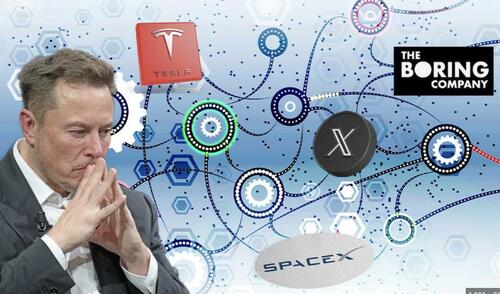
Musk's Interlocked Empire: Tesla's $573M Related-Party Deals Expose Tech Cronyism and Elite Wealth Concentration
Tesla's disclosed $573M in 2025 sales to Musk-controlled SpaceX and xAI, alongside a $2B investment and Musk's $158B compensation, illustrate a tightly integrated corporate ecosystem that prioritizes one individual's empire, raising governance concerns around insider dealing, conflicts of interest, and contributions to economic inequality in tech.
A regulatory filing reveals that Tesla generated $573.4 million in revenue during 2025 from sales to companies controlled by Elon Musk, including $430.1 million in Megapack battery systems sold to xAI and $143.3 million primarily in vehicles (including Cybertrucks) sold to SpaceX. These figures, disclosed in Tesla's amended 10-K filing with the SEC, also show Tesla investing approximately $2 billion into xAI (later converted to SpaceX equity following their merger) while paying the entities a combined roughly $15-25 million for consulting, licensing, support services, aircraft use, and security.[1][2][3]
While the company asserts these transactions occurred on terms comparable to those with unaffiliated third parties and were reviewed by the Audit Committee, the scale and directionality paint a picture of deeply intertwined operations across Musk's empire. xAI relies on Tesla's energy storage to power its AI data centers, which in turn develops Grok — the AI being integrated into Tesla vehicles. SpaceX has absorbed xAI and maintains a growing fleet of Tesla Cybertrucks. Engineers flow between Tesla, SpaceX, xAI, and X. Musk has discussed joint work on projects like the Roadster. This is not arm's-length commerce; it is a closed-loop ecosystem where a public company (Tesla) effectively subsidizes and sustains the founder's private and semi-private ventures.[4]
Viewed through the lens of pervasive corporate insider dealing, these arrangements exemplify how billionaire-led tech networks operate with minimal external friction. Musk's newly valued 2025 compensation package — reaching approximately $158 billion tied to performance stock options — further highlights the asymmetry: one individual commands resources on a scale nearly 40 times Tesla's annual net income, while public shareholders fund the infrastructure enabling cross-company synergies. Such structures evade the scrutiny traditional antitrust or market regulation might apply to independent entities, as ownership and control remain consolidated in a single visionary. When SpaceX eventually pursues public status, Wall Street will confront these overlapping interests directly.
Deeper connections emerge in how this model accelerates concentration of technological capability and capital. Tesla's battery and vehicle sales provide immediate revenue that bolsters its reported figures, yet a significant portion of its energy storage growth traces to an affiliated AI venture rather than arms-length commercial demand. Meanwhile, Tesla's $2 billion deployment into SpaceX/xAI redirects shareholder capital into high-risk, high-reward private endeavors. This blurs fiduciary boundaries — are Tesla decisions optimized for TSLA holders or for the broader Musk conglomerate? Heterodox economic analysis suggests this resembles modern feudalism or a keiretsu system, where elite networks internalize gains, socialize certain risks via public markets, and contribute to widening inequality. As one person orchestrates AI, space, automotive, and information platforms with self-reinforcing transactions, wealth and innovation power accrue disproportionately, evading mainstream narratives focused on competition rather than coordination among "rival" Musk entities.
These patterns are not unique to Musk but emblematic of tech industry cronyism, where personal relationships, shared talent pools, and overlapping ownership replace transparent market signals. The result is a system that rewards empire-building over dispersed economic opportunity, raising uncomfortable questions about governance, fair capital allocation, and whether such concentration ultimately serves or undermines broader societal progress.
Liminal Analyst: Musk's interlocking companies create a self-reinforcing private empire leveraging public capital, driving rapid cross-domain innovation while concentrating power and widening wealth gaps through arrangements that test the limits of independent corporate governance.
Sources (4)
- [1]Tesla Raked $573 Million in Sales From SpaceX and xAI Last Year(https://www.bloomberg.com/news/articles/2026-04-30/tesla-raked-573-million-in-sales-from-spacex-and-xai-last-year)
- [2]Tesla Brought in $573 Million From Selling to XAI and SpaceX Last Year(https://www.businessinsider.com/tesla-made-over-500-million-selling-xai-spacex-elon-musk-2026-5)
- [3]Tesla (TSLA) reveals $573M web of transactions between Musk companies(https://electrek.co/2026/05/01/tesla-tsla-web-transactions-musk-companies-spacex-xai-10ka-2025/)
- [4]Tesla Amended 10-K Filing(https://www.sec.gov/Archives/edgar/data/1318605/000110465926053166/tm2611837d1_10ka.htm)