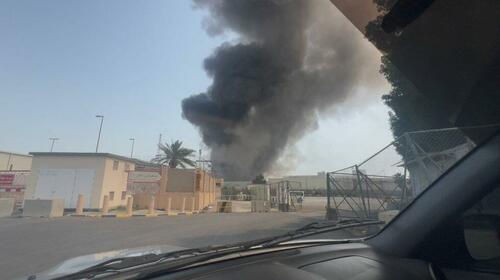
Undisclosed Iranian Strikes on US Bases Reveal Hidden Escalation and Air Defense Failures in Middle East Conflict
Multiple outlets confirm Iranian attacks, including a rare F-5 jet bombing of a Kuwaiti US base, caused extensive unreported damage across seven countries, exposing US defense vulnerabilities, prompting base evacuations, and revealing apparent efforts to downplay escalation and shield information from Congress during the 2026 Iran conflict.
Recent reporting has shed light on the extent of damage inflicted by Iranian forces on American military installations across the Middle East during the opening phases of the 2026 conflict, suggesting a level of escalation far beyond what the Trump administration has publicly acknowledged. According to NBC News, Iranian missile, drone, and even fixed-wing aircraft attacks targeted US bases in at least seven countries including Bahrain, Kuwait, Saudi Arabia, the UAE, Iraq, Jordan, and Qatar. One of the most striking claims involves an Iranian F-5 fighter jet— a legacy platform originally supplied by the US before the 1979 revolution and later reverse-engineered domestically as the HESA Kowsar—successfully bombing Camp Buehring in Kuwait despite layered air defenses. This marked the first time in decades an enemy fixed-wing aircraft struck a US base.[1][2]
The New York Times reported in March 2026 that many of the 13 US bases in the region were rendered largely uninhabitable, with those in Kuwait suffering the worst damage. Specific incidents include a March 1 Iranian drone strike on a makeshift operations center at Port Shuaiba in Kuwait that killed six US Army Reserve soldiers and injured over 20 others. Bases were subsequently evacuated, forcing troops to operate remotely from hotels and offices, a significant degradation of operational effectiveness. The Pentagon has confirmed at least 13 US deaths and over 400 injuries but has withheld detailed damage assessments from Congress, even as it requests record defense budgets. Officials reportedly asked commercial satellite firms like Planet Labs to obscure imagery of the affected sites.[3]
A Washington think tank assessment cited across reports, from the American Enterprise Institute, estimates Iran struck over 100 targets at 11 bases, with repair costs exceeding $5 billion—excluding destroyed radars, weapons systems, and specialized equipment. The US Navy's Fifth Fleet headquarters in Bahrain sustained serious but repairable damage. These details paint a picture of successful Iranian saturation attacks that exposed vulnerabilities in US Patriot systems and regional air defenses against a combination of low-cost drones, ballistic missiles, and opportunistic manned aircraft strikes.[4]
This undisclosed scale of exchange contradicts official narratives of contained or limited retaliation following US-Israeli strikes on Iranian nuclear and leadership targets in late February 2026. It points to hidden dimensions of the conflict: the apparent inability of forward-deployed US forces to fully deter or absorb attacks from a near-peer regional adversary, potential intelligence or tactical surprises that allowed an aging F-5 to penetrate defended airspace, and a pattern of narrative management that limits congressional and public oversight. The cover-up, combined with the high human and financial toll, suggests deeper strategic strain on America's power projection in the Gulf and raises questions about long-term basing viability next to Iranian territory. As repairs mount into the billions and bases remain compromised, the episode underscores how official silence may mask a pivotal shift in Middle East deterrence dynamics.
LIMINAL: The gap between public narratives and the scale of damage plus successful Iranian penetration of advanced defenses signals eroding US deterrence, hidden war costs likely to fuel domestic pushback, and a strategic reevaluation of vulnerable forward bases near Iran.
Sources (5)
- [1]NBC News: Iran caused more extensive damage to U.S. military bases than publicly known(https://www.nbcnews.com/world/iran/iran-caused-extensive-damage-us-military-bases-publicly-known-rcna331853)
- [2]The New York Times: Iran's Attacks Force U.S. Troops to Work Remotely(https://www.nytimes.com/2026/03/25/us/politics/iran-us-bases.html)
- [3]The Daily Beast: Trump Goons Caught Covering Up Massive War Damage(https://www.thedailybeast.com/trump-goons-caught-covering-up-massive-war-damage/)
- [4]The Aviationist: Report Claims Iranian F-5 Bombed U.S. Base in Kuwait(https://theaviationist.com/2026/04/26/report-claims-iranian-f-5-bombed-us-base/)
- [5]NYT Interactive: At Least 17 U.S. Sites Damaged in War With Iran(https://www.nytimes.com/interactive/2026/03/11/world/middleeast/iran-us-military-bases-strikes-map.html)