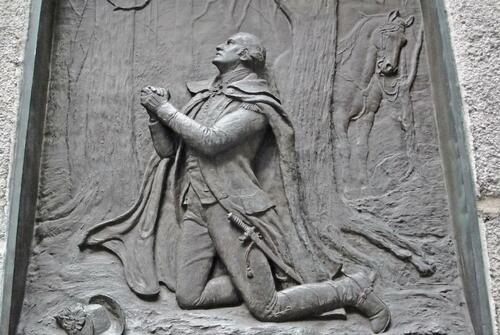
Media Hostility to White House Christian Rededication Event Reveals Selective Secularization Agenda
Mainstream media's intense criticism of the Trump-backed Rededicate 250 Christian prayer event on the National Mall, contrasted with positive coverage of Muslim mayor's Ramadan observances at City Hall, illustrates selective hostility toward public Christianity. This points to a deeper, ongoing cultural secularization that reframes America's Christian founding heritage as "nationalism" while embracing other faiths as diversity.
The Trump administration's sponsorship of "Rededicate 250," a major Christian prayer and praise event on the National Mall scheduled for May 17, 2026, has triggered sharp criticism from establishment outlets and progressive advocacy groups. Organizers describe the gathering—featuring Secretary of State Marco Rubio, Defense Secretary Pete Hegseth, House Speaker Mike Johnson, and faith leaders—as a reflection on America's founders' faith and a national rededication as "One Nation Under God" ahead of the country's 250th anniversary. Official White House materials frame it as an invitation for religious communities to pray for the nation.
Mainstream coverage, however, has largely focused on accusations of "Christian nationalism" and violations of church-state separation. The Washington Post detailed the event's emphasis on Christian roots and speakers, while NPR highlighted that nearly all participants are Christian and noted discomfort among some Americans with mixing religion and politics. PBS reported critics claiming the event "hijacks" history to promote a fusion of American and Christian identity. The New Republic and Public Citizen went further, labeling it an erasure of distinctions between church and state and an advancement of white evangelical Protestantism as quasi-official.
This reaction stands in contrast to coverage of New York City Mayor Zohran Mamdani's high-profile hosting of multiple Ramadan iftars at City Hall and Gracie Mansion. Reports from The New York Times and CNN portrayed these as positive blending of faith into public leadership, community outreach, and affirmations of diversity under the city's first Muslim mayor, with no widespread accusations of constitutional violations or "Islamic nationalism."
This selectivity is not isolated. It fits a broader, under-scrutinized pattern of cultural secularization in which public Christianity is framed as inherently exclusionary or theocratic, while expressions of other faiths are celebrated as multicultural progress. The First Amendment prohibits Congress from establishing religion or prohibiting its free exercise; the phrase "separation of church and state" originates in Jefferson's 1802 letter assuring Baptists they would not face a national church like England's. Early America was overwhelmingly Christian in character and demographics, with founders like John Adams affirming Christianity's general principles as foundational to independence and self-government.
Connections missed by mainstream narratives include the acceleration of secular trends: declining Christian affiliation, institutional skepticism toward public faith except when it aligns with progressive causes, and reframing of America's religious heritage as a threat rather than a source of its moral framework. Events like this expose how legacy media rarely applies the same lens to non-Christian governmental religious engagement, suggesting an ideological hostility that treats historic majority faith as the primary obstacle to a fully secular public square. As the nation approaches its semiquincentennial, such flashpoints reveal deepening divides over whether America's public life can accommodate the explicit faith of its founders or must subordinate it to modern secular norms.
LIMINAL: This selective outrage accelerates cultural secularization by normalizing hostility to Christianity in governance while platforming other faiths, likely deepening national fractures over identity and heritage as the 250th anniversary highlights unresolved tensions in America's founding principles.
Sources (6)
- [1]White House to host 9-hour prayer festival focused on Christian roots of U.S.(https://www.washingtonpost.com/religion/2026/05/13/trump-administration-host-rededicate-250-jubilee-mall-sunday/)
- [2]The Trump administration is planning a prayer event on the National Mall(https://www.npr.org/2026/05/15/g-s1-122276/the-trump-administration-is-planning-a-prayer-event-on-the-national-mall-all-but-one-of-the-speakers-is-christian)
- [3]Trump to join prayer gathering criticized for promoting Christian nationalism(https://www.pbs.org/newshour/politics/trump-to-join-prayer-gathering-criticized-for-promoting-christian-nationalism)
- [4]Mamdani Ushers in a New Tradition: Ramadan in City Hall(https://www.nytimes.com/2026/02/17/nyregion/mamdani-ramadan-muslim.html)
- [5]America Prays - Official White House Page(https://www.whitehouse.gov/freedom250/america-prays/)
- [6]Zohran Mamdani attended 17 iftars around NYC for Ramadan(https://www.cnn.com/2026/03/20/us/ny-muslims-ramadan-zohran-mamdani)