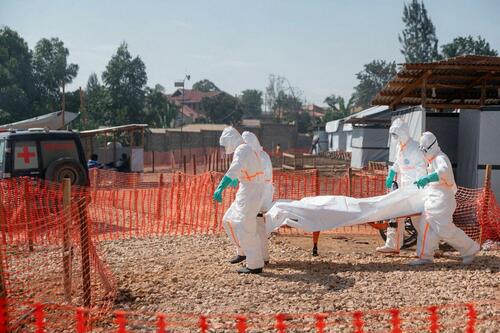
Ebola Outbreak in DRC Surges to 782 Cases Amid Conflict and Cross-Border Risks, CDC Warns of Potential Historic Scale
DRC Ebola (Bundibugyo) outbreak reaches 782 cases/181 deaths by mid-June 2026, spreading across eastern provinces amid conflict; CDC projects potential for 20k+ cases without better isolation; corroborated by WHO, CDC, ECDC; undercovered global threat tied to regional instability.
The Democratic Republic of the Congo (DRC) is grappling with a rapidly expanding Ebola outbreak caused by the Bundibugyo virus, with confirmed cases reaching 782 and deaths at 181 as of mid-June 2026, according to official reports and international health agencies. The outbreak, centered in Ituri province but now affecting North Kivu and South Kivu as well, has spread to additional health zones, underscoring vulnerabilities in eastern DRC exacerbated by ongoing armed conflict, population displacement, mining activities, and inadequate healthcare infrastructure.
Credible corroboration from the World Health Organization (WHO), U.S. Centers for Disease Control and Prevention (CDC), and European Centre for Disease Prevention and Control (ECDC) confirms the figures and highlights the outbreak's trajectory. It was declared a Public Health Emergency of International Concern (PHEIC) by WHO in May 2026 after initial detection in Ituri, with cases also reported in neighboring Uganda (19 cases, 2 deaths). The Bundibugyo strain is rarer than the Zaire strain seen in prior major outbreaks, with no approved vaccine or specific treatment available.
CDC modeling released in early June projects that without strong interventions—particularly rapid isolation of cases—the outbreak could exceed 20,000 cases within three months, potentially rivaling the scale of the 2014-2016 West Africa epidemic. Low isolation rates (around 20%) in simulations show high likelihood of massive growth, while 70% isolation significantly reduces that risk. Challenges include healthcare worker infections, community resistance, security incidents at facilities, and gaps in contact tracing amid conflict zones.
This surge connects to broader patterns of outbreak vulnerability in conflict-affected regions, where mainstream attention often prioritizes domestic issues over distant but interconnected global health threats. Cross-border mobility along the DRC-Uganda corridor and refugee movements heighten regional risks, though Uganda reports no new cases for over a week as of June 13. Recovery figures (around 56 in DRC) and ongoing isolation of hundreds offer some hope, but sustained international support is critical to prevent wider spread.
Global Health Agencies: Stronger cross-border coordination and conflict-sensitive response could contain spread, but persistent insecurity risks turning this into a prolonged regional crisis with economic and humanitarian ripple effects.
Sources (7)
- [1]WHO: Epidemic of Ebola Disease caused by Bundibugyo virus in the Democratic Republic of the Congo and Uganda(https://www.who.int/news/item/17-05-2026-epidemic-of-ebola-disease-in-the-democratic-republic-of-the-congo-and-uganda-determined-a-public-health-emergency-of-international-concern)
- [2]CDC: Ebola Outbreak: Current Situation (June 14, 2026 update)(https://www.cdc.gov/ebola/situation-summary/index.html)
- [3]ECDC: Ebola disease outbreak in the Democratic Republic of the Congo and Uganda(https://www.ecdc.europa.eu/en/ebola-outbreak-democratic-republic-congo-and-uganda)
- [4]ReliefWeb: DR Congo/Uganda: Ebola Outbreak - May 2026(https://reliefweb.int/disaster/ep-2026-000071-cod)
- [5]CDC MMWR: Modeled Scenario Projections for the Ebola Disease Outbreak(https://www.cdc.gov/mmwr/volumes/75/wr/mm7522e1.htm)
- [6]Wikipedia: 2026 Ebola epidemic(https://en.wikipedia.org/wiki/2026_Ebola_epidemic)
- [7]NPR: CDC: Ebola outbreak could rival the worst on record(https://www.npr.org/2026/06/05/nx-s1-5848082/ebola-virus-cdc-outbreak-democratic-republic-congo-uganda)