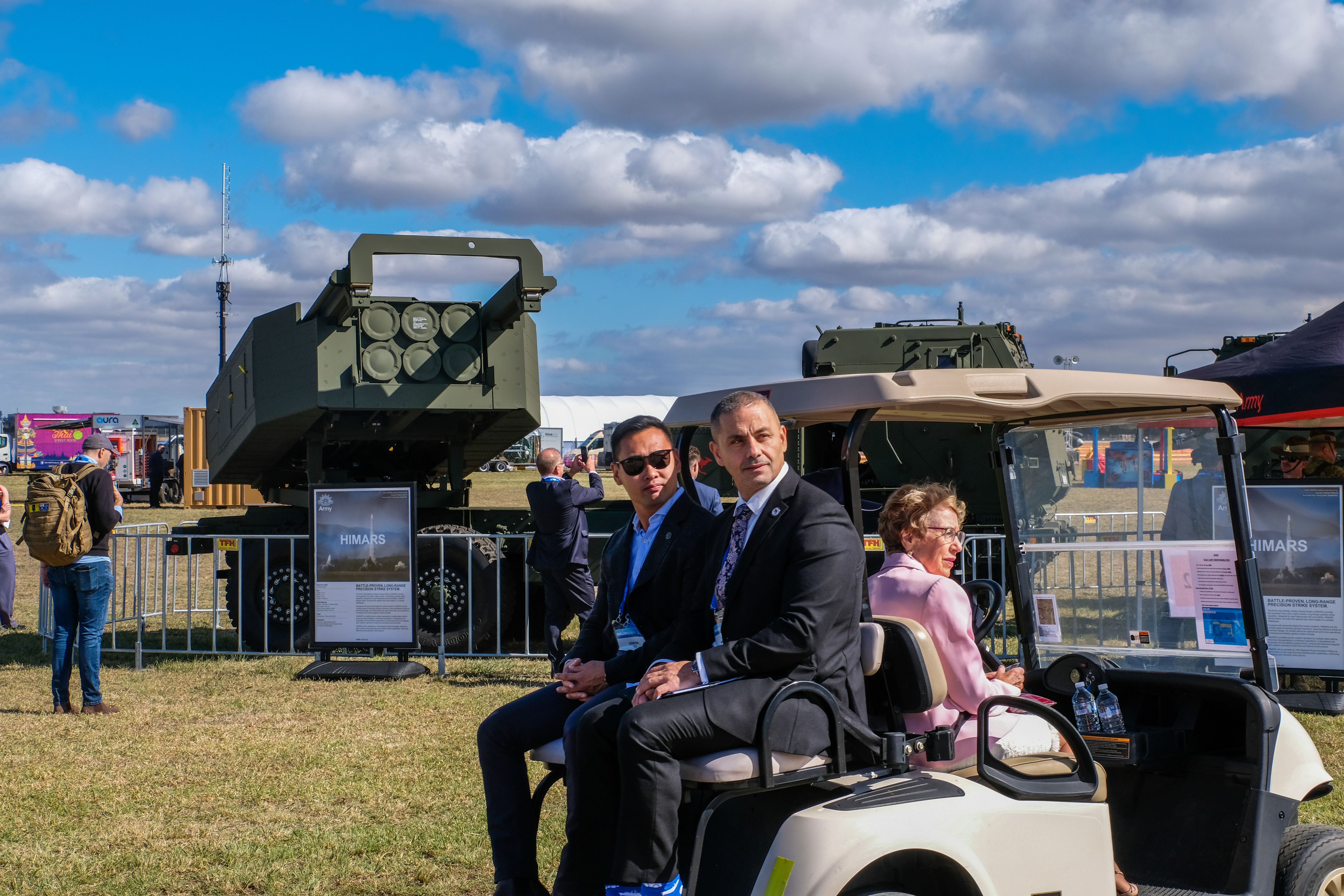
Australia's GMLRS Milestone: Accelerating Sovereign Precision Manufacturing and Indo-Pacific Defense Decoupling
Australia's first locally assembled GMLRS rocket is more than a manufacturing milestone—it signals accelerating allied sovereign precision-strike production, defense industrial decoupling from single-source vulnerabilities, and deeper Indo-Pacific preparedness against Chinese A2/AD capabilities, patterns largely overlooked in standard reporting.
The test-firing of Australia’s first locally assembled Guided Multiple Launch Rocket System (GMLRS) at Woomera marks a pivotal, yet under-analyzed, inflection point in allied defense industrial strategy. While the original Defense News dispatch accurately chronicles the technical event, the March 2025 arrival of HIMARS launchers, and Lockheed Martin’s Port Wakefield facility, it largely frames the story as a manufacturing milestone and quotes Australian and company officials on self-reliance. What it misses is the deeper strategic logic: this is deliberate defense decoupling from vulnerable global supply chains and over-dependence on continental U.S. production, executed within a larger pattern of Indo-Pacific preparedness that has received limited mainstream attention.
The March 2024 bilateral agreement aiming for 4,000 GMLRS rockets per year—ten times Australia’s own requirement—explicitly envisions Canberra as an export node feeding allied inventories. This mirrors the logic of the U.S. Department of Defense’s 2024 International Munitions Initiative and the 2025 U.S.-Australia PrSM memorandum of understanding. Synthesizing these with a 2024 CSIS report on allied long-range precision fires ('Distributed Lethality in the Indo-Pacific'), the pattern becomes clear: Washington is actively friend-shoring critical munitions production to trusted partners to mitigate risks exposed by Ukraine—where HIMARS and GMLRS usage rates overwhelmed U.S. stockpiles—and to counter the PLA Rocket Force’s massive inventory of precision strike systems.
Original coverage correctly notes GMLRS as merely the entry point, with Extended Range GMLRS, PrSM (500+ km), and hypersonics as the logical progression. Yet it underplays the operational geography. Australian-made precision munitions, fired from HIMARS positioned in the Northern Territory or forward-deployed on Pacific islands, directly challenge Beijing’s anti-access strategy. They create the kind of distributed, resilient fires network envisioned in the U.S. Army’s Long Range Precision Fires Cross Functional Team and Australia’s 2023 Defence Strategic Review. This is not simply 'sovereign capability' rhetoric; it is the industrial backbone for impactful projection in a potential high-intensity Taiwan or South China Sea contingency where trans-Pacific resupply could be contested for weeks or months.
The coverage also glosses over the supply-chain intelligence dimension. Rare-earth dependencies, microelectronics choke points, and single-source U.S. propellant production remain strategic vulnerabilities. By integrating Australian production lines in lockstep with Lockheed’s Camden, Arkansas facility, both nations create redundancy. This mirrors Japan’s post-2022 decision to dramatically scale indigenous missile output and South Korea’s K9 and Chunmoo export surge. These efforts collectively point to an emerging lattice of allied precision-strike manufacturing that receives far less scrutiny than AUKUS submarine deals or Quad summits.
Limited attention has been paid to the signaling effect on Beijing. Australia joining the exclusive club of GMLRS producers communicates that the United States is no longer willing to be the sole arsenal of democracy in a Pacific war. The $224 million PrSM investment and explicit pathway to hypersonic co-production further indicate that sovereign guided-weapons manufacturing is now core to Canberra’s hedging strategy. What began as risk-reduction assembly in 2025 is on track to become full-rate production by late 2026, embedding Australian industry into the global HIMARS ecosystem.
In the broader context of great-power competition, this event is best understood as part of a slow, methodical unwinding of just-in-time globalization in the defense sector. The Ukraine war provided the empirical proof; Chinese military modernization provided the urgency. Australia’s GMLRS rocket is therefore both a literal munition and a strategic marker: the alliance is no longer content to rely on American factories alone. The real story is the accelerating construction of a distributed, sovereign-capable precision-strike industrial base across the Indo-Pacific—one designed to survive the opening salvos of the very conflict it seeks to deter.
SENTINEL: Australia's GMLRS production ramp-up will likely trigger parallel co-production deals in Japan and South Korea within 24 months, creating a hardened, distributed allied munitions network that materially raises the cost of Chinese aggression by 2030.
Sources (3)
- [1]Australia touts first GMLRS artillery rocket assembled Down Under(https://www.defensenews.com/global/asia-pacific/2026/04/14/australia-touts-first-gmlrs-artillery-rocket-assembled-down-under/)
- [2]Distributed Lethality: The Future of Long-Range Precision Fires in the Indo-Pacific(https://www.csis.org/analysis/distributed-lethality-future-long-range-precision-fires-indo-pacific)
- [3]Australia's Guided Weapons and Explosive Ordnance Enterprise – Strategic Update 2024(https://www.aspi.org.au/report/gweo-enterprise-strategic-update-2024)