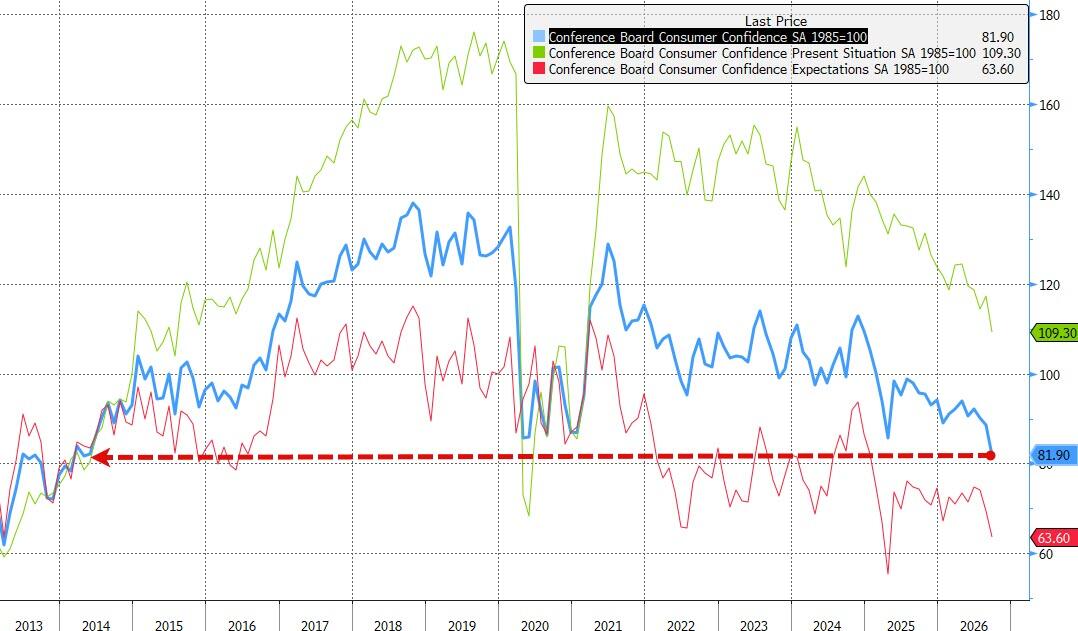
Consumer Confidence Hits Lowest Since 2014 Amid Surging Inflation Fears and Labor Market Jitters
Verified Conference Board data shows September 2026 consumer confidence crashing to 81.9, lowest since 2014, fueled by inflation, jobs concerns, and geopolitical factors—prompting scrutiny of economic resilience ahead of elections.
The Conference Board's Consumer Confidence Index plunged 6.7 points to 81.9 in September 2026, marking the lowest reading since April 2014 and missing economist expectations by a wide margin. This sharp decline, corroborated across major outlets including Reuters, CNBC, and Bloomberg, reflects deepening consumer pessimism driven by persistent inflation—particularly surging fuel costs—and softening views on the labor market and business conditions.
Present Situation Index dropped 7.9 points to 109.3, while the Expectations Index fell 5.9 points to 63.6, its third straight decline. For the first time since September 2024, more consumers viewed current business conditions negatively. Labor market perceptions worsened, with the jobs plentiful vs. hard-to-get differential hitting its lowest since February 2021. Inflation expectations rose to 6.1% average and 5.1% median over 12 months, with 68.4% anticipating higher interest rates.
Write-in responses highlighted rising prices, oil and gas costs, war/conflict (including the ongoing Iran conflict), politics, trade, and employment. This data point, released just before midterms, signals potential headwinds for consumer spending and broader economic sentiment. Connections to everyday finances include reduced optimism on household income growth and moderated stock price expectations, potentially amplifying caution in discretionary spending amid multidecade bond yields and AI-related uncertainties noted in coverage.
Broader context reveals downward trends across demographics, with older generations (Gen X, Boomers, Silent) showing steeper declines, while higher-income groups ($125k-$149k) saw notable drops. This indicator's trajectory could influence policy debates on recovery, as it ties directly to real-world behaviors like reduced buying plans and heightened sensitivity to cost-of-living pressures.
Economic Analyst: Persistent confidence erosion could dampen holiday spending and pressure policymakers on inflation relief, especially with fuel costs and geopolitical tensions amplifying household budget strains into 2027.
Sources (4)
- [1]US consumer confidence dives to more than 12-year low in September(https://www.reuters.com/business/us-consumer-confidence-dives-more-than-12-year-low-september-2026-09-29/)
- [2]Consumer optimism slides to lowest since 2014 as fears escalate over rising prices and jobs(https://www.cnbc.com/2026/09/29/consumer-optimism-slides-sharply-as-fears-escalate-over-rising-prices-and-jobs.html)
- [3]US Consumer Confidence Falls to Lowest Since 2014 on Economic Concerns(https://www.bloomberg.com/news/articles/2026-09-29/us-consumer-confidence-plunges-to-lowest-level-since-2014)
- [4]U.S. consumer confidence sinks to lowest level since 2014, survey finds(https://www.theglobeandmail.com/business/article-us-consumer-confidence-conference-board-survey/)