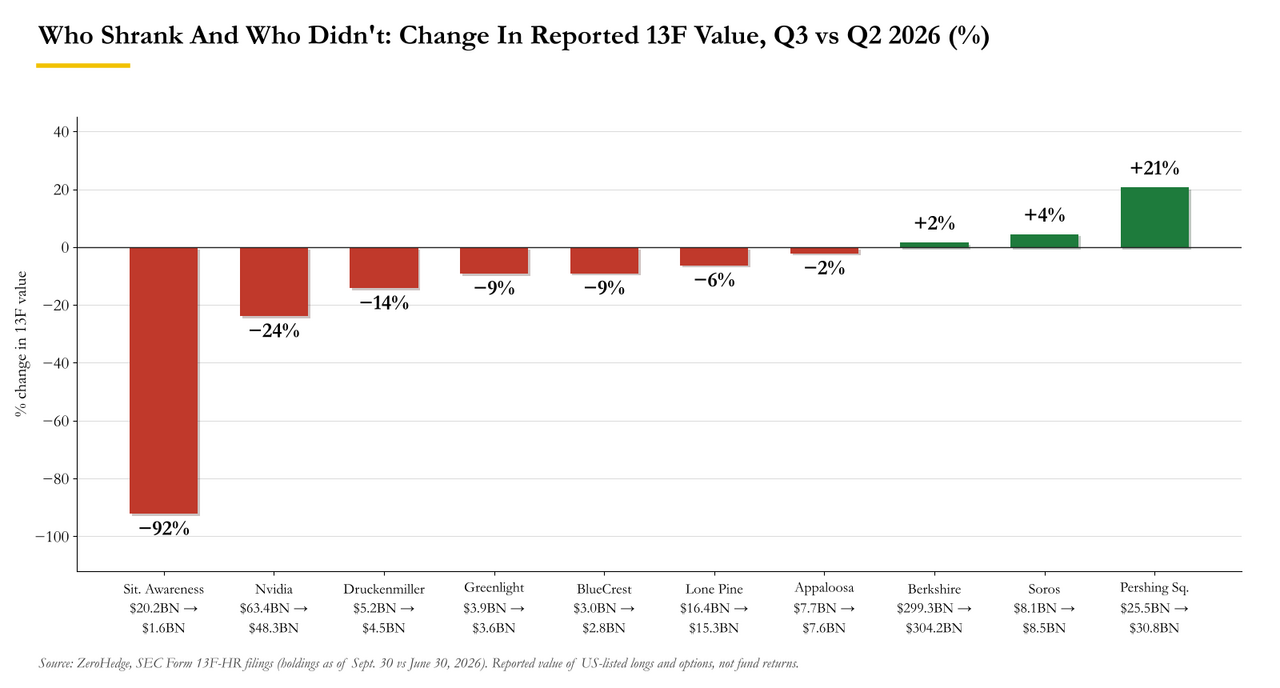
Q3 13Fs show Aschenbrenner’s public book collapsed from $20.2 billion to $1.6 billion before November’s chip crash, while Druckenmiller had already cut chip exposure
SEC filings show Leopold Aschenbrenner’s Situational Awareness public book fell from $20.24 billion to $1.58 billion by Sept. 30, 2026, after a July wipeout that drew in Citadel. Druckenmiller’s Duquesne is reported to have cut TSMC by about 94% and added gold miners in the same quarter, while Lone Pine gave back a huge AI-driven gain—before the SOX fell 12.3% on Nov. 5.
Documented: Form 13F filings are delayed snapshots of U.S.-listed long stock and option positions. They do not show shorts, swaps, or trades after quarter-end, and option lines are carried at the value of the underlying shares. They are not a complete map of what a fund “saw coming.”
What the filings show, as aggregated from Situational Awareness LP’s 13F-HR for the period ended Sept. 30, 2026 (SEC CIK 2045724, filed Nov. 16, 2026), is a collapse in reported public holdings from $20.24 billion at the prior quarter-end to $1.58 billion, a 92.21% drop in disclosed value. That is about $18.7 billion of reported 13F value that is no longer on the book. Common-stock lines that dominated the June 30 filing—Sandisk, Micron, Bloom Energy shares, TSMC ADRs, Nebius shares, CoreWeave, Core Scientific, and a long list of other AI-infrastructure names—are marked sold. What remained was a much smaller book heavy in options: Bloom Energy calls, Nebius calls, Sandisk calls, and a Roundhill memory ETF call, plus a large SharonAI common-stock position.
That shrinkage is not only a mark-to-market story. MarketWatch, citing the June 30 filing, documented that Sandisk and Micron alone were more than half the portfolio just before a July correction in which Sandisk fell about 43% and Micron about 24% by the time the fund negotiated a deal with Citadel on July 30. Chinese financial coverage of the same Q3 filing, citing the July episode, reported a roughly 67% loss that month and a subsequent sale of most of the public stock book, with a substantial portion taken by Citadel. Claimed, not independently re-audited here: the precise July performance figure and the terms of that transfer. Documented from the later 13F: by Sept. 30 the giant common-stock AI book was gone, and disclosed value was $1.58 billion.
A different pattern shows up at Stanley Druckenmiller’s Duquesne Family Office, and it is earlier. Multiple outlets reporting the Sept. 30, 2026 13F say Duquesne cut its TSMC ADR holding by about 94%, from 589,680 shares (the share count independently visible on its June 30 filing, valued then at about $282 million) to 32,700 shares, exited AMD, Sandisk, and Alphabet, nearly tripled Seagate, and opened gold-miner stakes in Newmont, Barrick, and Agnico Eagle worth about $129 million combined, or roughly 2.9% of an approximately $4.5 billion disclosed book. Natera was the largest disclosed position, near 29%. Those share-level chip cuts are reported by financial-data writeups of the filing rather than reproduced here from the raw EDGAR table; the gold-miner trio, the Alphabet exit, the Seagate increase, and the book size are corroborated by TokenPost’s account of the same snapshot. What is not documented is motive. A 13F cannot show whether the TSMC sale was a macro call, a rotation into storage and gold, or something else.
The market event these filings are being read against is real and later than the snapshot. On Nov. 5, 2026, Benzinga reported the Philadelphia Semiconductor Index down 12.3% and the iShares Semiconductor ETF down 12.8%, each the worst session since March 2020, with 28 of SOXX’s 30 holdings at least 20% below record highs. Bloomberg’s same-day coverage, filed while the session was still open, had the SOX down 9.2% and on pace for its worst day in months, tying the selling to post-midterm skepticism about the AI trade. Reuters’ later technical note puts the Nov. 5 SOX low at 8,997.39. So the quarter-end filings describe positioning as of Sept. 30—more than a month before that session—not trades placed into the crash.
Lone Pine is the contrast case, and it cuts against a simple “smart money left early” story. Institutional Investor and Hedgeweek, citing an investor, reported that Lone Pine’s Cypress long-short fund lost about 31% in the third quarter of 2026, including about 25% in July, after a very strong first half, leaving it roughly flat for the year. BeInCrypto, citing Bloomberg, put the same arc as up 44% through June and up 0.6% through September. The damage was in positions built into the AI complex—Nebius, Applied Materials, Seagate—not in a clean preemptive exit. Claimed via those investor accounts; the underlying 13F shows the holdings, not the monthly P&L.
The structural point that survives the caveats: disclosed elite books were not one trade. One highly concentrated, previously enormous AI book (Situational Awareness) had already been largely liquidated in public equities by Sept. 30 after a July drawdown severe enough to bring in Citadel. A famous macro allocator (Duquesne) is reported to have slashed leading chip longs in the same quarter and added gold miners and Seagate. A large fundamental long-short fund (Lone Pine) is reported to have given back a huge first-half gain inside the same AI complex. Retail and momentum exposure that was still in the trade met a Nov. 5 semiconductor session on the order of the March 2020 crash. None of that demonstrates that the AI capital-spending cycle is over, or that every reduced 13F line was foresight. It does show that, on the public record, some of the largest named allocators were already on different sides of the trade before the worst single chip session of the year.
Public filings show that by Sept. 30 some of the largest named AI-linked books had already been cut or had suffered forced shrinkage, while a benchmark chip index then fell more than 12% in a single November session. Anyone holding concentrated semiconductor and AI-infrastructure stocks was on the other side of that divergence, whether or not the managers’ earlier sales were intentional forecasts.
Sources (8)
- [1]Situational Awareness LP 13F-HR, period ended Sept. 30, 2026 (SEC)(https://www.sec.gov/Archives/edgar/data/2045724/000093583626000610/xslForm13F_X02/form13fInfoTable.xml)
- [2]Last10K aggregation of Situational Awareness 13F-HR, Nov. 16, 2026(https://last10k.com/sec-filings/2045724)
- [3]MarketWatch: Aschenbrenner fund concentration in Micron and Sandisk before the blow-up(https://www.morningstar.com/news/marketwatch/2026081720/investor-dubbed-ai-stock-god-had-56-of-his-funds-in-these-two-stocks-before-it-blew-up)
- [4]Benzinga: Chip stocks’ worst day since 2020(https://www.benzinga.com/markets/equities/26/11/62961405/chip-stocks-worst-day-since-2020-soxx-bear-market)
- [5]Bloomberg: Chips selloff worsens as fears about AI trade grip the market(https://www.bloomberg.com/news/articles/2026-11-05/chips-selloff-worsens-as-fears-about-ai-trade-grip-stock-market)
- [6]Reuters: Semiconductor stocks and the Nov. 5 SOX low(https://www.reuters.com/markets/global-markets-technicals-graphic-2026-11-16/)
- [7]TokenPost: Duquesne’s Sept. 30 gold-miner stakes and Alphabet exit(https://www.tokenpost.com/news/investing/58795)
- [8]Institutional Investor: Lone Pine’s reversal of fortune(https://www.institutionalinvestor.com/article/lone-pines-reversal-fortune)