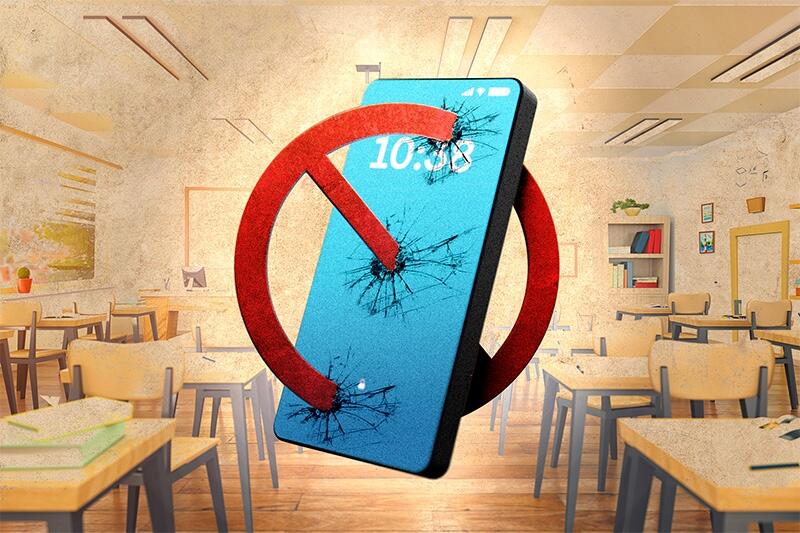
Harvard analysis links strict school phone bans to modest math and reading gains
A November 2026 Harvard–Dartmouth–NWEA analysis of 3.3 million students finds lockable all-day phone bans associated with about 0.01 standard deviations of extra annual growth in math and reading—roughly one to two weeks of learning—while a Stanford-led national study of similar pouches finds average test-score effects near zero. The gain is documented as modest and cost-effective; claims that it repairs the post-2013 achievement slide, or that phones caused that slide, remain interpretive.
Documented: On November 17, 2026, Harvard’s Center for Education Policy Research released a student-level analysis, written with Dartmouth economist Douglas Staiger and testing nonprofit NWEA, of NWEA MAP Growth scores for about 3.3 million students in roughly 4,600 schools across the 2021–22 through 2025–26 school years. The report, “Phone-Free Schools and Achievement Growth,” is a research release from the center, not a journal article. Schools that required phones to be stored in lockable pouches (Yondr-style) showed higher annual achievement growth of about 0.01 standard deviations in math and reading—described by the authors as roughly one to two extra weeks of learning a year, or about two minutes per hour of class time. Harvard’s Graduate School of Education and the center both state that the gain appeared in the first year and was still visible later, and that it did not differ sharply by student or school demographics. Faculty director Thomas Kane told the Harvard Gazette and the Associated Press, as reported by The Guardian, that bans “do have a positive effect on growth” but are “not a panacea.” The same materials put the pouch cost at about $25 per student, far below the cost of buying an extra week of teacher time.
Documented contrast: A separate national study of lockable pouches, led by Stanford’s Thomas Dee with co-authors including Matthew Gentzkow, Angela Duckworth, and Brian Jacob, and released as an NBER working paper, found average test-score effects “consistently close to zero” over three years—ruling out gains larger than about 0.007 student-level standard deviations—while noting a modest high-school math bump and small middle-school declines. That team also reported less in-school phone use, a first-year rise in discipline and dip in well-being that later faded or reversed, and little change in attendance or perceived bullying. Coverage in the Boston Globe and Education Week treats the two results as part of a still-mixed evidence base, not a settled verdict.
Claimed, not independently established here: Kane and co-authors frame the pouch effect as restoring about half of a “slow leak” in U.S. achievement since about 2013, a period that coincided with smartphones and broadband. That framing treats the decade-long decline and the ban effect as related magnitudes. The papers document a coincidence in timing; they do not demonstrate that phones caused the full pre-ban slide. Kane has also said a subset of students who were losing the most ground in reading appeared to stop those large within-year losses after strict bans—an interpretation offered by the authors, not a finding that every struggling student benefits.
Speculated: Whether classroom-only restrictions can close the rest of the gap, and whether after-school social media use is the larger remaining driver, are open questions the Harvard team itself flags. Kane has argued that states should seek usage data from platforms and has pointed to Meta’s large state settlement as a possible funding source for that research. Those are proposals, not results. Enforcement is another unresolved piece: psychologists and reporters have noted workarounds and uneven compliance even where bans are on the books. State laws covering more than 40 states, cited by The Guardian via a phone-policy tracker, are too new and too entangled with other trends for the Harvard authors to treat last year’s statewide effects as clean causal estimates.
What is solid is narrower than the headline version of the fight. A large U.S. student-level comparison finds a small, cheap, and statistically detectable academic bump where phones are physically locked away all day. A large competing national design finds almost no average test-score change from the same kind of pouch. Neither study shows that a pouch policy reverses a decade of declining scores, fixes attention outside school hours, or substitutes for instruction.
Parents, teachers, and state lawmakers are already locking phones away during the school day. The best current U.S. evidence says strict, enforced bans are linked to a small academic gain—not a cure for falling scores—and a major competing study finds almost no average test-score effect.
Sources (7)
- [1]Strict School Cellphone Bans Could Give Students Weeks More Time to Learn Each Year(https://www.gse.harvard.edu/ideas/news/26/11/strict-school-cellphone-bans-could-give-students-weeks-more-time-learn-each-year)
- [2]Phone-Free Schools and Achievement Growth: A Student-Level Analysis(https://cepr.harvard.edu/phone-free-schools)
- [3]Schools that ban cellphones see uptick in test scores — Harvard Gazette(https://news.harvard.edu/gazette/story/2026/11/schools-that-ban-cellphones-see-uptick-in-test-scores/)
- [4]School phone bans result in ‘modest’ academic gains for students, study shows(https://www.theguardian.com/education/2026/nov/17/school-phone-bans-results-students)
- [5]New evidence shows school phone bans are gradually improving test scores — Boston Globe(https://www.bostonglobe.com/2026/11/17/nation/new-evidence-shows-school-phone-bans-are-gradually-improving-test-scores/)
- [6]The Effects of School Phone Bans: National Evidence from Lockable Pouches — SIEPR(https://siepr.stanford.edu/publications/working-paper/effects-school-phone-bans-national-evidence-lockable-pouches)
- [7]What National Evidence Reveals About Strict School Phone Bans — Stanford Impact Labs(https://impact.stanford.edu/article/what-national-evidence-reveals-about-strict-school-phone-bans)