Militarization of the U.S. Economy: Defense Surge Amid Civilian Contraction Signals Late-Stage Imperial Shift
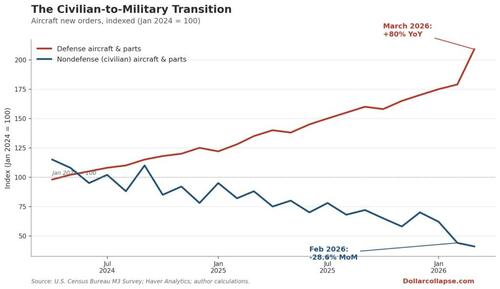
U.S. Census data shows defense orders up 18% while non-defense capital goods contract, coinciding with $1.5T+ defense budgets and $1T+ annual interest costs. This mirrors historical empire decline patterns, driving inflation and instability as civilian economy erodes.
Recent U.S. Census Bureau data reveals a stark divergence in manufacturing orders that underscores a broader transition toward a military-driven economy, a pattern observed in the late stages of historical empires. In March 2026, new orders for defense capital goods surged 18 percent month-over-month to $19.5 billion, while non-defense capital goods orders declined 1.2 percent. Excluding defense, overall new orders for manufactured durable goods turned negative, highlighting how Pentagon priorities are increasingly dominating industrial activity. This data, released in late April 2026, shows defense capital goods orders up dramatically year-over-year as civilian sectors face repeated contractions.
This shift aligns with escalating defense budgets. The Pentagon's FY2027 request approaches $1.5 trillion in total resources, including significant increases for shipbuilding, jets, and advanced systems—representing one of the largest year-over-year jumps in post-World War II history. Such spending occurs against a backdrop of federal net interest payments exceeding $1 trillion annually for the first time, a threshold crossed in FY2025 and projected to climb toward $1.5 trillion by 2032 according to the Committee for a Responsible Federal Budget. With tax increases politically untenable and foreign demand for Treasuries waning, monetary expansion via Federal Reserve policies becomes the default, echoing Ludwig von Mises' 1912 warning on governments resorting to inflation to obscure policy costs.
Historical parallels are instructive though imperfect. Rome under Diocletian expanded military payrolls and bureaucracy as civic productivity waned; post-1914 Britain redirected resources toward sustained militarization amid imperial fatigue. America's post-1971 trajectory, accelerated after Vietnam, shows similar redirection: federal deficits persisted and grew even as hot wars subsided. Today's numbers—interest expense now rivaling or exceeding major budget categories, M2 money supply expanding—suggest the middle class bears the squeeze through eroded purchasing power while defense contractors thrive.
Mainstream analyses often treat these as isolated budget decisions, yet they reflect deeper cycles of power decline. Prioritizing military capital goods over civilian aircraft and machinery diverts innovation and labor from productive sectors that historically underpinned economic hegemony. This accelerates global instability: heightened militarization raises conflict risks, while currency debasement erodes dollar dominance, prompting allies and adversaries alike to seek alternatives. The evaporation of the middle class between a 'thinning' currency and 'thickening' military apparatus risks social fractures that compound geopolitical vulnerabilities. Without addressing root productivity declines, this trajectory points toward the same endpoint seen in Weimar, late Rome, and the late Soviet period—where holders of state liabilities suffered most.
The forthcoming Federal Reserve decisions and Treasury auctions will test this dynamic further. While not yet a full wartime command economy, the data paints a peacetime empire reallocating its dwindling fiscal space. Credible fiscal observers warn these interest burdens are the new normal, locking in a feedback loop of borrowing, printing, and militarization that mainstream discourse has under-analyzed in the context of historical imperial cycles.
LIMINAL: This pivot to military prioritization amid civilian weakness will likely intensify inflationary pressures, weaken productive capacity, and heighten risks of global conflict as empires in decline historically lash out to preserve influence.
Sources (4)
- [1]Monthly Advance Report on Durable Goods Manufacturers' Shipments, Inventories and Orders(https://www.census.gov/manufacturing/m3/adv/current/index.html)
- [2]Trillion-Dollar Interest Payments Are the New Norm(https://www.crfb.org/blogs/trillion-dollar-interest-payments-are-new-norm)
- [3]Trump's $1.5 trillion defense budget includes $750 billion for ships, jets and Golden Dome(https://www.reuters.com/legal/government/trumps-15-trillion-defense-budget-includes-750-billion-ships-jets-golden-dome-2026-04-21/)
- [4]$1.5 Trillion Military Budget Would Add $5.8 Trillion to Debt Over Decade(https://www.crfb.org/blogs/15-trillion-military-budget-would-add-58-trillion-debt-over-decade)