Helium as Overlooked Chokepoint: Qatar Disruptions Expose Tech Supply Chain Fragility Beyond ASP Isotopes Opportunity
Qatar's Ras Laffan issues and Hormuz risks expose helium's critical role in semis, medicine, and defense. ASP Isotopes' high-concentration South African project offers an alternative, but analysis of USGS, DOE, and industry data reveals deeper, overlooked supply chain fragilities and historical underinvestment in non-Middle East sources.
While ZeroHedge's coverage correctly flags potential disruption to roughly one-third of global helium supply from damage at Qatar's Ras Laffan complex and threats to Strait of Hormuz transit, it understates structural vulnerabilities and misses key historical patterns. Primary documents from QatarEnergy's 2024 operational updates acknowledge maintenance issues at Ras Laffan but stop short of confirming long-term export collapse, whereas the article frames an imminent one-third loss. USGS Mineral Commodity Summaries (2023-2024) show Qatar supplying approximately 30% of world helium, with the U.S. Federal Helium Reserve's privatization under the 1996 Helium Privatization Act and subsequent 2010s drawdowns leaving Western supply more exposed to Middle East volatility than acknowledged.
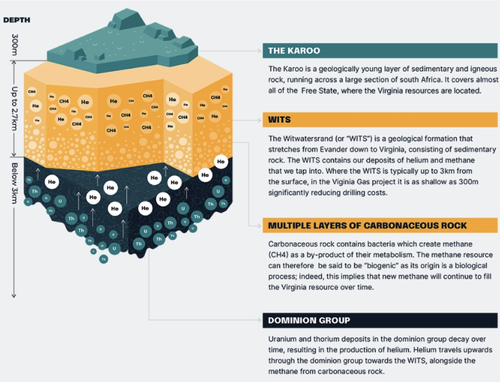
The editorial lens reveals helium's role as a non-substitutable input across semiconductors (used in plasma etching, leak detection, and wafer cooling per SEMI standards), MRI cryogenics (accounting for ~30% of demand), and defense applications including rocket purging and infrared sensors. ASP Isotopes' Virginia Gas Project in South Africa, with reported concentrations of 3.4% helium (peaking at 12%) versus Qatar's ~0.01%, offers extraction efficiency advantages. Company technical reports indicate Phase 1 targeting 58 MCF/day by late 2026, scaling in Phase 2. However, original coverage overlooks execution risks in South Africa's grid instability and permitting delays, as well as the fact that helium is almost always a byproduct of natural gas, tying its economics to LNG markets.
Patterns from related events prove instructive: the 2022 shortage triggered by Russia's invasion of Ukraine disrupting Amur plant exports, combined with maintenance at U.S. facilities, caused prices to spike over 300% in some contracts according to Bureau of Land Management data. Current Hormuz tensions echo 2019 disruptions. What coverage missed is the intersection with U.S. CHIPS and Science Act implementation—while billions target fabrication, upstream noble gas security receives scant attention in Department of Energy critical materials strategy documents. Canaccord Genuity's note on ASP revenue potential ($20M Phase 1 at $380/MCF) presents one perspective focused on investor upside; industry bodies like the Compressed Gas Association warn of systemic risk to medical imaging backlogs; defense analysts highlight classified helium-3 requirements with even tighter supply.
Synthesizing USGS reserve data, a 2021 National Academies of Sciences report on helium stewardship, and QatarEnergy export statistics shows few near-term substitutes exist. Recycling captures only 60-70% in closed-loop systems for specialized uses like quantum dilution refrigerators. ASP's U.S. International Development Finance Corporation backing and 'geopolitically neutral' jurisdiction provide diversification value, yet scaling to meaningful global percentage by 2030 remains uncertain. This represents an under-analyzed vulnerability where concentrated high-grade deposits could shift leverage away from traditional producers, but only if technical and political hurdles are cleared—echoing rare earth and neon supply lessons from China and Ukraine/Russia without guaranteeing resilience.
MERIDIAN: ASP's high-grade South African helium could diversify supply by 2027, yet without coordinated Western policy matching CHIPS Act scale to upstream critical gases, semiconductor and defense production will remain hostage to Persian Gulf stability for the next decade.
Sources (3)
- [1]USGS Mineral Commodity Summaries 2024 - Helium(https://pubs.usgs.gov/periodicals/mcs2024/mcs2024-helium.pdf)
- [2]QatarEnergy Ras Laffan Operational Update(https://www.qatarenergy.qa/en/news-media/news/ras-laffan-maintenance-2024)
- [3]National Academies: Selling the Nation's Helium Reserve (2021 update)(https://nap.nationalacademies.org/catalog/26121/selling-the-nations-helium-reserve)