Arsenal of Democracy 2.0: Pentagon's Push to Convert Auto Lines Signals Formal Return of War Economy
Credible reporting from WSJ, Reuters, and Newsweek confirms the Pentagon is actively briefing GM, Ford, and other manufacturers on converting civilian production to military output amid conflicts in Ukraine and Iran. This marks a WWII-style return to war economy footing under Hegseth, underreported amid market focus, signaling preparation for prolonged great-power conflict and industrial base resilience.
Senior U.S. defense officials have engaged directly with executives from General Motors, Ford Motor, GE Aerospace, and Oshkosh to explore repurposing civilian manufacturing capacity for weapons, munitions, and military equipment production, according to a detailed Wall Street Journal investigation. These preliminary discussions, which began prior to the escalation in Iran and amid ongoing depletion of stockpiles from the Ukraine conflict, represent a deliberate strategy by the Trump administration and Defense Secretary Pete Hegseth to place the defense industrial base on a "wartime footing." Reuters, Newsweek, and other outlets have corroborated the outreach, noting officials are assessing how quickly commercial factories and personnel could shift to backstop traditional defense contractors.
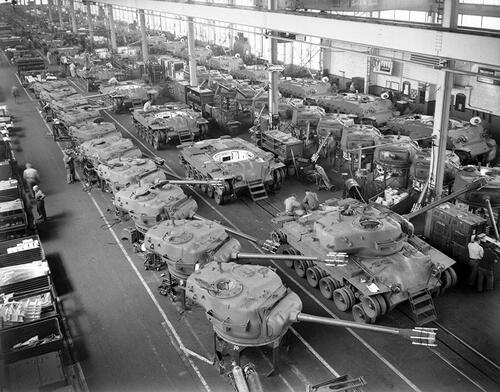
This is not mere contingency planning but the early architecture of a sustained war economy, echoing America's WWII 'Arsenal of Democracy' where Detroit's assembly lines halted civilian auto production to churn out tanks, bombers, and military vehicles at unprecedented scale. Reports highlight that Ford once produced nearly 278,000 military vehicles during that era, while the broader auto sector became central to victory. Today's version arrives as dual conflicts in Eurasia strain inventories of missiles, drones, and tactical systems, with the Pentagon explicitly seeking 'all available commercial solutions.'
What mainstream coverage frames as pragmatic replenishment reveals a deeper, underreported pattern: preparation for protracted great-power competition rather than short-term crises. Market optimism continues to dominate headlines—focusing on quarterly auto sales, EV transitions, and consumer demand—yet this mobilization underscores a strategic bet that future conflicts (potentially involving peer adversaries) will demand industrial depth beyond specialized defense firms. Connections to broader policy emerge in the preservation of convertible manufacturing bases; flooding markets with incompatible foreign platforms risks eroding the very surge capacity now being activated.
Labor challenges, including potential union resistance, remain a wildcard, as does the technical downtime for retooling modern plants optimized for just-in-time efficiency into wartime surge producers. German automaker Volkswagen's parallel shift of a factory toward Iron Dome components illustrates this is not solely an American phenomenon but a transatlantic recognition that peacetime globalization has left industrial cores hollowed for high-intensity scenarios. As Palmer Luckey has noted in related discussions, WWII victory hinged on commandeering existing factories more than building new ones from scratch.
By leveraging underused civilian lines at scale, the U.S. is hedging against the vulnerabilities of a hyper-specialized supply chain. This move, while framed in terms of maintaining 'decisive advantage,' signals policymakers anticipate multi-year attrition rather than decisive quick wins. The pattern risks being obscured by financial narratives prioritizing near-term earnings over these tectonic shifts in economic orientation toward security and resilience.
Liminal: Policymakers are treating sustained great-power conflict as the baseline scenario, quietly converting consumer manufacturing into strategic surge capacity and exposing the fragility of peacetime globalization in favor of hardened industrial autonomy.
Sources (4)
- [1]Pentagon Approaches Automakers, Manufacturers to Boost Weapons Production(https://www.wsj.com/politics/national-security/pentagon-approaches-automakers-manufacturers-to-boost-weapons-production-19538557)
- [2]Pentagon approaches automakers, manufacturers to boost weapons production, WSJ reports(https://www.reuters.com/business/autos-transportation/pentagon-approaches-automakers-manufacturers-boost-weapons-production-wsj-2026-04-16/)
- [3]Ford, GM could be about to make weapons for the first time since WW2(https://www.newsweek.com/ford-gm-could-be-about-to-make-weapons-for-the-first-time-since-ww2-11836674)
- [4]Arsenal of Democracy 2.0? US revives World War II era playbook as Pentagon eyes automakers(https://www.businesstoday.in/world/story/arsenal-of-democracy-20-us-revives-world-war-ii-era-playbook-as-pentagon-eyes-automakers-525977-2026-04-16)