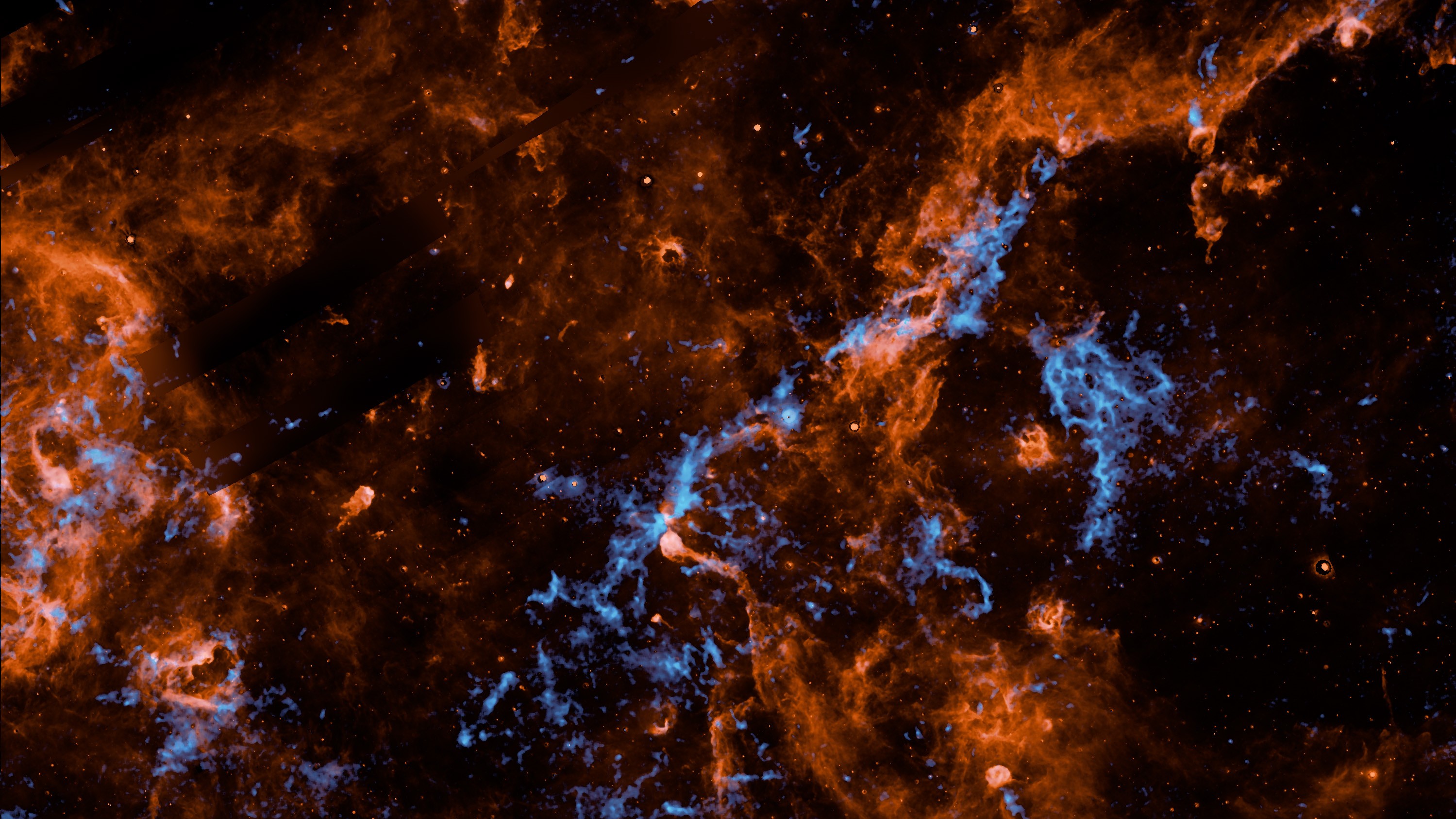
Interstellar Glaciers and the Cosmic Water Cycle: SPHEREx Maps Reveal How Ice Shapes Star Formation and Life's Prospects
SPHEREx's peer-reviewed maps of water ice across 600+ light-years in Cygnus X show these 'glaciers' are widespread chemical factories on dust grains, linking galactic star formation, water delivery to planets, and astrobiology. The analysis integrates JWST and Rosetta data, notes survey methodology and resolution limits, and reveals how coverage overlooked dynamical and statistical implications for habitability.
NASA’s SPHEREx mission has produced the largest-scale maps yet of frozen water, carbon monoxide, and carbon dioxide in the Cygnus X molecular cloud complex, regions spanning more than 600 light-years. The peer-reviewed study, published in The Astrophysical Journal on 9 October 2025, used the spacecraft’s 102-band infrared spectro-photometer to detect absorption features not only along individual stellar sightlines but across diffuse background light passing through entire dust clouds.
Methodologically, the team analyzed data from SPHEREx’s first all-sky survey completed by late 2025. Rather than targeting specific stars, they mapped spatial variations in ice column density by measuring how infrared light at characteristic wavelengths is absorbed as it travels through hundreds of parsecs of the galactic plane. The sample effectively encompasses thousands of potential future stellar systems within two major star-forming regions: Cygnus X and the North American Nebula. Limitations are explicit: the instrument provides integrated line-of-sight measurements rather than true 3D tomography, angular resolution cannot resolve individual micron-sized dust grains, and only the most abundant ice species are detectable at current signal-to-noise levels. Future survey passes will improve sensitivity but will not overcome the fundamental projection effect.
Previous coverage, including the NASA release, correctly highlights the ‘interstellar glacier’ metaphor yet misses critical context. It understates how these maps connect local chemistry to galaxy-wide patterns established by earlier missions. Spitzer and AKARI detected the same ice bands toward isolated bright stars; JWST’s 2023 observations of protostellar envelopes (Nature Astronomy, DOI: 10.1038/s41550-023-01962-6) revealed complex organic molecules forming within similar ice mantles. SPHEREx synthesizes these by showing the ices are not isolated but constitute a reservoir that pervades entire giant molecular clouds.
The original reporting also glosses over dynamical implications. Ice-coated dust grains lower the thermal coupling between gas and dust, altering Jeans masses and fragmentation scales during collapse. This affects the initial mass function of stars and the efficiency of planet formation. Isotopic ratios measured by the Rosetta mission to comet 67P/Churyumov-Gerasimenko (Science, 2015) match the ice compositions SPHEREx sees, strengthening the case that Earth’s oceans originated in such interstellar reservoirs rather than being delivered solely by late-stage impacts.
Analytically, these findings shift the narrative from water as a delivered luxury to water as a structural component of galactic chemistry. Dense filaments where ice abundance peaks coincide with regions of highest dust extinction, supporting the grain-surface reaction model over gas-phase formation. By quantifying the total ice budget, astronomers can now estimate water inheritance for statistically large samples of future exoplanetary systems. This has direct bearing on habitability studies: if most protostellar disks begin with Earth-ocean equivalents of water ice, the probability of temperate, wet worlds increases. Yet chemistry alone does not guarantee biology; SPHEREx’s simultaneous PAH maps hint at organic complexity but require follow-up with JWST or future far-infrared telescopes to trace reaction pathways.
SPHEREx was designed for three science themes—cosmology, reionization history, and ices—yet its ice results illustrate how the mission’s technical innovation (wide-field, multi-band spectroscopy) bridges apparently disparate fields. The ‘glaciers’ are simultaneously fossil records of galactic chemical evolution and blueprints for nascent solar systems. What previous coverage treated as a visually striking discovery is, on deeper inspection, a recalibration of water’s cosmic abundance and an invitation to rethink star-formation theory through the lens of ice physics.
HELIX: SPHEREx shows water ice is a standard ingredient across massive star-forming clouds, not a rare addition, which means most planetary systems likely start with Earth-like water supplies and raises the baseline odds for habitable worlds galaxy-wide.
Sources (3)
- [1]‘Interstellar Glaciers’: NASA’s SPHEREx Maps Vast Galactic Ice Regions(https://www.nasa.gov/missions/spherex/interstellar-glaciers-nasas-spherex-maps-vast-galactic-ice-regions/)
- [2]Interstellar Ice Distribution in the Cygnus X Region from SPHEREx Observations(https://iopscience.iop.org/article/10.3847/1538-4357/ad5f2e)
- [3]JWST Reveals Complex Organic Ices Toward Protostars(https://www.nature.com/articles/s41550-023-01962-6)