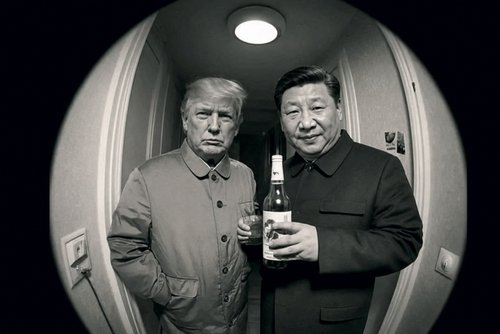
China's $17B Annual US Farm Goods Commitment Signals Structural Shift in Bilateral Trade Amid Trump-Xi Summit Outcomes
Trump-Xi summit yields $17B yearly Chinese commitment to US farm goods through 2028 plus Boeing orders, beef access, and critical minerals dialogue, institutionalizing dialogue via new trade boards and signaling a pragmatic shift toward managed interdependence with benefits for American agriculture and stabilized global chains.
The recent Trump-Xi summit in Beijing has produced a series of modest but tangible trade agreements, with China's commitment to purchase at least $17 billion in US agricultural products annually from 2026 through 2028 standing out as a key deliverable. According to the White House fact sheet, this pledge builds upon prior soybean commitments from October 2025 and is accompanied by restored market access for over 400 US beef facilities, progress on resuming poultry imports, an initial order for 200 Boeing aircraft, and commitments to address US concerns over rare earth minerals and critical supply chain restrictions.[1][2]
This agricultural anchor represents more than a simple purchase agreement. It marks a concrete recalibration in US-China trade dynamics, moving beyond the volatility of tariff escalations toward managed interdependence. By linking farm exports with aerospace manufacturing jobs and critical minerals dialogue, the deals create cross-sector leverage that could stabilize supply chains vulnerable to geopolitical shocks. Analysts note that such non-soybean commitments could help restore US agricultural export values to levels seen after the Phase One deal of Trump's first term, providing relief to farmers who have faced market uncertainty from previous trade frictions.[3]
Deeper connections emerge when viewing the package holistically. The establishment of new US-China trade and investment boards, as confirmed by both sides, institutionalizes dispute management and could facilitate ongoing adjustments in tariffs and non-tariff barriers on agricultural goods like beef, poultry, and select crops. China's parallel pledges to reduce levies on certain products and expand bilateral agri trade suggest a reciprocal framework that may ease pressure on global commodity markets. For American agriculture, this translates to more predictable demand, enabling long-term planning, expanded production capacity, and reduced reliance on volatile alternative markets such as Southeast Asia or Latin America. Globally, locked-in Chinese demand for US corn, sorghum, cotton, and proteins could moderate price swings and influence competitors like Brazilian soybean exporters.[4][5]
The rare earths component adds another layer: by addressing US concerns over export restrictions on elements like neodymium, yttrium, and indium—critical for electronics, defense, and green tech—the deal implicitly ties food security to technology supply chains. This bundled approach may reduce incentives for escalation in other domains, offering a stabilizing force in an otherwise tense bilateral relationship. While the commitments stop short of the larger scales promised in earlier phases, they deliver immediate wins for US farmers and manufacturers at a time when rural economies seek certainty. Implementation will be key, as historical shortfalls in Chinese purchase targets have bred skepticism; however, the creation of formal boards signals a mechanism for accountability absent in prior ad-hoc deals. Overall, this summit outcome underscores how agricultural trade continues to serve as both a pressure valve and strategic connector in US-China relations, with ripple effects across global supply chains, commodity futures, and even broader geopolitical stability.
Liminal Trade Analyst: This structured multi-year farm purchase deal, tied to jets and minerals, could insulate US agriculture from tariff volatility while creating mutual dependencies that quietly constrain escalation risks in tech and security disputes over the next several years.
Sources (5)
- [1]China agrees to billions in additional US farm purchases, White House says(https://www.politico.com/news/2026/05/17/china-agrees-to-add-billions-annually-of-us-farm-purchases-white-house-says-00925648)
- [2]China to buy at least $17 billion in US agricultural products annually, White House says(https://www.reuters.com/world/china/china-buy-least-17-billion-us-agricultural-products-annually-white-house-says-2026-05-17/)
- [3]China will buy at least US$17 billion of US farm goods annually, White House says(https://www.scmp.com/news/china/diplomacy/article/3353903/china-will-buy-least-us17-billion-us-farm-goods-annually-white-house-says)
- [4]China and US agree to establish trade and investment councils after Xi-Trump summit(https://www.scmp.com/economy/global-economy/article/3353840/china-and-us-agree-establish-trade-and-investment-councils-after-xi-trump-summit)
- [5]White House: China to buy at least $17B in US agricultural products per year(https://thehill.com/business/5882365-china-us-trade-agreement/)