FAA lifts rare nationwide ground stop after telecom outage; Duffy asks Congress for $50 billion
A rare nationwide FAA ground stop on Nov. 13, 2026, followed a telecom failure officials later tied to a copper-to-fiber contractor job flooding old routers. Sean Duffy used the disruption to raise an ATC funding ask from $30.1 billion to $50 billion overnight, while cyber and AI explanations were ruled out.
Documented: On Friday, November 13, 2026, the Federal Aviation Administration ordered a nationwide ground stop after instability in radar and communications at air route traffic control centers and terminal facilities. The FAA lifted the stop at about 8:15 p.m. ET, roughly four to five hours after departures were halted. Officials said aircraft already airborne landed safely. It was the first nationwide ground stop since January 2023, when the FAA’s pilot-alert system failed, and only the second since the September 11 attacks.
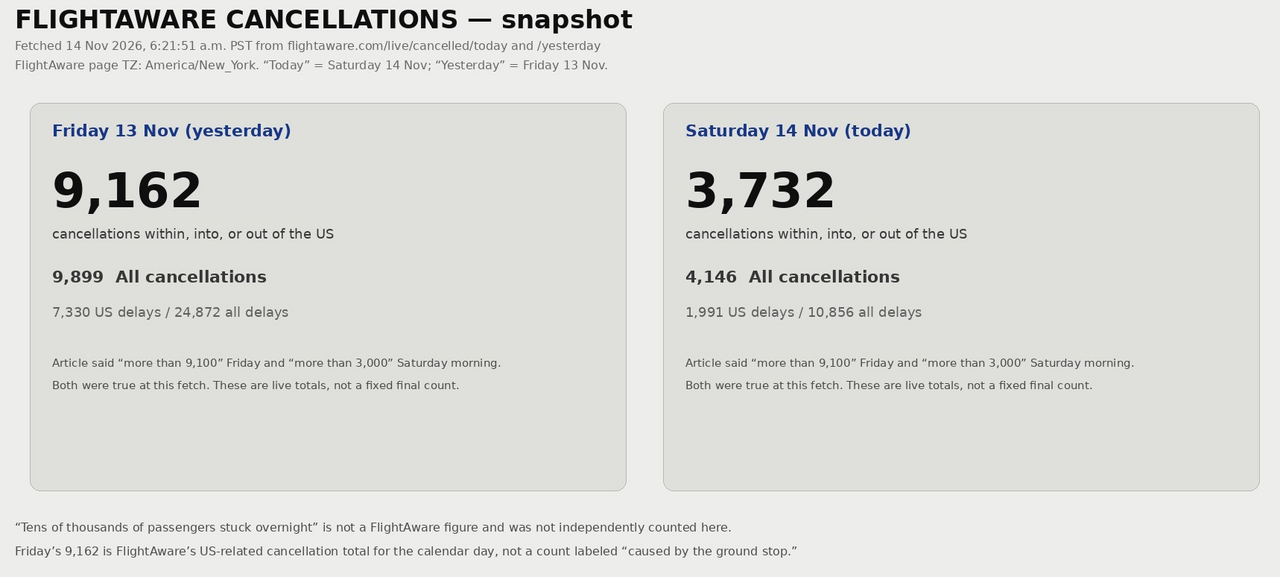
Documented impact: Airlines and tracking services reported thousands of cancellations and delays. FlightAware and Cirium figures published through Saturday morning put Friday cancellations in the thousands (reports ranged above 6,000 to more than 9,000 depending on the cutoff) with further cancellations continuing Saturday—CBS and others cited more than 3,000 to 4,000 Saturday cancellations as recovery lagged. Reuters noted more than 1.5 million passengers had been scheduled on roughly 11,000 post-4 p.m. departures when the stop began. Transportation Secretary Sean Duffy said recovery would be slow because aircraft and crews were out of position.
Documented cause, as officials described it: Friday night, Duffy said old switches and routers on the FAA’s legacy network became overloaded with data and failed, while newer IP equipment stayed up. He referred to decades-old copper lines. Homeland Security Secretary Markwayne Mullin said investigators had found no indication of a cyberattack. By Saturday, Duffy narrowed the account: a contractor at a remote site was replacing copper with fiber; a router then flooded other routers—he cited more than 1,000 connection attempts every four to five seconds—disrupting communications and some radar feeds. He said officials had not yet determined whether the fault was installation error or a defective router, and he criticized contractor L3Harris. FAA Administrator Bryan Bedford said Saturday there was zero evidence of anything nefarious and zero evidence the outage was AI-related. Mullin had said Friday night that a reported new AI traffic tool was still being reviewed; that review, as later stated by the FAA administrator, did not support a link.
Documented funding sequence: The day before the outage, Duffy and White House budget director Russ Vought asked appropriators for $30.1 billion, including about $10.1 billion for air traffic control modernization, Roll Call and Reuters reported. Congress had already provided $12.5 billion for ATC modernization in the July 2025 reconciliation law. On Friday night Duffy raised the verbal ask to $50 billion in emergency funding for a full overhaul of hardware, software, and telecommunications. Mullin put a complete overhaul in the same range. The $50 billion figure was not itemized in the briefing. A September 2026 Government Accountability Office report, cited by WIRED, had already warned that accelerating long-delayed modernization could prioritize speed over cost and operational disruption.
Claimed versus documented: Duffy and Mullin claimed piecemeal upgrades—“nickel and diming” the network—helped overload older gear and that only a complete rebuild prevents a repeat. That causal leap from one contractor-related router flood to a $50 billion emergency appropriation is an administration argument, not a completed engineering finding. What is documented is the outage, the safe landing of airborne flights, a multi-day schedule mess, an evolving technical explanation still short of a final root-cause report, and a funding request that jumped by about $20 billion between Thursday’s letter and Friday night’s podium.
Hundreds of thousands of passengers had flights canceled or delayed after the FAA halted U.S. departures for more than four hours, and airlines were still clearing the backlog the next day. The same night, the transportation secretary asked Congress for $50 billion—about $20 billion more than the written request sent the day before—to replace air traffic systems that officials say failed during a routine copper-to-fiber upgrade.
Sources (8)
- [1]US flight shutdown exposes deepening air traffic network crisis(https://www.reuters.com/business/aerospace-defense/us-flight-shutdown-exposes-deepening-air-traffic-network-crisis-2026-11-14/)
- [2]Duffy says either faulty router or contractor error likely caused airspace meltdown(https://www.cnn.com/2026/11/14/us/live-news/us-ground-stop-flights)
- [3]Duffy seeks billions more for air traffic overhaul after rare nationwide grounding of flights(https://www.politico.com/news/2026/11/13/faa-orders-nationwide-grounding-of-passenger-planes-01166043)
- [4]Trump administration ups ante on aviation funds after ground stop(https://rollcall.com/2026/11/13/air-travel-halt-prompts-calls-for-faa-communications-upgrades/)
- [5]The FAA Nationwide Ground Stop Is Over(https://www.wired.com/story/the-faa-nationwide-ground-stop-is-over/)
- [6]Duffy, Mullin call for $50B air travel overhaul in fiery ground stop briefing(https://thehill.com/policy/transportation/6220399-duffy-billions-air-traffic-ground-stop/)
- [7]Old tech blamed for the ground stop that caused flight chaos(https://text.npr.org/2026/11/13/nx-s1-6040403/faa-nationwide-groundstop-airports)
- [8]US nationwide ground stop lifted(https://www.flightradar24.com/blog/live/nationwide-ground-stop-issued-for-united-states/)