Fed minutes say most officials see AI debt growing through complex, opaque structures
October FOMC minutes show most officials flagging rapidly growing AI debt in opaque structures, while a Fed stability report and Governor Barr put related off-balance-sheet commitments above $3 trillion.
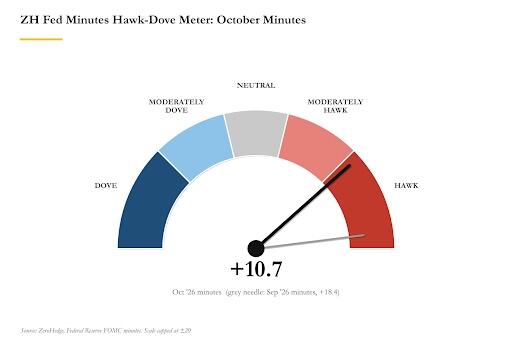
Documented: Minutes of the Federal Open Market Committee’s late-October policy meeting, released in mid-November 2026, record that officials held the federal funds rate steady while “almost all” participants judged that further increases in the target range would likely be appropriate if the economy evolved as they expected. The same minutes put artificial intelligence near the center of both the inflation discussion and the financial-stability discussion. Reuters and CNBC reported that almost all participants commented on risks from a scenario in which returns on AI investment disappointed investors, and that most participants observed that AI-related debt had grown rapidly, much of it through complex and opaque financing structures. A few participants noted that AI-related exposures were becoming concentrated among a small number of firms. Staff briefing the committee flagged off-balance-sheet leasing commitments and circular financing arrangements among AI-related firms as channels that could amplify losses if those returns disappointed.
That language sits on top of a separate, documented staff assessment in the Fed’s November 2026 Financial Stability Report. Coverage of the report by Reuters, Axios, and Fortune, and a November 16 speech by Governor Michael Barr, describe “advanced computing” debt issuance rising to more than $680 billion by October 2026—about five times issuance in all of 2023—and accounting for roughly 31 percent of nonfinancial investment-grade corporate debt issuance, up from under 6 percent in 2023. Barr said on-balance-sheet debt at the seven largest AI-related firms was expected to exceed $800 billion before year-end, while the potential maximum nominal value of other obligations—signed but not-yet-started leases, take-or-pay contracts, and residual value guarantees—exceeded $3 trillion. Barr compared the pace of balance-sheet leverage to the late-1990s telecom buildout and said the complexity can be opaque, which can worsen selloffs when sentiment shifts because it is hard to see where risk sits. The same stability report found AI the most frequently cited risk among surveyed market contacts, at 87 percent, up from 50 percent six months earlier.
Claimed, not demonstrated in the minutes: that this financing structure is already a unique historical precursor of a system-wide crisis, or that mainstream coverage has ignored it. Reuters, CNBC, Axios, and Fortune all led with the AI-financing passage alongside the hawkish rate discussion. The minutes also record staff judgment that elevated asset valuations and hedge-fund leverage were the most salient vulnerabilities, while strong bank and household balance sheets were an important buffer. The stability report itself noted that circular financing could, in some designs, let the largest firms absorb losses and limit spillovers.
Speculated: the size of any loss if AI returns disappoint, how much of the off-balance-sheet stack would become a cash claim on banks or funds rather than on the hyperscalers, and whether a valuation reset would transmit like a classic credit bust or mainly like an equity and private-credit repricing. Those outcomes are not in the minutes. What is documented is narrower and still material: the central bank has put rapid growth, opacity, concentration, and circular financing of the AI buildout on the official risk register, at the same time most officials were arguing policy was not yet restrictive enough to bring inflation back to 2 percent.
Investors, banks, and companies financing data centers now face an official Fed finding that a large share of AI commitments sits outside ordinary debt totals and is hard to map. Households and borrowers are affected separately because the same meeting record shows almost all officials still leaning toward higher rates to slow inflation.
Sources (5)
- [1]Fed policymakers concerned about financial system risks, minutes show(https://www.reuters.com/legal/transactional/fed-policymakers-concerned-about-financial-system-risks-minutes-show-2026-11-18/)
- [2]Fed minutes: Officials expect more rate hikes, worry about AI(https://www.cnbc.com/2026/11/18/fed-minutes-october-2026.html)
- [3]Speech by Governor Barr on some potential financial stability implications of artificial intelligence(https://www.federalreserve.gov/newsevents/speech/barr20261116a.htm)
- [4]AI rockets to top of worries about financial system in latest Fed survey(https://www.reuters.com/business/finance/ai-rockets-top-worries-about-financial-system-latest-fed-survey-2026-11-13/)
- [5]Federal Reserve flags financial risks tied to AI financing boom(https://www.axios.com/2026/11/16/fed-ai-boom-financial-risks)