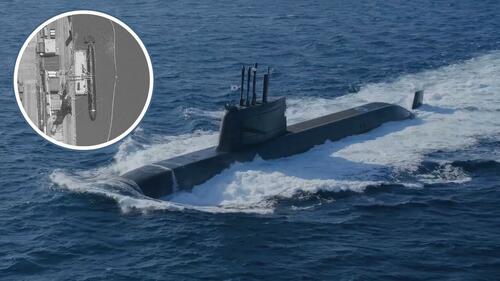
China's Sailless 120-Meter Submarine: Satellite Evidence Reveals Stealth Breakthrough with Undersea Infrastructure Implications
Satellite imagery from June 2026 reveals China's launch of a large sailless nuclear attack submarine at Jiangnan Shipyard, featuring advanced stealth characteristics and possible seabed mission capabilities that could target undersea cables critical to global communications and military networks. This development, corroborated across defense outlets, highlights Beijing's rapid submarine innovation and production advantages with significant implications for Indo-Pacific security and undersea domain dominance.
Recent commercial satellite imagery has captured the launch of a novel 120-meter submarine at Shanghai's Jiangnan Shipyard, distinguished by its complete absence of a traditional sail, X-shaped stern control surfaces, narrow beam, and streamlined hull optimized for reduced hydrodynamic drag and acoustic signature. According to detailed analysis by Naval News, the vessel—visible moored alongside a barge in late May and early June 2026—measures approximately 394 feet long and 33-36 feet wide, features a sleek bow, and may incorporate pumpjet propulsion for quieter high-speed operations. A parallel launch appears to have occurred at the Huludao nuclear submarine facility, suggesting China is now capable of simultaneous first-of-class construction on separate production lines, a feat Western shipyards struggle to match.[1]
This design builds directly on an earlier experimental sailless submarine launched at the same Jiangnan yard in 2018, which featured only a minimal bump instead of a conning tower. The new vessel is significantly larger and appears optimized for operational use rather than pure testing. Defense analysts note it is unlikely to be a ballistic missile platform due to its proportions but is most probably a nuclear-powered attack submarine, potentially incorporating hybrid nuclear-air-independent propulsion (AIP) concepts previously tested in the Type-041 Zhou class.[1]
While mainstream coverage has focused on the vessel's hydrodynamics and noise reduction, deeper examination reveals potential for specialized seabed missions. Asia Times reporting highlights that the sailless configuration, which minimizes protrusions that could snag on cables or sensors, is well-suited for operations against undersea infrastructure. With 99% of global internet traffic and substantial military communications relying on seabed fiber-optic cables, such a platform could enable persistent monitoring, tapping, or sabotage in chokepoints like the Bashi Channel near Taiwan or trans-Pacific routes serving U.S. bases in Guam and Hawaii. Experts including Joseph Trevithick and Ryan Martinson emphasize how this stealth profile could penetrate anti-submarine barriers such as the "Fish Hook" sensor network, shifting undersea competition into the digital and economic domains.[2]
China has launched 15-20 submarines across at least eight new classes in the past five years, dramatically outpacing U.S. and allied production rates hampered by supply chain issues and yard capacity limits. This industrial tempo, combined with iterative experimentation visible primarily through satellite reconnaissance from providers like Vantor, underscores a strategic emphasis on undersea asymmetry. Militarnyi and other defense outlets confirm the vessel's unusual profile aligns with Beijing's pattern of revealing advanced concepts through OSINT rather than official announcements.[3]
The convergence of these factors—novel hull geometry for superior submerged performance, parallel nuclear submarine production, and a doctrinal focus on critical infrastructure—suggests more than incremental progress. It points to a deliberate effort to complicate Western anti-submarine warfare calculations in the Indo-Pacific, where undetected high-speed or loitering seabed assets could prove decisive in gray-zone scenarios or outright conflict. As satellite imagery continues to peel back layers of official secrecy, the undersea power balance appears to be tilting faster than publicly acknowledged.
Liminal Analyst: China's sailless submarine production lines and seabed-focused stealth designs could enable undetected infrastructure attacks, eroding Western undersea superiority and complicating Pacific conflict scenarios by the early 2030s.
Sources (4)
- [1]New Mystery Submarine Signals China’s Rapid Undersea Expansion(https://www.navalnews.com/naval-news/2026/06/new-mystery-submarine-signals-chinas-rapid-undersea-expansion/)
- [2]China's sailless submarine takes warfare to the seabed(https://asiatimes.com/2026/06/chinas-sailless-submarine-takes-warfare-to-the-seabed/)
- [3]Satellite Captures Unidentified Chinese Submarine With Unusual Design(https://militarnyi.com/en/news/satellite-captures-unidentified-chinese-submarine-with-unusual-design/)
- [4]Mystery 120-meter Chinese submarine ditches traditional sail design(https://interestingengineering.com/military/china-sailless-submarine-satellite-images)