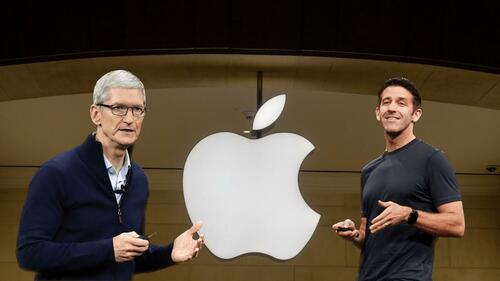
End of the Cook Era: Apple's Leadership Transition, AI Ambitions, and Unseen Geopolitical Currents
Tim Cook's succession by hardware chief John Ternus in 2026 ends a transformative 15-year era at Apple. Beyond financial metrics, the change carries implications for AI hardware acceleration, regulatory diplomacy, and supply-chain exposure to U.S.-China tensions that initial coverage largely overlooked.
Apple Inc. announced on August 2025 that Tim Cook will step down as CEO effective September 1, 2026, transitioning to executive chairman while John Ternus, currently senior vice president of Hardware Engineering, assumes the chief executive role. The board approved the move unanimously. Cook, who joined Apple in 1998 and succeeded Steve Jobs in 2011, presided over a period in which the company's market capitalization expanded from approximately $350 billion to over $4 trillion, with annual revenue rising from $108 billion to $416 billion. The ZeroHedge coverage frames this primarily through a financial lens, crediting share buybacks and operational efficiency rather than product innovation. However, this misses the broader policy and geopolitical context that defined Cook's tenure and will likely constrain or enable Ternus's agenda.
Primary documents, including Apple's August 2025 press release and Cook's past congressional testimonies (such as his 2021 appearance before the U.S. Senate Judiciary Subcommittee on Competition Policy regarding App Store practices), reveal a CEO deeply engaged in global regulatory navigation. Cook's letter to shareholders and earnings call transcripts consistently emphasize supply-chain resilience amid U.S.-China tensions, including export controls on advanced semiconductors under the CHIPS and Science Act of 2022 and Entity List restrictions. These factors were largely absent from the initial ZeroHedge summary.
Multiple perspectives emerge on the implications. Hardware-focused analysts point to Ternus's leadership in developing the M-series chips and neural engines as positioning Apple to accelerate on-device AI processing, reducing reliance on cloud providers and mitigating data-privacy regulations such as the EU's General Data Protection Regulation and the forthcoming AI Act. From this view, the transition supports Apple's 'Apple Intelligence' rollout by prioritizing silicon-level integration over software partnerships. Conversely, investor letters and analyst reports from firms tracking antitrust litigation (including the U.S. Department of Justice's 2024 complaint against Apple) suggest that an engineering-centric CEO may lack Cook's diplomatic finesse in managing Brussels regulators enforcing the Digital Markets Act, which compels sideloading and alternative app stores.
Geopolitically, the shift marks the end of an era in which Cook personally cultivated relationships in Beijing, as documented in State Department readouts and Apple's supplier responsibility reports. With roughly 90% of iPhone assembly still occurring in China per Apple's 2024 Form 10-K, Ternus inherits a supply chain vulnerable to cross-strait tensions over Taiwan and potential export licensing changes for lithography equipment. This connects to larger patterns: the same semiconductor competition visible in Huawei's Kirin chip resurgence and TSMC's Arizona expansion. The original coverage overlooked how Cook's policymaker engagement role as executive chairman may be intended to insulate Ternus from these non-technical challenges.
Synthesizing Apple's official announcement, the company's FY2025 earnings materials, and Levinson's board statement shows deliberate continuity messaging. Yet history suggests succession at Apple has rarely been seamless; the post-Jobs transition itself required Cook to defend the firm against activist investors questioning its innovation pipeline. Ternus's promise to 'lead with the values and vision that have come to define this special place' echoes Jobs-era language but will be tested against current realities: slowing iPhone replacement cycles, services growth under competition from regulatory-mandated openness, and the capital-intensive race toward spatial computing and generative AI hardware.
What the initial reporting got wrong was reducing Cook's legacy to buybacks. Primary SEC filings demonstrate that services revenue grew from 6% to over 25% of total revenue under Cook, a strategic pivot that buffered hardware cyclicality while attracting antitrust scrutiny precisely because of its success. Markets will likely price in both the perceived stability of internal succession and the uncertainty of executing an AI strategy under heightened great-power competition. The appointment of Levinson as lead independent director further signals board emphasis on continuity over disruption.
Ultimately, this transition occurs at the intersection of corporate strategy and public policy. Whether Ternus can maintain Apple's valuation premium while satisfying divergent demands from Washington, Brussels, and Beijing remains the central open question neither the ZeroHedge piece nor the initial press materials fully address.
MERIDIAN: Ternus's hardware expertise may speed Apple's on-device AI chips, yet Cook's departure as chief diplomat leaves the company more exposed to regulatory friction in Europe and supply shocks from East Asia that could redefine its $4T valuation.
Sources (3)
- [1]Tim Cook Stepping Down As Apple CEO; John Ternus, Head Of Hardware, Will Take Over(https://www.zerohedge.com/markets/tim-cook-stepping-down-apple-ceo-john-ternus-head-hardware-will-take-over)
- [2]Apple Leadership Transition Press Release(https://www.apple.com/newsroom/2025/08/tim-cook-to-step-down/)
- [3]U.S. Senate Judiciary Committee Hearing on Competition Policy - Testimony of Tim Cook(https://www.judiciary.senate.gov/meetings/competition-policy-and-digital-platforms)