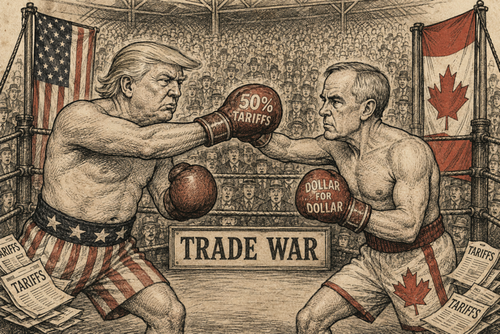
Escalating U.S.-Canada Trade War: Trump's 50% Tariffs Hit Canadian Exports, Loonie Weakens Amid Broader Economic Ripple Effects
Credible reports confirm Trump's new 50% tariffs on Canadian goods and threats of further auto/steel duties in 2027, correlating with loonie weakness and Canadian retaliation plans. This amplifies risks to supply chains, currency stability, and cross-border commerce.
President Donald Trump has intensified a trade dispute with Canada, imposing 50% tariffs on approximately $20-28 billion worth of Canadian goods including furniture, plastics, plywood, electrical equipment, and other imports effective August 22, 2026, following the collapse of negotiations. In a Truth Social post, Trump accused Canada of 'ripping off' the U.S. with high tariffs on American farm products, citing a $60 billion trade deficit, and declared 'WE DON'T NEED CANADA, THEY NEED US!' as Canada conducts 95% of its trade with the U.S.[1][1]
Additional tariffs on cars, trucks, automotive parts, and steel are slated to rise to 50% starting January 1, 2027, unless production shifts to the U.S. These measures build on earlier 2026 tariffs and target a diffuse range of small and medium enterprises across supply chains.[2][3]
The Canadian dollar (loonie) has weakened in response to the uncertainty and escalation. Prime Minister Mark Carney's government has pledged support for affected businesses, though experts note the challenges in crafting aid for varied industries compared to prior steel-focused packages. Canada plans dollar-for-dollar retaliation effective September 8.[4][5]
Geopolitically, the tariffs underscore how bilateral tensions directly pressure currencies, disrupt integrated North American supply chains (especially autos and manufacturing), and raise costs for consumers and firms on both sides. Broader implications include heightened volatility in financial markets, potential shifts in investment toward U.S. production, and strained alliances amid ongoing global trade frictions.
Market Analyst: Persistent tariffs will likely sustain CAD depreciation and force supply chain reconfiguration, with small Canadian exporters facing acute pressure while U.S. consumers absorb higher prices across diffuse goods categories.
Sources (5)
- [1]Trump slams Canada with new 50 percent auto tariffs for 2027(https://www.aljazeera.com/economy/2026/8/24/trump-slams-canada-with-new-50-percent-auto-tariffs-for-2027)
- [2]Trump's 50% tariffs on Canada take effect as Carney vows to retaliate(https://abcnews.com/Business/trumps-proposed-tariffs-canada-hurtle-deadline-amid-trade/story?id=135833861)
- [3]U.S. and Canada fall deeper into a trade war with new tariffs(https://www.pbs.org/newshour/world/u-s-imposes-50-tariffs-on-20-billion-worth-of-canadian-products-canada-says-it-will-retaliate)
- [4]Canada-U.S. tariffs: Trump threatens 50% duties on autos(https://www.ctvnews.ca/world/trumps-tariffs/article/we-dont-need-canada-they-need-us-trump-threatens-50-tariffs-on-all-cars-trucks-live-updates-here/)
- [5]Trump announces tariffs on Canadian vehicles, steel in escalation of trade war(https://www.washingtonpost.com/business/2026/08/24/trump-announces-tariffs-canadian-vehicles-steel-escalation-trade-war/)