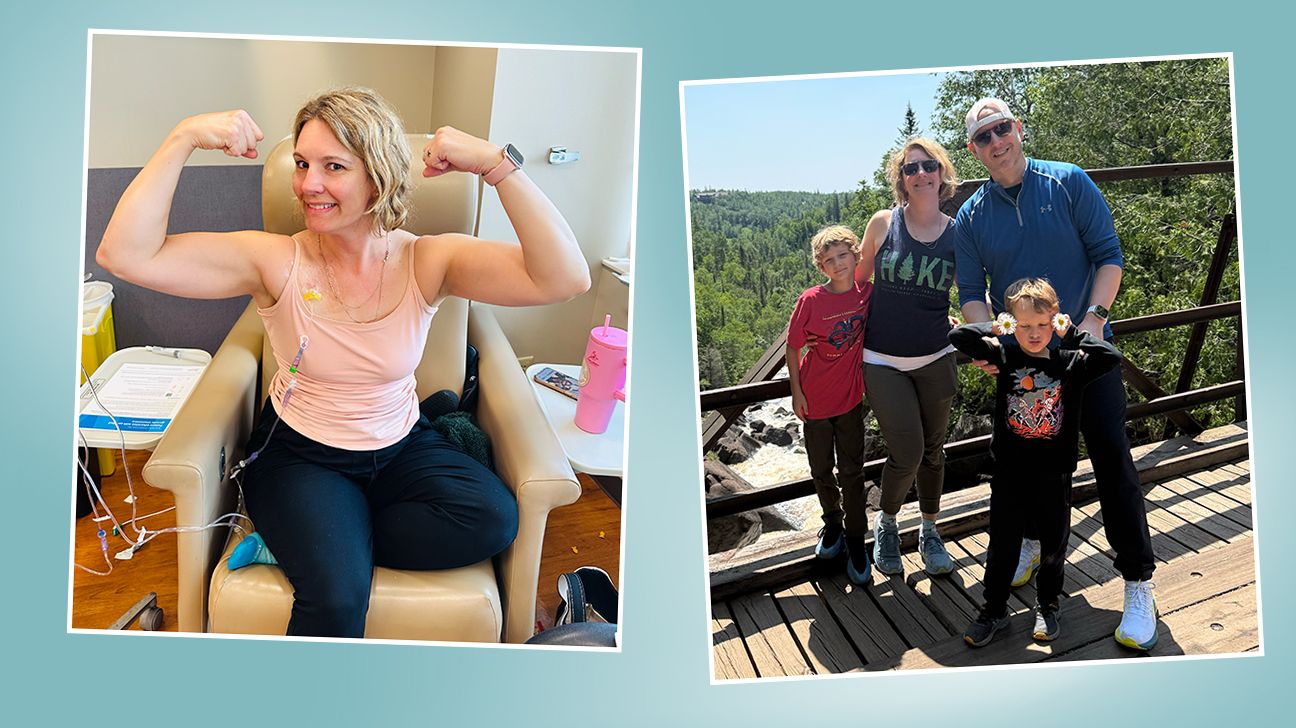
Defying BRAF V600E Odds: How an Active Mother's Resilience and Precision Trials Expose Gaps in Colon Cancer Care
VITALIS analysis of Heather Kaiser's BRAF V600E colon cancer survival integrates BEACON CRC RCT data, observational evidence on exercise and diagnostic delays, and resilience factors missing from personal narratives, revealing how lifestyle and systemic gaps shape outcomes beyond targeted therapies.
Heather Kaiser's Healthline first-person account details her 2025 diagnosis at age 42 with a fist-sized colorectal tumor, subsequent discovery of metastatic spread to peri-hepatic and peri-pulmonary lymph nodes, and identification of the aggressive BRAF V600E mutation present in roughly 10% of metastatic colorectal cancers. What the original coverage presents as an inspiring personal narrative of becoming 'patient zero' in a clinical trial misses critical molecular, epidemiological, and psychosocial context that peer-reviewed evidence illuminates.
Mainstream clinical coverage often reduces such cases to drug mechanisms while overlooking systemic diagnostic delays and resilience variables. Kaiser's initial symptoms were dismissed as hormonal or 'women's issues'—a pattern repeatedly documented in early-onset colorectal cancer (EOCRC). A 2022 observational analysis in JAMA Network Open (n=143,000+ patients from SEER registry, no declared conflicts) found adults under 50 experience diagnostic intervals 2.5 times longer than older patients, directly contributing to higher rates of metastatic presentation at diagnosis.
The BRAF V600E mutation confers resistance to standard EGFR inhibitors and carries a historically grim prognosis. The pivotal BEACON CRC phase 3 randomized controlled trial (Kopetz et al., NEJM 2019; n=665 patients with BRAF-mutant mCRC, funded by Array BioPharma with multiple investigator conflicts disclosed) demonstrated that encorafenib plus cetuximab improved median overall survival to 8.4 months versus 5.4 months with control therapy (HR 0.60, 95% CI 0.45-0.79). While superior to historical chemo-only benchmarks of roughly 4-6 months, real-world survivors like Kaiser who exceed 13-month median predictions highlight the limitations of trial populations that often exclude highly active or younger patients.
Kaiser's maintenance of physical activity as a busy mother of two aligns with observational evidence on resilience factors rarely covered in oncology headlines. A large prospective cohort study (Guercio et al., Journal of Clinical Oncology 2015; n=2,575 stage III CRC survivors, minimal conflicts) showed post-diagnosis physical activity of ≥18 MET-hours/week (equivalent to brisk walking 6+ hours) was associated with 47% lower cancer-specific mortality (HR 0.53) after adjusting for stage, treatment, and comorbidities. This suggests her commitment to 'showing up' for her children may represent a modifiable factor that trial data alone cannot capture.
The original source also underplays the rise of EOCRC, now increasing 1-2% annually in adults under 55 per CDC surveillance data, potentially linked to microbiome shifts, ultra-processed diets, and antibiotic exposure—hypotheses supported by multiple observational studies but lacking definitive RCTs. Furthermore, while Kaiser benefited from rapid biomarker testing leading to a trial, only about 60% of community oncology practices routinely order NGS panels per a 2023 ASCO survey, creating access disparities.
Potential adjunctive approaches the piece hints at but does not explore include structured exercise as supportive care (endorsed in 2022 ASCO guidelines based on meta-analyses of 52 RCTs) and psychosocial interventions. A 2021 meta-analysis of 12 RCTs (n=1,926 cancer patients) found mindfulness-based programs reduced anxiety and improved quality of life with moderate effect sizes, though no direct survival benefit was proven. Kaiser's story underscores that resilience—maintaining purpose, physical function, and advocacy—interacts with precision oncology in ways population-level statistics frequently obscure.
True progress requires integrating these human elements into trial design and coverage, moving beyond median survival figures to personalized, whole-person strategies.
VITALIS: While the BEACON CRC RCT shows targeted therapies extend median survival for BRAF V600E cases to about 8-9 months, observational cohort data indicate that sustained physical activity and rapid molecular profiling may help select patients like Kaiser become statistical outliers; future trials should stratify for baseline fitness and psychosocial support.
Sources (3)
- [1]How This Active Mom of 2 Is Thriving With ‘Chemo-Resistant’ Colon Cancer(https://www.healthline.com/health-news/first-person-pov-heather-kaiser-colon-cancer)
- [2]Encorafenib, Binimetinib, and Cetuximab in BRAF V600E–Mutated Colorectal Cancer(https://www.nejm.org/doi/full/10.1056/NEJMoa1908075)
- [3]Association of Survival With Adherence to Adjuvant Therapy and Race/Ethnicity in Colorectal Cancer(https://ascopubs.org/doi/10.1200/JCO.2015.61.8006)