Airline Consolidation Signals Test for U.S. Antitrust Policy Amid Geopolitical Fuel Volatility
American rejects United merger on antitrust grounds while analysts flag United-Delta as viable; ties into post-deregulation consolidation patterns, geopolitical fuel shocks from the Strait of Hormuz, and tests of current administration policy with impacts on competition, fares, and stocks.
American Airlines has formally rejected merger discussions with United Airlines, stating in an official corporate release that a combination 'would be negative for competition and for consumers, and therefore inconsistent with our understanding of the administration's philosophy toward the industry and principles of antitrust law.' This follows United CEO Scott Kirby's direct pitch to President Trump. White House Press Secretary Karoline Leavitt responded that the administration has 'not something the president or the White House has an opinion on,' per official briefing transcripts.
ZeroHedge coverage accurately reported these statements alongside Wells Fargo analyst Christian Wetherbee's assessment that an American-United deal controlling roughly 40% of domestic capacity is improbable, while a United-Delta pairing could emerge as more realistic, potentially with JetBlue as a smaller target for United to gain New York and Florida assets. However, the coverage underemphasized long-term structural patterns and missed key connections to geopolitical risk.
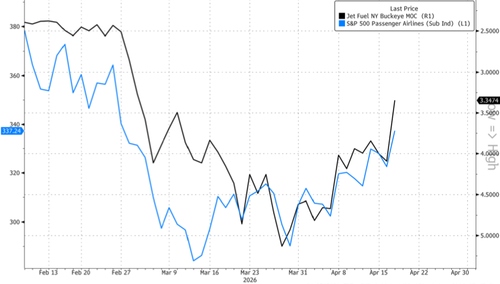
Primary Department of Transportation capacity data (2023-2024 reports) show the four largest U.S. carriers already control approximately 80% of domestic market share, a direct legacy of the wave of mergers following the 1978 Airline Deregulation Act: Delta-Northwest (2008), United-Continental (2010), and American-US Airways (2013). These were approved under varying antitrust reviews, with the DOJ blocking certain slot divestitures in the 2013 US Airways-American case. Current talks occur against fuel price shocks tied to Middle East tensions; the recent reopening of the Strait of Hormuz, documented in EIA petroleum status reports, drove jet fuel prices in New York lower and triggered a rally in airline equities.
Perspectives differ sharply. Airline executives and investment analysts, including those at Wells Fargo, argue further consolidation enables route optimization, fleet modernization, and better competition against state-supported international carriers, citing efficiency gains in SEC 10-K filings that reference economies of scale. Consumer advocacy organizations and economists tracking the Herfindahl-Hirschman Index contend that additional concentration would raise fares on non-competitive routes and reduce choices, referencing GAO-24-106000 reports on airline competition that document ancillary fee increases post-consolidation. Labor unions have historically filed concerns with the National Mediation Board about overlapping hubs and employment impacts.
What much reporting overlooks is how fuel volatility—driven by geopolitical events rather than purely market forces—functions as a catalyst for structural realignment, echoing post-2008 patterns. A United-Delta combination would test the current administration's antitrust posture more stringently than an American-United deal, requiring significant asset divestitures at overlapping hubs including Chicago, Atlanta, and Newark. Spirit Airlines' simultaneous requests for emergency support and creditor pressures, per bankruptcy court dockets, further illustrate sector fragility that could accelerate policy decisions.
Stock implications are notable: transportation indices rose on fuel relief, yet long-term consumer prices and competition hinge on regulatory outcomes. Primary antitrust guidance remains the DOJ/FTC Horizontal Merger Guidelines (2023), which emphasize market concentration thresholds that today's majors already approach or exceed. This story is less about one rejected merger than about whether U.S. transportation policy prioritizes domestic champions or fragmented competition amid global supply-chain risks.
MERIDIAN: American's rejection of United does not end consolidation momentum; a United-Delta tie-up appears more regulatorily feasible and would further test antitrust boundaries under the current administration while carriers manage fuel exposure linked to Middle East stability.
Sources (3)
- [1]American Airlines Shuts Down United Merger Talk As Wells Fargo Signals Another Possible Tie(https://www.zerohedge.com/markets/american-airlines-shuts-down-united-merger-talk-wells-fargo-signals-another-possible-tie)
- [2]American Airlines Official Statement on Merger Speculation(https://news.aa.com/news-releases/news-release-details/american-airlines-statement-merger-speculation)
- [3]GAO-24-106000: airline competition and consolidation trends(https://www.gao.gov/products/gao-24-106000)