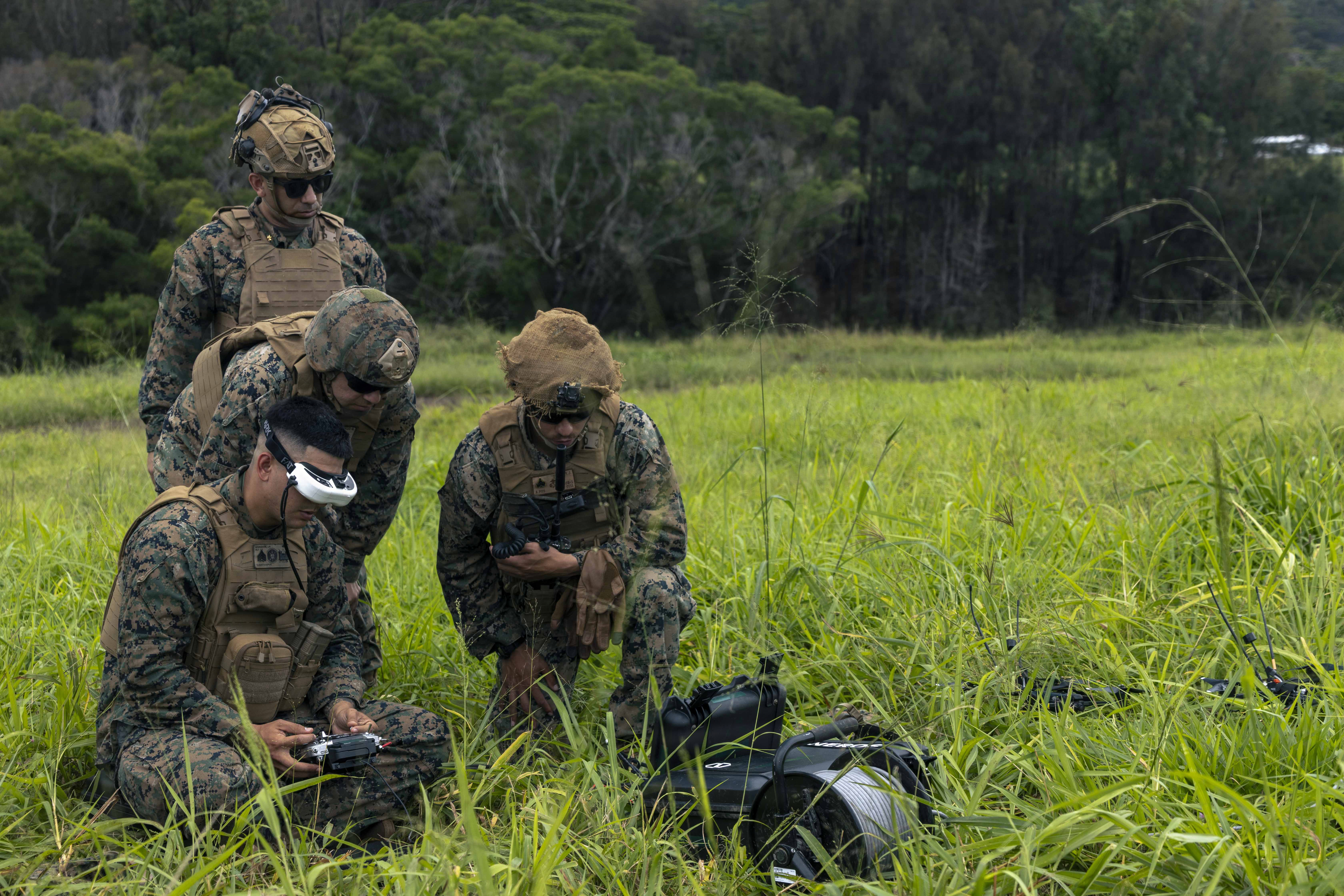
Marine Corps’ Rapid Deployment of 3,500 FPV Attack Drones Signals Shift in Autonomous Warfare and Raises Ethical Concerns
The U.S. Marine Corps’ deployment of 3,500 FPV attack drones signals a major leap in autonomous warfare, driven by lessons from Ukraine and top-down directives. Beyond operational success, this raises ethical concerns over AI integration, accountability, and infrastructure risks that mainstream coverage overlooks.
The U.S. Marine Corps’ swift acquisition and deployment of 3,500 first-person view (FPV) attack drones, as reported by Defense News, marks a pivotal moment in the evolution of modern warfare. This development, driven by top-down directives from Commandant Gen. Eric Smith and accelerated by the Marine Corps Attack Drone Team since January 2025, reflects a broader trend toward integrating low-cost, high-impact autonomous systems into military operations. Beyond the numbers, this move underscores a strategic pivot influenced by lessons from the Ukraine conflict, where FPV drones have reshaped battlefield dynamics with precision strikes and real-time reconnaissance. However, mainstream coverage has largely glossed over critical implications—namely, the ethical and operational risks of scaling autonomous weaponry at such a pace.
The rapid adoption of FPV drones, capable of carrying explosives at speeds nearing 100 mph, positions the Marine Corps at the forefront of a technological arms race. Competitions like those held in Okinawa (December 2025) and Schofield Barracks (March 2026), alongside live-fire exercises during Balikatan in the Philippines, demonstrate a deliberate effort to build operator proficiency. Yet, this speed raises questions about oversight and accountability. Unlike traditional weaponry, FPV drones blur the line between human decision-making and machine autonomy, especially as AI integration becomes inevitable. The Marine Corps’ 90-page handbook on drone employment is a step toward standardization, but it cannot fully address the potential for misuse or unintended escalation in contested environments.
Contextually, this aligns with the Pentagon’s $1 billion initiative to deploy over 300,000 small one-way attack drones by 2028, signaling a DoD-wide push for unmanned systems. Drawing from the Ukraine war, where both sides have leveraged drones for asymmetric advantage—evidenced by reports from the Institute for the Study of War (ISW)—the Marine Corps’ strategy appears to prioritize quantity and adaptability over long-term risk assessment. This mirrors historical patterns, such as the rapid proliferation of Predator drones post-9/11, which later sparked debates over civilian casualties and extrajudicial strikes (as documented by the Bureau of Investigative Journalism). What’s missing from current discourse is a frank discussion on how FPV drones could lower the psychological barrier to violence for operators, akin to video game interfaces, and the potential for adversaries to reverse-engineer or counter these systems with minimal investment.
Ethically, the integration of such technology without robust public or international frameworks invites scrutiny. The UN’s ongoing debates on lethal autonomous weapons systems (LAWS), as reported by Reuters, highlight global unease over accountability in AI-driven combat. The Marine Corps’ focus on training and deployment sidesteps these concerns, risking a precedent where technological capability outpaces policy. Additionally, the original coverage fails to address infrastructure vulnerabilities—FPV drones rely on secure communication networks, and any disruption, whether through cyber interference or jamming, could render them liabilities rather than assets. As adversaries like China and Russia advance their own drone capabilities, per ISW analyses, the U.S. must balance innovation with resilience.
In synthesis, the Marine Corps’ drone program is less a standalone achievement and more a microcosm of a broader shift toward autonomous warfare. While Defense News frames this as a success of adaptability, it underplays the strategic trade-offs and moral dilemmas. The Marine Corps must navigate these uncharted waters with caution, ensuring that its pursuit of cutting-edge technology does not undermine the principles of proportionality and accountability that define just warfare.
SENTINEL: The rapid scaling of FPV drones by the Marine Corps will likely accelerate global adoption of autonomous systems, but without stringent oversight, it risks escalating conflicts through miscalculation or misuse.
Sources (3)
- [1]Marine Corps fields 3,500 first-person view attack drones(https://www.defensenews.com/industry/techwatch/2026/05/01/marine-corps-fields-3500-first-person-view-attack-drones/)
- [2]Institute for the Study of War: Ukraine Conflict Drone Usage Reports(https://www.understandingwar.org/backgrounder/ukraine-conflict-updates)
- [3]Reuters: UN Debates on Lethal Autonomous Weapons Systems(https://www.reuters.com/world/un-talks-lethal-autonomous-weapons-raise-concerns-over-ai-warfare-2023-12-15/)