Xi-Putin Beijing Summit Accelerates Multipolar Bloc Against US Unilateralism in Iran and Energy Markets
The Xi-Putin summit demonstrates deepening Sino-Russian coordination opposing US actions in Iran while leveraging energy deals to build parallel economic systems, accelerating a multipolar order that undermines dollar dominance and Western sanctions effectiveness.
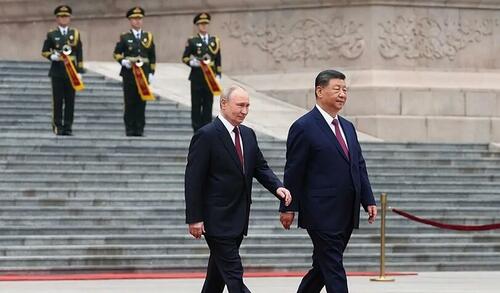
In a carefully timed display of strategic alignment, Chinese President Xi Jinping hosted Russian President Vladimir Putin in Beijing on May 20, 2026, extending the same lavish state honors recently afforded to Donald Trump. The summit occurred against the backdrop of escalating US-Iran tensions, with both leaders issuing coordinated calls for de-escalation that implicitly targeted American military actions. Xi explicitly warned against new strikes on Iran, denounced what he termed the 'law of the jungle' in international affairs, and urged an immediate comprehensive ceasefire alongside the unimpeded flow of oil through the Strait of Hormuz.[1][2]
This was no mere diplomatic formality. Putin assured China of Russia's reliability as an energy supplier amid global oil supply disruptions caused by the Iran conflict, highlighting bilateral ties at an 'unprecedentedly high level' while the two sides inked approximately 40 agreements spanning trade, technology, intellectual property, and an extension of their foundational 25-year treaty of good-neighborliness. Energy cooperation featured prominently, with Moscow positioning itself as a critical lifeline for Beijing as Western sanctions continue to reshape global markets. China already purchases nearly half of Russia's oil exports, creating a parallel economic architecture increasingly insulated from dollar-based finance.[3][4]
Going deeper than surface-level reporting on the pomp and statements, this summit reveals the accelerating consolidation of a multipolar bloc explicitly designed to erode the efficacy of US sanctions and dollar hegemony. By coordinating on the Iran file—where Xi's four-point peace proposal and emphasis on Hormuz stability directly challenge potential US escalation—Beijing and Moscow are not only shielding a key partner in the resistance axis but also protecting their own energy and trade interests. The Strait of Hormuz handles roughly one-fifth of global oil and LNG, including significant Chinese imports; any prolonged disruption would validate their push for alternative payment systems and supply chains free from Western veto power.[5]
Connections others miss include the deliberate sequencing: Putin's visit immediately following Trump's trip to Beijing sends an unmistakable signal of leverage. While Washington seeks bilateral deals, the Russia-China axis doubles down on multilateral institutions like BRICS and the Shanghai Cooperation Organization to rewire global governance. Their joint emphasis on 'root causes' of the Ukrainian crisis without endorsing Western narratives, paired with energy pacts that bypass SWIFT and dollar clearing, points to a longer-term strategy of de-dollarization. Energy leverage here functions as both shield and sword—Russia gains a sanctioned-proof market, China secures discounted commodities outside US financial rails, and together they demonstrate that unilateral 'bullying' produces the very multipolarity it seeks to prevent.
Mainstream coverage from Bloomberg, Al Jazeera, and Anadolu Agency confirms the summit's focus on Iran ceasefire urgency, deepened energy ties, and criticism of unilateral force, lending credence to heterodox analyses that view this not as opportunistic diplomacy but as structural statecraft challenging the post-WWII order. As sanctions regimes lose potency against coordinated autocratic economies, the dollar's exorbitant privilege faces gradual but measurable erosion through these parallel architectures.[6]
The optics of identical red-carpet treatment for Putin and Trump, complete with military honors and public symbolism, further underscore Beijing's balancing act while prioritizing its 'no-limits' partnership with Moscow. This coordination suggests the multipolar project is maturing faster than many Western analysts admit, with energy security and opposition to 'law of the jungle' interventions serving as the ideological and practical glue.
LIMINAL: This coordination hastens the decline of unilateral US financial power by forging sanctioned energy corridors and parallel institutions, likely prompting accelerated BRICS-led de-dollarization within 2-3 years.
Sources (5)
- [1]China's Xi Hosts Putin, Steps Up Call for Iran Ceasefire(https://www.bloomberg.com/news/videos/2026-05-20/daybreak-europe-5-20-2026-video)
- [2]Iran war live: Tehran warns US of 'surprises'; Xi, Putin meet in Beijing(https://www.aljazeera.com/news/liveblog/2026/5/20/iran-war-live-tehran-warns-of-many-more-surprises-if-conflict-resumes?update=4589332)
- [3]Putin, Xi meet in Beijing following Trump visit amid US-Iran war(https://aa.com.tr/en/asia-pacific/putin-xi-meet-in-beijing-following-trump-visit-amid-us-iran-war/3942665)
- [4]Tracking Chinese and Russian Statements on the Iran War(https://www.washingtoninstitute.org/policy-analysis/tracking-chinese-and-russian-statements-iran-war)
- [5]Putin and Xi hold Beijing talks amid Iran war tensions(https://en.yenisafak.com/world/putin-and-xi-hold-beijing-talks-amid-iran-war-tensions-3718459)