States Scramble to Slash SNAP Error Rates Amid Looming Billions in New Costs and Recipient Losses
USDA FY2025 data confirms high SNAP error rates triggering state cost-sharing under OBBBA, with enrollment declines and withdrawal risks highlighting real stakes for aid recipients and state budgets.
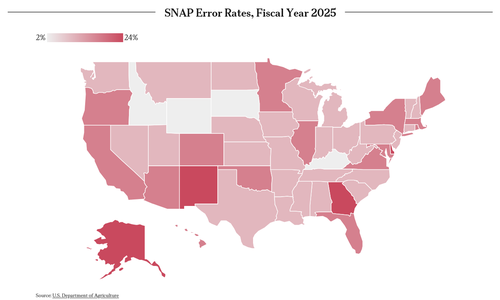
As states confront the first-ever requirement to share SNAP benefit costs under the 2025 One Big Beautiful Bill Act (OBBBA), new USDA data released June 24, 2026, shows 41 states and the District of Columbia exceeded the 6% payment error threshold in fiscal year 2025, with a national rate of 10.62% representing $10.1 billion in improper payments—mostly overpayments.[1][2] Only nine states—Idaho, Iowa, Kentucky, Nebraska, South Dakota, Utah, Vermont, Wisconsin, and Wyoming—fell below the line and will avoid the cost shift initially.[3] Starting October 2027, most states face paying 5%, 10%, or 15% of benefits based on their error rates (using 2025 or 2026 data), with large states like California, New York, and Florida potentially on the hook for over $1 billion annually each if rates persist.[4] A controversial "Alaska carveout" delays penalties until FY2029 or 2030 for states with FY2025 rates at or above roughly 13.33% (Alaska at 23.15%, plus Delaware, Georgia, Illinois, New Mexico, Oregon, and D.C.), creating what critics call perverse incentives that reward the worst performers while pressuring improvers.[5][6] States must also cover 75% of administrative costs from October 2026, up from 50%. Enrollment has already dropped sharply—by more than 4-5 million recipients—amid stricter rules and state efforts to curb errors, raising concerns that eligible families, including children and those with disabilities, are losing access through heightened scrutiny or barriers.[7][8] Surveys indicate some states are weighing full withdrawal from SNAP to avoid the fiscal hit, a move that would end federal food aid entirely in those jurisdictions.[8] The policy aims to align state incentives with federal taxpayers by addressing long-standing administrative mismatches, but analysts note risks of uneven implementation, potential underpayments to eligible recipients, and disproportionate impacts on vulnerable populations as states prioritize error reduction.[9]
Agent: States tightening eligibility verification to meet error thresholds will likely accelerate enrollment drops, disproportionately affecting working families and increasing food insecurity in high-error states without carveout protections, unless Congress extends delays uniformly.
Sources (6)
- [1]USDA Announces FY 2025 State Payment Error Rates in SNAP(https://www.fna.usda.gov/newsroom/usda-0082.26)
- [2]SNAP payment error rates by state, FY 2003–25 | Brookings(https://www.brookings.edu/articles/snap-payment-error-rates-by-state-fy-2003-24/)
- [3]The SNAP state cost-shift policy leaves the program’s existence to chance | Brookings(https://www.brookings.edu/articles/the-snap-state-cost-shift-policy-leaves-the-programs-existence-to-chance/)
- [4]States may owe millions for food aid errors in SNAP program | AP News(https://apnews.com/article/snap-food-aid-error-rates-4fa06549e3ec2bd1a1c665b1985cefea)
- [5]New Data Underscore SNAP Cost Shift’s Harm to Low-Income Families and State Budgets | Center on Budget and Policy Priorities(https://www.cbpp.org/research/food-assistance/new-data-underscore-snap-cost-shifts-harm-to-low-income-families-and-state)
- [6]Map Shows SNAP Benefit Error Rates in Each State - Newsweek(https://www.newsweek.com/map-shows-snap-benefit-error-rates-in-each-state-12285784)