AI Reshapes Tech Workforce: Surging White-Collar Layoffs and Rising Jobless Claims Point to Underreported Labor Market Strain
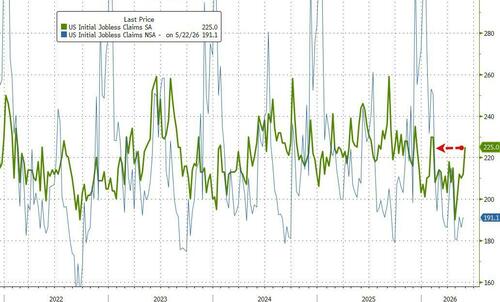
May 2026 data shows tech announcing 38k+ job cuts—the most in two years—driven by record AI-related reductions (38k+ in May, 22% YTD), aligning with a jump in initial jobless claims to 225k. This signals structural white-collar labor weakness often minimized in aggregate economic reporting.
While headline economic numbers often paint a picture of resilience, fresh data reveals a sharper story unfolding in the technology sector. Initial unemployment claims jumped to 225,000 for the week ending May 30, 2026—the highest in three months—according to the U.S. Department of Labor. This uptick, concentrated in states like California, coincides with Challenger, Gray & Christmas reporting that U.S. tech firms announced 38,242 job cuts in May, the highest monthly total in nearly two years.
For the third consecutive month, artificial intelligence topped the list of cited reasons for layoffs, driving 38,579 positions eliminated in May alone—40% of all announced cuts that month and a record high since tracking began in 2023. Year-to-date, AI has been linked to 87,714 cuts, representing 22% of all 2026 layoffs and already exceeding the full-year 2025 total. Technology now leads all industries in cut announcements, with 123,653 positions eliminated so far this year, up 66% from the same period in 2025.
These figures, corroborated by reports from The Wall Street Journal and Yahoo Finance, highlight a targeted restructuring: major firms including Meta, Intuit, and Cisco are reallocating resources toward AI capabilities, often at the expense of white-collar roles in engineering, administration, and middle management. Unlike blue-collar or cyclical layoffs of past cycles, these reductions disproportionately affect skilled professionals whose transitions may not immediately register in aggregate unemployment insurance claims, which have remained below the 1.8 million continuing claims threshold.
Mainstream coverage frequently emphasizes that overall private-sector cuts are down 7% year-over-year and that hiring announcements slightly outpace 2025 levels. However, this 'low-hire, low-fire' environment masks a deeper transformation. As Andy Challenger, chief revenue officer at Challenger, Gray & Christmas, noted, 'The labor market is being reshaped by technology in real time. AI is now the leading reason companies give for cutting jobs.' This dynamic risks creating pockets of structural white-collar unemployment that broader statistics downplay, especially as AI adoption accelerates across finance, legal, and media sectors.
Connections to wider economic signals emerge when viewed through the lens of recent high-profile mergers, acquisitions, and bankruptcy-related cuts also rising in Challenger's data. With pre-pandemic hiring plans still historically low, the tech sector's AI pivot may foreshadow slower reabsorption of displaced workers, challenging optimistic 'soft landing' narratives. Official DOL data and independent trackers like Trading Economics confirm the claims uptick occurred even as layoff announcements from non-tech sectors remained relatively contained, underscoring the uneven impact.
This acceleration in AI-driven reductions—now the dominant driver—suggests companies are prioritizing capital reallocation toward automation over workforce expansion, a trend with potential ripple effects on consumer spending, regional economies in tech hubs, and long-term skills mismatch that conventional jobless claims metrics are ill-equipped to fully capture.
LIMINAL: Accelerating AI-driven white-collar tech cuts are quietly eroding skilled labor demand faster than official stats reflect, potentially triggering a harder landing for professional services and exposing overreliance on automation narratives.
Sources (6)
- [1]May Job Cuts Rise 16% from April; Highest May Total Since 2020(https://www.challengergray.com/blog/challenger-report-may-job-cuts-rise-16-from-april-highest-may-total-since-2020/)
- [2]Technology Sector Leads U.S. Layoff Plans(https://www.wsj.com/economy/jobs/technology-sector-leads-u-s-layoff-plans-ae1d722d)
- [3]Layoff announcements tick higher in May, with AI as the leading cause(https://finance.yahoo.com/economy/article/layoff-announcements-tick-higher-in-may-with-ai-as-the-leading-cause-093000409.html)
- [4]News Release - US Department of Labor Unemployment Insurance Data(https://www.dol.gov/ui/data.pdf)
- [5]United States Challenger Job Cuts(https://tradingeconomics.com/united-states/challenger-job-cuts)
- [6]US weekly jobless claims increase marginally amid low layoffs(https://www.reuters.com/business/us-weekly-jobless-claims-increase-marginally-amid-low-layoffs-2026-05-28/)