Nike's Exit from S&P 100 Signals Broader Market Shift Amid Prolonged Stock Decline
Nike's removal from the S&P 100 after an ~80% stock drop from its 2021 peak marks a market-cap driven rebalance favoring tech firms, amid business challenges like flat revenue and competition, with limited direct ties to cultural factors in credible reporting.
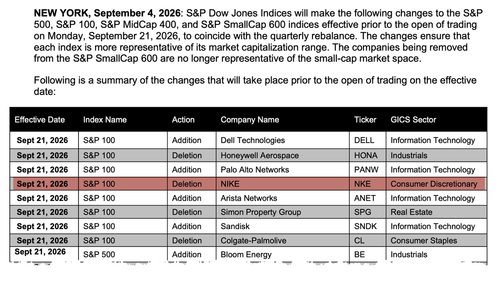
S&P Dow Jones Indices announced on September 4, 2026, that Nike (NKE) will be removed from the S&P 100 effective September 21, 2026, as part of its quarterly rebalance, ending the company's nearly 18-year tenure in the elite blue-chip index. The move keeps Nike in the broader S&P 500 but reflects its diminished market capitalization, now around $57 billion after closing at $38.40 on September 5—levels not seen in over a decade.[1][2]
The stock has fallen approximately 75-80% from its late 2021 peak above $170, erasing roughly $220-230 billion in market value. This decline stems from stagnant revenue growth (fiscal 2026 revenue essentially flat at $46.4 billion), margin pressures, challenges in Greater China, and intensifying competition from brands like On and Hoka. New CEO Elliott Hill is overseeing a turnaround focused on product innovation and marketplace strategy, though results remain pending.[3][4]
Nike joins other exits from the S&P 100, including Honeywell Aerospace, Simon Property Group, and Colgate-Palmolive. Replacements—Dell Technologies, Palo Alto Networks, Arista Networks, and SanDisk—highlight a pronounced tilt toward technology, cloud infrastructure, cybersecurity, and data hardware in the index. This rebalance underscores how AI-driven spending and tech sector momentum are reshaping benchmarks traditionally dominated by consumer giants.[5]
While social media commentary has linked Nike's struggles to cultural marketing decisions, official analyses and reporting emphasize operational and competitive factors over political ones. The index change itself carries limited mechanical impact due to Nike's continued S&P 500 inclusion, but it amplifies perceptions of the brand as a value or turnaround story rather than a growth leader. This episode illustrates how prolonged underperformance can trigger institutional re-evaluations, influencing valuations and investor strategies across consumer discretionary sectors amid rapid tech advancement.
Market analysts: Sustained tech dominance in benchmarks like the S&P 100 will continue pressuring traditional consumer brands' relative valuations, accelerating portfolio shifts toward AI and infrastructure plays unless turnaround efforts yield rapid revenue growth.
Sources (5)
- [1]Nike Exits the S&P 100 Index. 4 Tech Stocks Move In(https://beincrypto.com/nike-sp-100-exit-tech-replacements/)
- [2]Nike Stock Fell 78% And S&P 100 Exit May Mark Capitulation(https://www.forbes.com/sites/jimosman/2026/09/06/nike-stock-fell-78-and-sp-100-exit-may-mark-capitulation/)
- [3]Nike removed from S&P 100 after 75% stock drop wipes $230 billion in market value(https://cryptobriefing.com/nike-removed-sp100-stock-crash/)
- [4]Bloom Energy, Illumina, and Everpure Set to Join S&P 500; Others to Join S&P 100...(https://markets.ft.com/data/announce/detail?dockey=600-202609041915PR_NEWS_USPRX____PH41499-1)
- [5]Nike Exits S&P 100: The Story Behind the Sportswear Giant's $220B Fall(https://www.ibtimes.co.uk/nike-market-value-plunge-sp100-exit-2026-1818105)