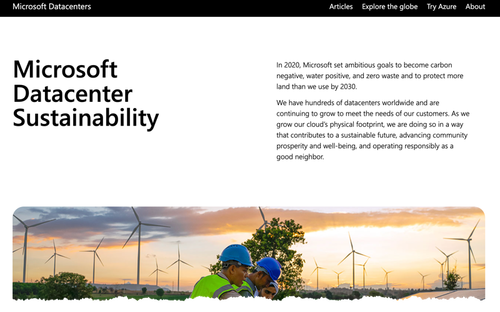
Microsoft's Green Pledge at Risk: AI Energy Demands Clash with Climate Goals
Microsoft may abandon its 2030 clean-energy target for data centers amid a $190 billion AI infrastructure push, highlighting a clash between technological innovation and climate goals. This reflects broader industry trends, geopolitical rivalries with China, and investor tensions over ESG priorities, revealing systemic gaps in addressing AI’s energy demands.
Microsoft's potential retreat from its ambitious 2030 '100/100/0' clean-energy target for data centers, which aimed to match 100% of its electricity use with renewable energy 100% of the time, signals a broader tension between the escalating energy demands of artificial intelligence (AI) development and corporate climate commitments. Originally reported by Bloomberg and amplified by ZeroHedge, the tech giant's projected $190 billion in AI data center spending this fiscal year underscores the scale of the hyperscaler capital expenditure (capex) cycle. This race to build compute infrastructure, with industry-wide capex nearing $700 billion in 2023, has forced Microsoft and peers like Meta, Google, and Amazon to confront a stark reality: AI's energy appetite may outpace the availability and affordability of renewable energy sources. Microsoft's emissions have already surged 23% since the pre-AI era, a trend mirrored across Big Tech, as data centers—adding roughly 1 gigawatt of capacity every three months—strain existing power grids.
Beyond the original coverage, which framed this as a cost-driven decision, deeper geopolitical and systemic factors are at play. The ZeroHedge piece misses the strategic imperative behind Microsoft's pivot: the unspoken rivalry with China, where data centers rely heavily on coal-powered grids, offering a cost and speed advantage in AI deployment. This 'existential fight for survival,' as termed by Alexia Kelly of the High Tide Foundation, isn't just about market share—it's about technological dominance in a field where national security and economic power are increasingly intertwined. Furthermore, the original reporting overlooks the policy vacuum surrounding AI energy demands. While Microsoft negotiates with Chevron for natural gas plants in Texas's Permian Basin, there’s little discussion of how governments could incentivize or mandate renewable integration to balance innovation with sustainability.
Historical patterns reveal a recurring conflict: tech booms often prioritize speed over environmental impact until regulatory or public pressure forces course correction. The dot-com era saw similar infrastructure rushes with little regard for energy footprints until later scrutiny. Today, the AI boom amplifies this dynamic, as data centers consume power equivalent to small cities. A 2023 report from the International Energy Agency (IEA) projects that data center electricity demand could double by 2026, potentially accounting for 6% of global energy use if unchecked. Meanwhile, renewable energy deployment, while growing, struggles with intermittency and grid integration—issues Microsoft’s pre-AI climate goals did not fully account for.
What’s missing from the discourse is the investor angle. As Microsoft and others recalibrate green pledges, shareholder priorities could shift. Climate-focused funds, which hold significant stakes in Big Tech, may pressure for transparency on emissions trade-offs, while growth-focused investors might applaud capex redirected to AI leadership. This tension could redefine ESG (Environmental, Social, Governance) metrics in the tech sector, especially as regulators in the EU and US begin eyeing AI’s carbon footprint. The European Commission’s 2022 Digital Strategy, for instance, hints at future energy efficiency mandates for data centers, a policy Microsoft’s current trajectory may clash with.
Synthesizing sources, it’s clear the AI-climate conflict is not just Microsoft’s dilemma but an industry-wide reckoning. The IEA’s projections, paired with Microsoft’s reported talks with Chevron, suggest a short-term reliance on fossil fuels that could lock in emissions for decades. Yet, the broader context of US-China tech rivalry, often underreported, adds a layer of urgency that justifies such compromises in the eyes of some stakeholders. Ultimately, Microsoft’s potential abandonment of its green pledge is less a failure of intent and more a symptom of systemic unpreparedness for AI’s energy demands—a gap neither corporate goodwill nor current policy frameworks are equipped to bridge.
MERIDIAN: Microsoft's potential pivot from green pledges could signal a broader industry trend where AI-driven energy needs trump climate goals, unless regulatory frameworks evolve to enforce sustainable innovation.
Sources (3)
- [1]Existential Fight For Survival: MSFT May Nuke Green Data Center Climate Pledge(https://www.zerohedge.com/ai/existential-fight-survival-msft-may-nuke-green-data-center-climate-pledge)
- [2]IEA Electricity 2024 Report(https://www.iea.org/reports/electricity-2024)
- [3]European Commission Digital Strategy(https://ec.europa.eu/info/strategy/priorities-2019-2024/europe-fit-digital-age_en)