Altman's Equity Giveaway: Backdoor Government Backstop and the Next Phase of Tech-State Fusion
OpenAI's equity donation plan for a Public Wealth Fund, discussed with the Trump White House and enjoying cross-aisle support, is synthesized as a veiled backstop mechanism that socializes AI risks while advancing deeper public-private fusion between tech giants and the federal government.
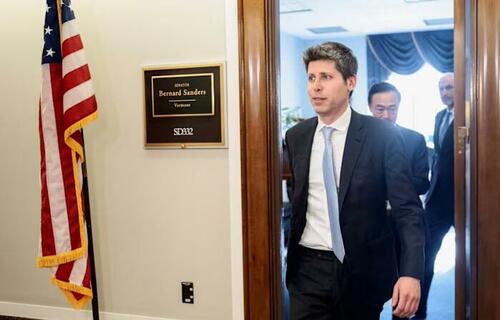
Sam Altman’s recent engagements with the Trump administration reveal a calculated pivot: proposing that OpenAI and peer AI firms donate equity stakes to seed a sovereign-wealth-style "Public Wealth Fund" that would distribute returns to American citizens. According to CNBC reporting, these discussions have been underway for over a year, with Altman first pitching the concept to the administration in 2025; the idea was formalized in OpenAI’s April 2026 policy paper "Industrial Policy for the Intelligence Age." President Trump publicly endorsed elements of the plan on Air Force One, stating that "pieces [of AI companies] could be given to the American public" so citizens become partners in the technology’s future. Forbes notes the proposal has drawn unlikely bipartisan support, including from Bernie Sanders, who has discussed sovereign wealth fund models with Altman, and MAGA figures like Steve Bannon, all framing it as a response to AI-driven job displacement—nearly 50,000 AI-related layoffs tracked in early 2026 alone.
This equity-sharing mechanism, distinct from direct government ownership as seen in the Trump administration’s prior stakes in Intel and IBM, is presented as populist wealth democratization or "universal basic capital." Yet viewed through the lens of OpenAI’s well-documented financial pressures, it functions as a sophisticated insertion of public liability. Months earlier, OpenAI CFO Sarah Friar explicitly called for federal "backstop" and "guarantee" mechanisms to lower the cost of financing the company’s massive data center and infrastructure commitments, comments that triggered market selloffs before being walked back, as detailed in contemporaneous New York Times and CNN coverage. The Financial Times has similarly reported on OpenAI’s sovereign-wealth-style fund proposal as a way to ease public anxiety over AI’s rapid rollout.
Deeper connections emerge when examining the broader tech-state fusion. By giving citizens individual equity exposure in loss-making, capital-intensive AI ventures valued on pre-IPO paper near $1 trillion, the scheme creates a political constituency invested in OpenAI’s success—implicitly pressuring future administrations to provide loan guarantees, subsidies, regulatory forbearance, or direct bailouts should the capex bets fail to generate promised returns. This aligns with Trump’s February 2026 executive order establishing a national sovereign wealth fund and his administration’s AI national security directives. What others frame as sharing prosperity masks a risk-transfer play: privatized upside for insiders, socialized downside for taxpayers. It represents an evolution of public-private capture where frontier AI labs help draft industrial policy while the state underwrites the energy, compute, and financial infrastructure required for an AI arms race. The result is not mere partnership but a quiet merger—Silicon Valley sets the trajectory, Washington supplies the backstop—accelerating America’s commitment to intelligence-age dominance at the expense of clear lines between corporate ambition and public obligation.
Liminal: This equity scheme creates political lock-in for future government support of AI bets, quietly shifting massive private risks onto the public balance sheet and cementing a fused tech-state regime where innovation leaders draft policy and taxpayers fund the safety net.
Sources (4)
- [1]Trump administration, OpenAI discussing possible government stake in the company(https://www.cnbc.com/2026/06/05/trump-open-ai-altman-stake.html)
- [2]Could Americans Build Wealth Through AI? Why Trump May Be Considering Equity-Sharing Scheme(https://www.forbes.com/sites/alisondurkee/2026/06/06/could-americans-build-wealth-through-ai-why-trump-may-be-considering-equity-sharing-scheme/)
- [3]OpenAI Races to Quell Concerns Over Its Finances(https://www.nytimes.com/2025/11/06/technology/openai-finances-debt-data-centers.html)
- [4]What we know about the plan to give Americans an equity stake in AI(https://www.ft.com/content/8559a3f9-86de-4a1c-8a75-6623e83e6a00)