The Looming Closure of 40,000 US Retail Stores by 2030: A Symptom of Broader Economic Shifts
UBS projects 40,000 US retail store closures by 2030 due to e-commerce growth, but the implications extend beyond retail to labor, real estate, and policy gaps. This analysis explores overlooked impacts on inequality, urban planning, and global supply chains, tying the trend to broader economic shifts post-pandemic.
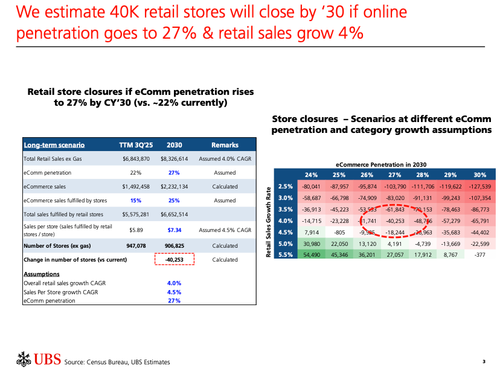
The projection by UBS consumer analyst Michael Lasser that 40,000 US retail stores could close by 2030, driven by e-commerce penetration rising from 22% to 27%, is more than a statistic—it signals a profound transformation in the American economic landscape. While the original ZeroHedge report highlights the raw numbers and affected sectors like clothing and consumer electronics, it underplays the cascading effects on interconnected systems such as labor markets, urban planning, and social equity, as well as the historical patterns of retail disruption. This analysis delves deeper into these dynamics, connecting the retail decline to post-pandemic recovery trends and broader geopolitical and policy contexts.
First, the labor market implications are stark. Retail employs over 15 million Americans, according to the US Bureau of Labor Statistics (BLS), and the loss of 40,000 stores could translate to hundreds of thousands of job losses, disproportionately affecting low-wage workers in rural and suburban areas where alternative employment options are limited. The ZeroHedge piece mentions labor impacts but does not contextualize this against the already uneven recovery from the COVID-19 pandemic, where service-sector workers have struggled to regain footing. This trend also mirrors historical disruptions, such as the decline of manufacturing jobs in the late 20th century, which similarly reshaped communities and fueled regional inequality.
Second, the commercial real estate sector faces an existential challenge not fully explored in the original coverage. The National Association of Realtors (NAR) reports that retail properties already suffer from vacancy rates nearing 10% in many markets as of 2023. A wave of closures could exacerbate this, driving down property values and tax revenues for local governments, which rely on commercial zones to fund public services. This creates a feedback loop: declining municipal budgets may lead to reduced infrastructure investment, further deterring physical retail recovery. The original report misses how this ties into broader urban-suburban divides, as city centers with mixed-use developments may adapt by repurposing retail spaces into residential or office hubs, while sprawling suburban malls risk becoming ghost structures.
Third, the consumer spending shift to e-commerce reflects not just technological change but also a policy gap. While the ZeroHedge article nods to demographic pressures like Elon Musk’s 'population winter,' it overlooks how government policies—or the lack thereof—have failed to address the digital divide that accelerates retail’s decline. Rural and low-income communities, often with limited broadband access, are less equipped to pivot to online shopping, as noted in a 2022 Federal Communications Commission (FCC) report on internet access disparities. This creates a bifurcated economy where e-commerce giants thrive while local retailers, unable to compete on price or logistics, collapse. The original coverage also misses the geopolitical angle: US reliance on global supply chains for e-commerce goods heightens exposure to disruptions like trade tensions or shipping crises, as seen in the 2021 Suez Canal blockage.
Synthesizing multiple sources, the UBS projection aligns with a 2023 McKinsey report on retail trends, which predicts that hybrid shopping models—combining in-store and online experiences—will dominate by 2030, yet only large retailers with capital to invest in technology will survive. Meanwhile, a BLS analysis from 2022 underscores the vulnerability of retail jobs to automation, suggesting that e-commerce growth will further erode employment even in warehouses, as robotics replace human workers. These sources highlight a critical oversight in the ZeroHedge report: the closures are not merely a market-driven inevitability but a policy challenge requiring intervention, whether through workforce retraining, tax incentives for small retailers, or antitrust scrutiny of e-commerce monopolies.
Ultimately, the projected closure of 40,000 stores is a microcosm of larger economic transformations—globalization, digitalization, and demographic shifts—that demand a reevaluation of how societies balance technological progress with social stability. The story is not just about retail’s decline but about what kind of economy and community structures will replace it, a question the original coverage leaves unanswered.
MERIDIAN: The retail closure wave will likely accelerate regional inequality, as rural areas lose jobs and tax bases faster than urban centers can adapt. Policy inaction on digital access and workforce retraining could deepen this divide by 2030.
Sources (3)
- [1]UBS Retail Projection via ZeroHedge(https://www.zerohedge.com/markets/40000-us-retail-stores-could-close-2030)
- [2]McKinsey & Company: The Future of Retail 2023(https://www.mckinsey.com/industries/retail/our-insights/the-future-of-retail)
- [3]US Bureau of Labor Statistics: Retail Employment Trends 2022(https://www.bls.gov/oes/current/oes_nat.htm)