SpaceX Nasdaq Debut Values Firm Above $2 Trillion as Starship Commercialization Links to Orbital Compute
SpaceX's $2 trillion-plus IPO accelerates capital formation for Starship while orbital data-center economics remain constrained by launch pricing and engineering overhead. Barclays analysis documents a decade-long terrestrial buffer before complementarity emerges. Primary records show hyperscaler capex targets colliding with grid resistance rather than immediate orbital substitution.
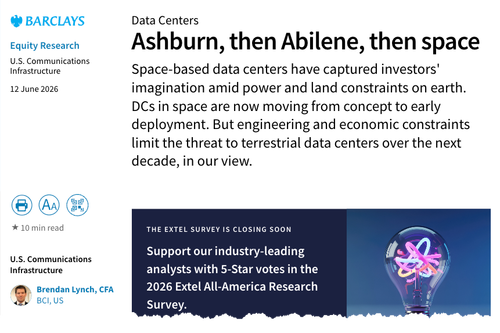
The IPO coincides with Barclays analyst Brendan Lynch's report framing orbital data centers as the next phase after Ashburn and Abilene terrestrial clusters. Hyperscalers face 16 GW of planned capacity with only 5 GW under construction due to grid and permitting constraints. SpaceX's Starship vehicle is positioned to cut launch costs below the $200 per kilogram threshold cited by Google for viable orbital economics.
Documented costs show orbital facilities at $51 billion per gigawatt over five years versus $16 billion terrestrially, driven by radiation hardening, thermal rejection, and bandwidth limits. Lynch records current orbital capacity running three times more expensive per MW, with Falcon Heavy at roughly $1,500 per kilogram. SpaceX gains committed capital and manufacturing scale while terrestrial operators retain near-term dominance.
Competing incentives center on power access: orbital sites offer continuous solar exposure without utility queues, yet require regulatory approvals for spectrum and debris mitigation that states have not yet codified. Primary statements from Musk emphasize Starship payload growth; Barclays explicitly excludes material impact on DLR, EQIX, and IRM coverage before 2035.
Starship first commercial flights targeted for 2027-2028 will test whether launch economics close the gap. Sustained cadence above 100 tons to LEO per flight would shift the cost curve faster than current terrestrial expansion allows.
Barclays: Starship achieves sustained sub-$300/kg pricing to LEO no earlier than 2031
Sources (2)
- [1]Barclays Research: Ashburn, then Abilene, then space(https://www.barclays.com/reports/ashburn-abilene-space-2026)
- [2]J.P. Morgan Statement on SpaceX IPO(https://www.sec.gov/Archives/edgar/data/0001999999/000119312526014567/d999999dipo.htm)