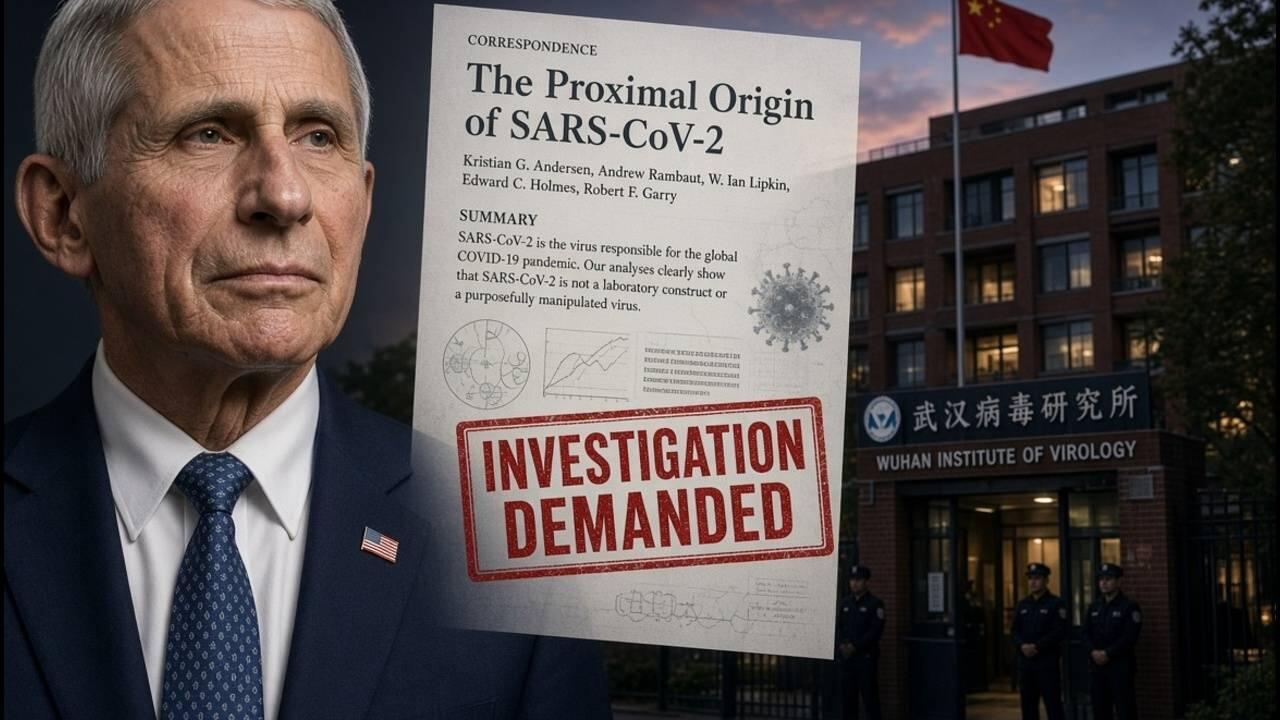
NIH director asks Nature Medicine to investigate whether Fauci, Collins and Farrar shaped the 2020 Proximal Origin paper without credit
NIH Director Jay Bhattacharya has asked Nature Medicine to investigate whether Fauci, Collins and Farrar made uncredited contributions to the 2020 Proximal Origin paper and whether a correction or retraction is warranted. An October 2026 HHS advisory opinion already describes their involvement from released emails; authors deny ghostwriting, and the journal has not yet ruled.
Documented: On or about 18 November 2026, NIH Director Jay Bhattacharya wrote to the editors of Nature Medicine asking for a formal, independent review of authorship and acknowledgements on the March 2020 correspondence “The Proximal Origin of SARS-CoV-2.” Multiple outlets, including Politico, Science, the New York Post and The Telegraph, reported the letter. It asks whether Anthony Fauci, Francis Collins and Jeremy Farrar contributed substantively to the conception, drafting, revision or publication of the manuscript without being named, and it asks the journal to consider correction or retraction if the record is incomplete. Bhattacharya requested a review plan and timetable within 30 days. Science reported that he offered no new primary evidence in the letter and that NIH has no authority over the privately published journal.
Documented context, not a new finding: The paper, credited to Kristian Andersen, Andrew Rambaut, W. Ian Lipkin, Edward Holmes and Robert Garry, concluded that the authors did not believe a laboratory-based scenario was plausible. An HHS Office of General Counsel advisory opinion dated 1 October 2026 (Advisory Opinion 26-02) states that subsequently released correspondence shows Farrar convened the 1 February 2020 origins call that included Fauci, Collins and several eventual authors; that Fauci and Collins received and discussed early drafts; and that Farrar helped coordinate drafting and made at least one direct edit. None of the three was listed as an author or acknowledged contributor. The same opinion notes that on 17 April 2020 Fauci pointed from a White House briefing to a study by evolutionary virologists consistent with a natural jump, without disclosing his prior involvement. The opinion treats the episode as an illustration of why material contributions should be disclosed; it does not redefine the episode as research misconduct under 42 C.F.R. Part 93, which excludes ordinary authorship disputes from the federal definition of plagiarism.
Claimed, and contested: Bhattacharya’s letter, as described by the New York Post and others, frames the issue as alleged ghostwriting and unacknowledged substantive contributions, citing congressional records including a 6 March 2020 email thanking Fauci, Collins and Farrar for “advice and leadership.” Co-author Ian Lipkin told Science the paper “definitely was not ghostwritten,” and that reviewing drafts and offering comments does not confer authorship. Andersen has previously told congressional investigators that the officials did not direct the scientific conclusions. Whether participation in the February call, receipt of drafts, and Farrar’s edit meet journal or ICMJE thresholds for authorship or acknowledgement is the question the letter puts to Nature Medicine; it is not settled by the letter itself.
Documented tension in the private record, as summarized by HHS and by reporting that tracks the same emails: before publication, participants discussed a laboratory accident as a live possibility. The New York Post, citing the NIH account of the correspondence, reported that Farrar described his view as split 50-50 and that Holmes was described as leaning toward a lab origin. The published paper used stronger public language against a laboratory scenario. That gap between private uncertainty and public certainty is documented in the released correspondence. What it proves about motive—scientific judgment converging on a natural origin, versus narrative management—is not established by the existence of the emails alone.
Speculated, and not demonstrated by the November 2026 letter: that the three officials secretly wrote the paper, that they coordinated a cover-up at the highest levels of the health bureaucracy, or that mainstream outlets ignored a settled finding of misconduct. What is on the record is narrower and still consequential: senior funders and conveners were in the drafting conversation, were not credited, and one of them later cited the paper in public as if it were an independent study.
The paper was used by officials and newsrooms to treat a laboratory origin as implausible while the people who funded and convened the authors were not named. Whether that omission violated authorship rules is now a formal question from the agency that succeeded them, and the answer affects how readers should weigh both the paper and the public statements that leaned on it.
Sources (5)
- [1]NIH director calls for new probe of controversial COVID-19 origin paper(https://www.science.org/content/article/nih-director-calls-new-probe-controversial-covid-19-origin-paper)
- [2]NIH asks if Fauci secretly wrote paper that dismissed Covid lab leak theory(https://www.politico.com/news/2026/11/18/proximal-origin-covid-fauci-collins-bhattacharya-nature-01171756)
- [3]HHS Advisory Opinion 26-02 on authorship and third-party contributions(https://www.hhs.gov/guidance/sites/default/files/hhs-guidance-documents/advisory-opinion-26-02.pdf)
- [4]NIH demands Nature Medicine investigate landmark paper that dismissed COVID lab leak theory(https://nypost.com/2026/11/18/us-news/nih-demands-nature-medicine-investigate-landmark-paper-that-dismissed-covid-lab-leak-theory/)
- [5]The plot to discredit the Covid lab leak theory was a crime against science(https://www.telegraph.co.uk/news/2026/11/18/plot-discredit-covid-lab-leak-theory-was-a-crime/)