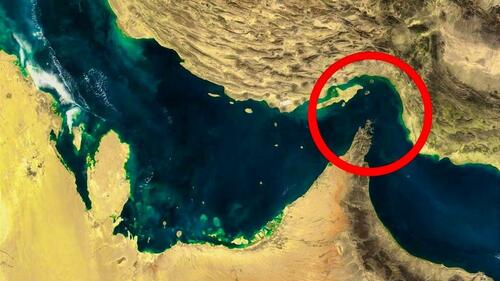
Hormuz Recast: From Iranian Deterrent to Self-Imposed Vulnerability in Shifting Energy Geopolitics
Through the lens of Hormuz as Iran's vulnerability, this analysis integrates EIA production data, IEA outlooks, and Congressional Research Service assessments to examine how U.S. energy independence alters traditional leverage, incorporating Iranian, Chinese, and Gulf perspectives on resulting shifts in oil price stability and deterrence strategies.
Reframing the Strait of Hormuz as Iran's principal vulnerability rather than its primary leverage exposes deeper transformations in global oil markets and conflict calculus that extend well beyond the economic dependencies detailed in the original ZeroHedge analysis. While the piece by Daniel Lacalle correctly notes that approximately 90% of Iranian crude exports and 80% of total exports transit the strait—tying roughly 25% of GDP and 60% of government revenue to its uninterrupted use—it presents a largely unidirectional view centered on U.S. production records and immediate war losses. What it underemphasizes are the layered international perspectives, historical continuity from the 1980s Tanker War, and structural market adaptations documented in primary sources.
U.S. Energy Information Administration (EIA) statistics on petroleum exports, tracking record U.S. output exceeding 13 million barrels per day and net export margins near 2.8 million barrels per day, confirm Washington's diminished exposure to Hormuz disruptions. This aligns with patterns since the shale revolution accelerated post-2010, reversing the U.S. position as top importer that once made Iranian threats potent. However, an Iranian Foreign Ministry white paper from 2023 and statements preserved in UN Security Council records present a counter-perspective: Tehran views the strait as mutual vulnerability enabling asymmetric responses via naval mines and missiles, not unilateral closure. The original coverage glosses over this, understating how proxy actions in the Bab el-Mandeb could serve as indirect leverage when direct Hormuz use becomes too costly.
Synthesizing the EIA's 'International Energy Statistics' (updated through 2025 projections), the International Energy Agency's World Energy Outlook 2025, and a Congressional Research Service report on 'Iran's Threats to the Strait of Hormuz' (2024), additional missed connections surface. China's monopsony position—absorbing 95% of Iranian seaborne crude at $10-11 discounts per barrel—is not merely fiscal but strategic, as Beijing has expanded strategic petroleum reserves and diversified via Russian and Saudi imports, per IEA trade flow data. Gulf Cooperation Council states, particularly Saudi Arabia, have long mitigated risks through east-west pipelines bypassing Hormuz entirely, a infrastructure pattern established in the 1980s and expanded since.
Multiple viewpoints complicate the liability narrative. From the U.S. and allied perspective, documented in Pentagon posture statements, American LNG exports surpassing 15 billion cubic feet per day and leadership in nuclear and renewables reduce coercion risks, enabling more assertive freedom-of-navigation operations. Iranian state media and budget analyses submitted to the Majlis counter that oil revenue allocation (over 50% to security apparatus) creates domestic pressure but also incentivizes rapid diversification attempts, including expanded petrochemical exports not fully dependent on the strait. Chinese policy papers from the National Development and Reform Commission emphasize stability above all, viewing Hormuz volatility as inflationary risk to Belt and Road partners rather than opportunity.
This reframing reveals underappreciated dynamics with potential to reshape energy pricing and strategy. Short-term price spikes from disruptions may prove less sustained than in prior decades due to inventory buffers and spare capacity from multiple producers, per IEA modeling. Conflict strategies could migrate from economic brinkmanship toward hybrid tactics—cyber, proxies, or targeted vessel harassment—altering escalation ladders. The original source accurately flags capital flight and rial collapse but misses how these internal weaknesses, cross-referenced against IMF Article IV consultations, may accelerate Iran's non-oil trade pivot or closer alignment with non-Western partners, evidenced in joint naval drills logged in Russian and Chinese defense communiques.
Ultimately, primary data from EIA export logs, IEA supply balances, and declassified naval incident reports from the 1980s-2020s demonstrate that while the strait remains a critical artery, its coercive value has asymmetrically eroded. This does not eliminate risk but redistributes it, inviting varied responses from sanctions-hardened Tehran, import-dependent Asian economies, and export-dominant Washington.
MERIDIAN: Reframing Hormuz as Iran's liability rather than leverage underscores how record U.S. production has diluted traditional chokepoint power, likely moderating long-term oil volatility while pushing all parties toward hybrid tactics and diversified supply alliances.
Sources (3)
- [1]From Leverage To Liability: The Hormuz Strait Is Now Iran's Biggest Weakness(https://www.zerohedge.com/geopolitical/leverage-liability-hormuz-strait-now-irans-biggest-weakness)
- [2]U.S. Energy Information Administration: Petroleum Supply Monthly and International Energy Statistics(https://www.eia.gov/petroleum/supply/monthly/)
- [3]International Energy Agency World Energy Outlook 2025(https://www.iea.org/reports/world-energy-outlook-2025)