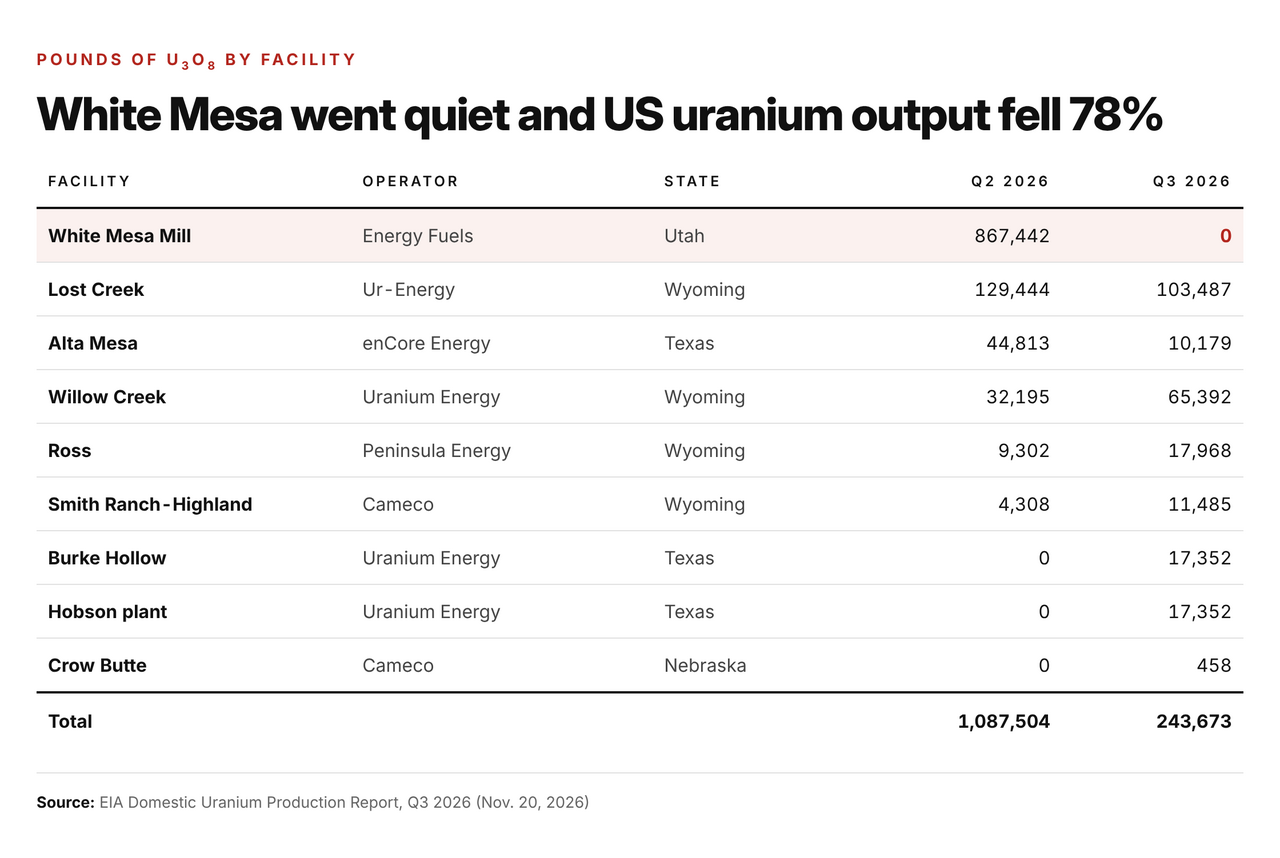
US uranium concentrate output fell 78% in Q3 2026 after the only conventional mill paused, while utilities still sourced just 7% of 2025 deliveries domestically
EIA data show U.S. uranium concentrate output fell 78% from Q2 to Q3 2026 because White Mesa, the only conventional mill, paused. That volatility sits on a small domestic base: U.S.-origin uranium was only 7% of 46.9 million pounds delivered to utilities in 2025, and NNSA has asked industry about roughly 4 million pounds a year of unobligated U.S. material from 2030.
Documented: The U.S. Energy Information Administration’s quarterly Domestic Uranium Production Report, as reported by World Nuclear News and trade summaries of the Nov. 20, 2026 release, counted 243,673 pounds of uranium concentrate (U3O8) in the third quarter of 2026, down 78% from 1,087,504 pounds in the second quarter. EIA attributed the drop primarily to Energy Fuels’ White Mesa mill in Utah—the country’s only operating conventional uranium mill—which produced 867,442 pounds in Q2 and zero in Q3 after the company stopped uranium processing in June to rebuild ore inventory and shifted toward rare earth processing. The eight facilities that did produce in the quarter were all in-situ recovery plants (Wyoming, Texas, and Nebraska). Energy Fuels has said it plans a processing campaign expected to yield about 1 million pounds; World Nuclear News placed the start of a large-scale campaign in the first quarter of 2027, while company updates have also pointed to a Q4 2026 restart. Year-to-date 2026 output through three quarters already exceeded EIA’s full-year 2025 production figure of about 2.1 million pounds. Versus Q3 2025, when White Mesa was also idle, output was down about 26%.
Documented, and the more durable fact: a single campaign schedule can move the national total by three-quarters in one quarter because the domestic base is still small. It is not, on the published numbers, evidence that mines shut or that annual production has collapsed. ISR output outside White Mesa did not account for the quarterly plunge.
Documented on demand and origin: EIA’s Uranium Marketing Annual Report (data for 2025, released July 2026) shows U.S. civilian reactor owners and operators took delivery of 46.9 million pounds U3O8-equivalent in 2025, 16% less than in 2024, at a weighted-average price of $58.46 per pound. U.S.-origin material was 7% of those deliveries, down from 8% in 2024. Canada was 32%, Kazakhstan 28%, and Australia 15%. A quarter of output at the Q3 2026 rate is a few days of that annual delivery volume, not a new structural break.
Documented on a separate, non-substitutable demand: the National Nuclear Security Administration issued a Request for Information (not a contract or award) for unobligated, U.S.-origin uranium concentrate and conversion for defense missions—tritium production and naval propulsion—material that foreign-origin uranium under peaceful-use obligations cannot fill. The long-term figure in the RFI is about 4 million pounds of U3O8 a year, with acquisitions contemplated as early as 2030 to build capacity for later requirements. That ask is roughly double what the whole U.S. industry produced in 2025. Producers, including Uranium Energy, have said they can support it; that is a company claim against licensed capacity, not demonstrated 2026 output.
Documented on the Korean side of the ZeroHedge framing: Korea Hydro & Nuclear Power posted invitation ITT-2602-NF for 6,000 metric tons of U3O8 (about 13.2 million pounds) over 2028–2037, bids due Dec. 28, 2026. Commercial commentary has described softer floor-and-ceiling terms than a prior tender; those pricing mechanics are claimed in market notes, not restated here as EIA fact.
Speculated, and not established by these releases: that the quarterly crater itself is a sudden policy failure, or that it will immediately reprice U.S. electricity or hand foreign suppliers new leverage beyond the import dependence EIA already measures. The unobligated-defense gap and the 7% domestic share of utility deliveries are the documented structural points. The 78% figure is real, narrow, and mostly a scheduled pause at one mill.
U.S. nuclear utilities still get the large majority of their uranium from Canada, Kazakhstan, and Australia, and defense programs need a separate stream of U.S.-origin material that imports cannot replace. A pause at one Utah mill can swing the national production statistic because domestic output remains a small share of what reactors actually buy.
Sources (6)
- [1]White Mesa mill to resume processing as US uranium production falls — World Nuclear News(https://world-nuclear-news.org/articles/white-mesa-mill-to-resume-processing-as-us-uranium-production-falls)
- [2]Uranium Marketing Annual Report, data for 2025 — U.S. Energy Information Administration(https://www.eia.gov/uranium/marketing/)
- [3]US nuclear reactor operators bought less U3O8, held more inventory in 2025 — S&P Global(https://www.spglobal.com/energy/en/news-research/latest-news/electric-power/080526-us-nuclear-reactor-operators-bought-less-u3o8-held-more-inventory-in-2025-eia)
- [4]NNSA Uranium Acquisition RFI — HigherGov document summary(https://www.highergov.com/document/rfi-df-uranium-acquisition-pdf-7cd97/)
- [5]Public tender ITT-2602-NF uranium concentrates — KHNP(https://www.khnp.co.kr/eng/selectBbsNttView.do?key=566&bbsNo=213&nttNo=77754)
- [6]US, EU bodies report on nuclear fuel market situation — World Nuclear News(https://www.world-nuclear-news.org/articles/us-eu-bodies-report-on-nuclear-fuel-market-situation)