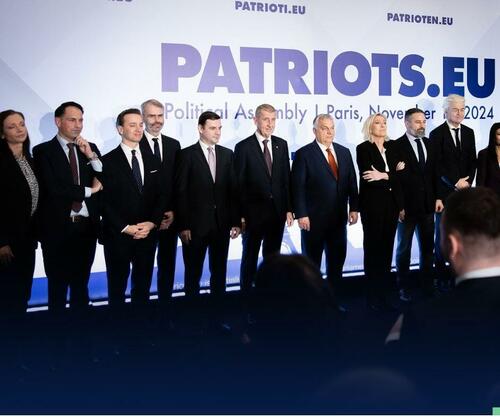
EU's Selective Funding Cuts Target Orbán's Patriots for Europe Amid Broader Pattern of Populist Marginalization
EU Parliament advances funding suspension for Orbán-linked Patriots for Europe over €4.3M misuse claims involving Philip Claeys, as Transparency International pushes OLAF probe; contrasts sharply with expedited EU fund releases to incoming pro-EU Hungarian leader Péter Magyar, revealing selective enforcement against populist factions.
The European Parliament's recent resolution to impose funding cuts on the Patriots for Europe group, founded by Viktor Orbán's Fidesz party, represents more than administrative housekeeping—it exemplifies Brussels' systematic use of financial and investigative levers to sideline nationalist and sovereignty-focused political forces. At the center of the controversy is Philip Claeys, secretary-general of both the now-defunct Identity and Democracy (ID) group and its successor, Patriots for Europe. Allegations center on the mismanagement of approximately €4.3 million in EU funds, including fictitious contracts, improper procurement, and transfers to non-parliamentary entities linked to far-right networks.
Transparency International EU has escalated the matter by filing a complaint with OLAF, the EU's anti-fraud office, urging a complementary administrative investigation into Claeys' role in authorizing the expenditures. The watchdog highlighted the European Parliament's prior inaction as 'astonishing,' especially given an ongoing European Public Prosecutor’s Office (EPPO) probe into the ID group's practices. Le Monde's investigative reporting, in collaboration with other outlets, detailed how the ID group— which included Marine Le Pen’s National Rally—directed funds to associations tied to far-right figures, practices now casting a shadow over the Patriots, the third-largest bloc in the current Parliament.
This development connects to a longer trajectory of EU pressure against populist movements. Le Pen herself faces a ban from running for office following her conviction for misusing European Parliament funds, a case she attributes to political persecution. Similar mechanisms have been deployed against Orbán's governments in Hungary, resulting in the freezing of billions in cohesion and recovery funds—approximately €17 billion total—tied to rule-of-law and anti-corruption benchmarks. Hungary has met many conditions, yet release has been slow.
In stark contrast, the EU is now fast-tracking engagement with Péter Magyar, Hungary's incoming prime minister whose Tisza party defeated Orbán-aligned forces. Magyar's recent meetings with Ursula von der Leyen and other EU leaders signal imminent unlocking of the frozen funds, with deadlines as tight as August 2026 for judicial and transparency reforms. Mainstream coverage frames this as necessary governance and anti-corruption measures, yet the pattern reveals selective enforcement: rigorous scrutiny and defunding for groups challenging migration policies, supranational authority, and green transitions, while pro-EU successors receive accelerated access to resources.
This dynamic risks eroding democratic legitimacy. By weaponizing audits, funding suspensions, and partnerships with organizations like Transparency International—long critical of Hungary—the EU institutions appear to prioritize containment of populist resurgence over neutral application of rules. Orbán's planned political renewal, alongside Le Pen's appeal and the Patriots' 12% seat share, underscores why curbing such movements remains a priority for Brussels elites. The vote and ongoing investigations may achieve short-term silencing, but they fuel narratives of a democratic deficit, potentially boosting anti-establishment sentiment in upcoming national elections across the continent.
The episode highlights connections often missed in coverage: parallel scandals involving far-right funding of nonprofits, the continuity of personnel like Claeys across parliamentary groups, and the geopolitical timing alongside Hungary's leadership transition. Rather than isolated 'irregularities,' these actions form a coherent strategy of marginalization that mainstream outlets frequently sanitize as procedural safeguards.
Liminal: Brussels' pattern of financial isolation against nationalist groups like Patriots while rewarding compliant successors like Magyar will deepen voter distrust, accelerating populist gains in 2027 French and other national elections as citizens perceive EU institutions as arbiters of acceptable politics rather than neutral administrators.
Sources (6)
- [1]EU anti-fraud office weighs probe into top far-right Patriots official(https://www.politico.eu/article/eu-anti-fraud-office-weighs-probe-into-top-far-right-patriots-official-philip-claeys/)
- [2]Watchdog complaint ramps up pressure on Parliament over far-right funds probe(https://www.euractiv.com/news/watchdog-complaint-ramps-up-pressure-on-parliament-over-far-right-funds-probe/)
- [3]Far-right RN and allies face new embezzlement scandal at European Parliament(https://www.lemonde.fr/en/les-decodeurs/article/2025/07/03/far-right-rn-and-allies-face-new-embezzlement-scandal-at-european-parliament_6742983_8.html)
- [4]Hungary's Magyar meets von der Leyen to game-plan unlocking frozen EU funds(https://www.politico.eu/article/hungary-peter-magyar-ursula-von-der-leyen-eu-recovery-funds-brussels-meeting/)
- [5]Patriots for Europe secretary-general under new scrutiny for alleged EU funds misuse(https://euobserver.com/213300/patriots-for-europe-secretary-general-under-new-scrutiny-for-alleged-eu-funds-misuse/)
- [6]Hungary's next PM says frozen EU funds will be paid out soon(https://www.bbc.com/news/articles/c392ln77w30o)