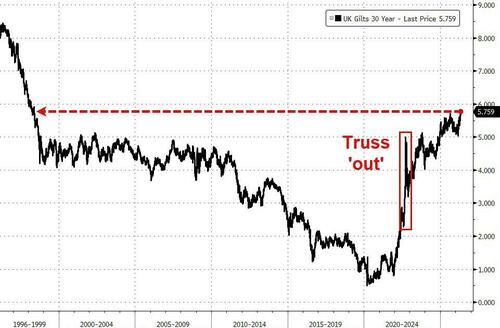
UK Gilt Yields Hit Near 30-Year Highs: A Nexus of Political Instability and Geopolitical Risk
UK gilt yields reaching near 30-year highs reflect a dangerous mix of political uncertainty under Keir Starmer, geopolitical energy shocks, and structural declines in bond demand. Beyond the 'Trussian chaos' narrative, historical parallels to the 1970s and post-Brexit market shifts signal risks of broader global bond market instability.
UK gilt yields have surged to their highest levels since 1998, surpassing even the peaks during the 2022 Liz Truss 'mini-budget' crisis, as reported by ZeroHedge. This escalation, with the 10-year yield jumping 70 basis points since the onset of recent geopolitical tensions in the Middle East, reflects a toxic blend of domestic political fragility and external economic pressures. The original coverage highlights fears over Prime Minister Keir Starmer's tenuous leadership and the potential for a leftward policy shift to counter Green Party momentum, alongside the economic strain from soaring energy prices. However, it misses deeper structural issues and historical parallels that contextualize this moment as a potential tipping point for broader market instability.
First, the domestic political landscape is more fragmented than the source suggests. While Starmer's leadership is under scrutiny, the upcoming May local elections are not merely a litmus test for his tenure but a signal of deeper voter disillusionment with both major parties. Historical data from the UK Electoral Commission shows consistent declines in voter turnout for local elections since the 2008 financial crisis, alongside rising support for smaller, issue-driven parties. This fragmentation could exacerbate policy unpredictability, a factor bond markets historically punish, as seen during the 1976 IMF crisis when UK yields spiked amid political deadlock. The source underplays how this uncertainty compounds fiscal concerns, especially as Goldman Sachs notes limited volatility premium in options markets—a potential underestimation of tail risks if a leadership challenge or fiscal misstep materializes.
Second, the geopolitical lens requires expansion beyond energy price shocks tied to Middle Eastern conflicts. The UK's heavy reliance on imported energy, with over 40% of natural gas coming from foreign sources per the Department for Energy Security and Net Zero, mirrors vulnerabilities exposed during the 1973 OPEC oil embargo. Back then, inflation and yield spikes forced aggressive monetary tightening, a pattern echoed today as markets price in three quarter-point rate hikes by the Bank of England this year. What the original coverage misses is the cascading effect on global bond markets. The UK's outsized yield increase compared to other developed markets, as tracked by Bloomberg, signals it as a 'weak link'—a canary in the coal mine for investor confidence in sovereign debt amid synchronized global tightening. This could trigger contagion, particularly in Eurozone periphery nations with similar fiscal constraints, a dynamic overlooked in the source's Sterling-focused analysis.
Finally, the structural shift in gilt demand is a critical blind spot. The source mentions waning pension fund activity but fails to connect this to broader implications. Bank of England data indicates that defined-benefit pension funds, once a stabilizing force in the gilt market, have reduced holdings by nearly 20% over the past decade as schemes close or shift to de-risking strategies. This withdrawal, combined with post-Brexit declines in foreign investor appetite (down from 30% to 25% of gilt ownership since 2016 per UK Debt Management Office), leaves the market more susceptible to volatility. Unlike the Truss crisis, where rapid intervention by the Bank of England stemmed the collapse, current conditions lack a clear circuit breaker, especially if geopolitical shocks intensify.
In synthesizing these perspectives, the current gilt yield surge is not just a replay of 'Trussian chaos' but a confluence of cyclical and structural risks with echoes of past crises—1973, 1976, and 2022. The interplay of political instability, energy dependence, and declining traditional demand could position the UK as a flashpoint for wider bond market stress, a connection the original coverage does not fully draw. While markets may absorb short-term shocks, as Goldman Sachs predicts limited Sterling depreciation, the longer-term risk is a loss of credibility in UK fiscal management, potentially necessitating external intervention akin to the 1976 IMF bailout if yields continue their ascent unchecked.
MERIDIAN: The trajectory of UK gilt yields suggests a heightened risk of fiscal credibility erosion if political or geopolitical shocks intensify. Without stabilizing demand or policy clarity, a breaking point akin to past crises may loom within the next 6-12 months.
Sources (3)
- [1]UK Gilt Yields Near 30-Year Highs As Political/Geopolitical Fears Spark Trussian Chaos(https://www.zerohedge.com/markets/uk-gilt-yields-near-30-year-highs-politicalgeopolitical-fears-spark-trussian-chaos)
- [2]Bank of England: Statistical Interactive Database - Gilt Market Holdings(https://www.bankofengland.co.uk/statistics/details/further-details-about-gilt-market-data)
- [3]UK Debt Management Office: Gilt Market Ownership Report(https://www.dmo.gov.uk/data/gilt-market/ownership-of-gilts/)