Office CRE Distress Moves from Paper Writedowns to Realized Losses as CMBS Maturities Force Reckoning
Credible reporting confirms the shift to realized CRE losses via CMBS delinquencies and maturities, with stark city-level variances and emerging buyer opportunities; analysis ties this to wider economic policy needs for resilience amid uneven recovery.
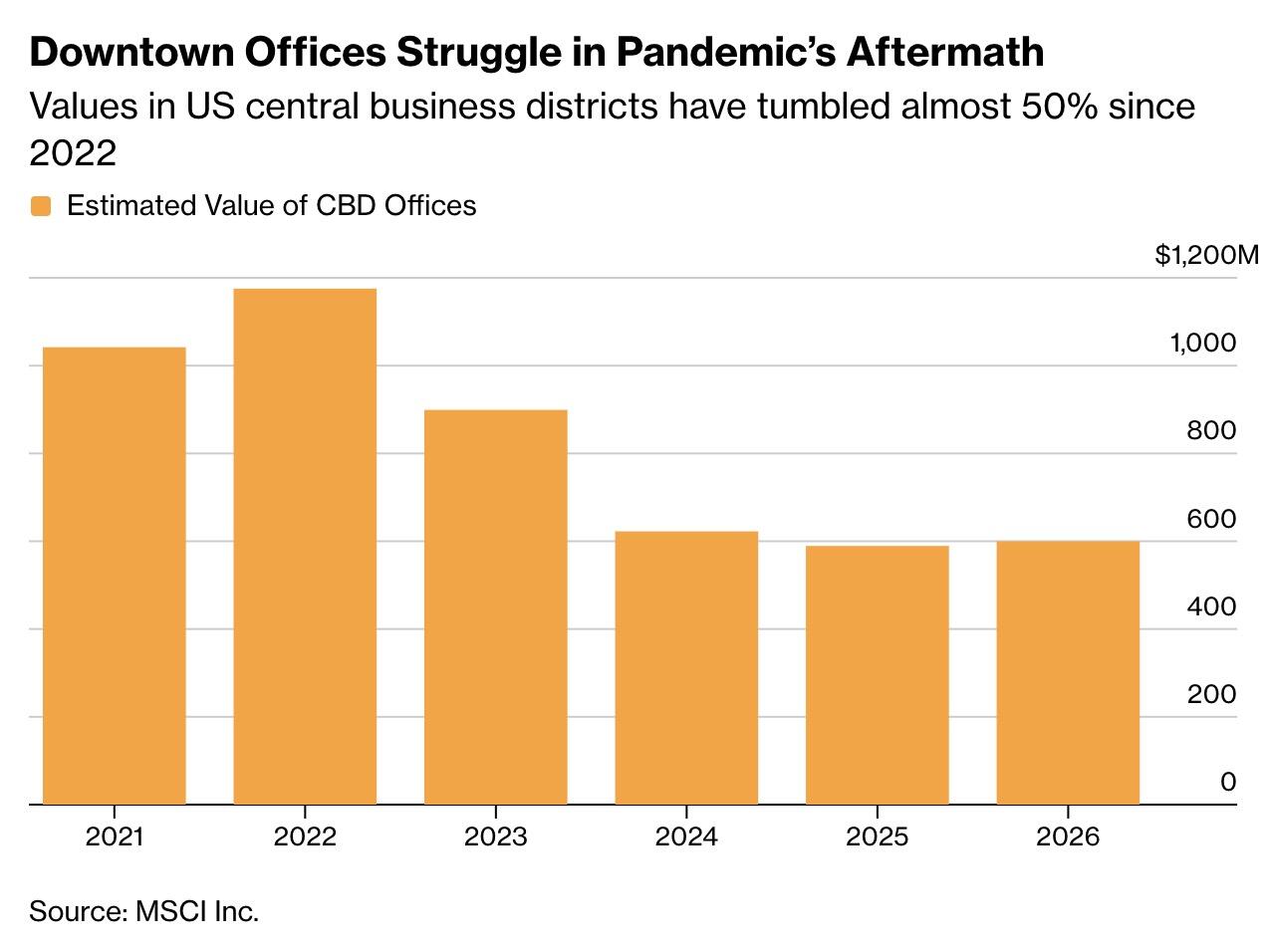
The U.S. commercial real estate sector, particularly offices, is transitioning from deferred pain via loan modifications and extensions to actual realized losses for lenders and investors, as documented in a detailed Bloomberg investigation. High-profile examples like Chicago's Aon Center—purchased for $712 million in 2015, refinanced with $536 million in CMBS debt, and now appraised at just $195 million—illustrate the scale of repricing, with the lender rejecting further extensions amid tenant losses.[1][2]
Trepp data shows office CMBS delinquency rates hovering near 11-12% in recent months, levels exceeding post-2008 peaks in some readings and driven by roughly $64 billion in maturing office loans this year and next, of which nearly $40 billion are already troubled.[3] This shift coincides with persistent high vacancies: downtown Chicago around 23-28% and Denver metro/downtown near 28-39%, though some quarterly stabilization signals appear.[4][5]
Recovery remains highly uneven. New York and San Francisco show pockets of resilience from finance/tech and AI-driven demand, while older Class B assets nationwide face demolition risks—CoStar projects significant Chicago square footage exiting via conversion or teardown. Distressed sales often clear 20% below recent appraisals, per Deutsche Bank analysis, yet this is attracting value investors resetting cost bases, as seen in 601W's acquisition of another Chicago property at a steep discount.
Broader implications extend to economic resilience and policy. The maturity wall, though easing slightly overall, exposes vulnerabilities in legacy underwriting amid remote work shifts and elevated rates. Policy responses could accelerate adaptive reuse (e.g., residential conversions) or targeted incentives for high-vacancy markets to mitigate localized downturns and support municipal tax bases. The tale of two markets—prime vs. secondary, resilient metros vs. struggling ones—highlights how structural changes in work patterns are reshaping urban economies, potentially spurring innovation in mixed-use development but risking prolonged drag on related sectors like construction and services if unaddressed.
LIMINAL: The realized losses signal a necessary market reset that could enhance long-term economic resilience if paired with proactive conversion policies, but fragmented metro outcomes risk deepening regional inequalities without targeted intervention.
Sources (5)
- [1]US Office Real Estate Crisis Shifts to CMBS Investor Losses(https://www.bloomberg.com/news/features/2026-09-21/us-office-real-estate-crisis-shifts-to-cmbs-investor-losses)
- [2]Chicago’s Aon Center Appraised at 195 Million(https://internationalinvestment.biz/en/usa/8860-chicagos-aon-center-is-appraised-at-195-million.html)
- [3]2026 CMBS Delinquency Rates(https://www.commercialsearch.com/news/cmbs-delinquency-rates/)
- [4]Denver's office vacancy improves halfway through 2026(https://www.denvergazette.com/2026/07/10/denvers-office-vacancy-improves-halfway-through-2026/)
- [5]Downtown office vacancy ended 2025 at another record high(https://www.chicagobusiness.com/commercial-real-estate/downtown-office-vacancy-ended-2025-another-record-high)