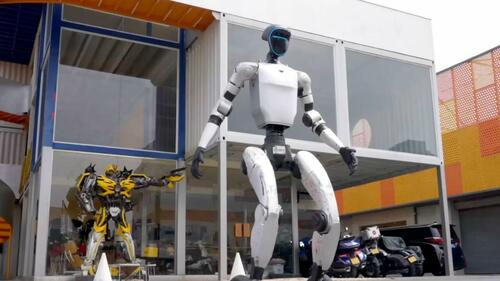
China's SeeLight S1 Robots Enter Homes: Spark Immediate Fears of Domestic Job Losses and Radical Household Transformation
GigaAI's deployment of 100 SeeLight S1 humanoid robots into Wuhan homes for chores like cooking and laundry is confirmed across Chinese and international outlets. Framed through fears of rapid domestic job losses and household upheaval, the story reveals deeper links to embodied AI challenges, China's labor strategy for its aging population, privacy erosion in private spaces, and global debates on automation's uneven societal impacts that could demand new safety nets within years.
A Wuhan-based robotics firm has taken a bold step in embodied AI by deploying its first batch of 100 SeeLight S1 humanoid robots into real-world household environments for testing daily chores. According to reports, the two-armed, wheeled robots have demonstrated capabilities like preparing breakfast, microwaving food, loading dishwashers, folding laundry, organizing wardrobes, and making beds in demonstration apartments. GigaAI describes the SeeLight S1 as powered by an embodied foundation model that interprets natural language, perceives surroundings, plans actions, and adapts to interruptions or layout changes—capabilities the company contrasts with mere 'cerebellum' tasks like acrobatics seen in viral videos.
While impressive, the rollout immediately triggers deeper societal anxieties that extend far beyond technical benchmarks. As these machines cross the threshold from factories into ordinary homes, they surface primal fears about job displacement for domestic workers, nannies, and elder caregivers, alongside profound shifts in family dynamics and private life. Reports indicate initial trials are targeting hi-tech employee housing this month, with free household pilots for families with elderly members, children, or pets slated for early 2027 in Wuhan. Yet the symbolism of robots handling intimate tasks like childcare assistance or elder care resonates globally, raising questions about what happens when mechanical 'brains' inhabit the least predictable of spaces: human homes.
This development connects to broader patterns others often miss. Moravec's paradox—where machines struggle with the very sensorimotor skills humans find effortless—remains evident, as tasks like folding one shirt can take over ten minutes and spilling liquids persists. However, GigaAI's approach of using real homes as data-collection platforms for iterative learning mirrors China's aggressive national push into humanoid robotics to address labor shortages amid an aging population. Reuters coverage of related initiatives highlights government acknowledgment of potential factory layoffs, with proposals for AI unemployment insurance emerging alongside optimism that new jobs will offset losses.
The household angle amplifies these tensions uniquely. Domestic roles have historically been undervalued and often filled by migrant or informal labor; robots could accelerate displacement here faster than in manufacturing, prompting debates on economic inequality—who can afford a $28,000 robot maid?—and the emotional void left when machines replace human interaction in caregiving. Experts remain divided on timelines, with some academics arguing true dexterity for unstructured homes may require over a decade, positioning space applications ahead of kitchens. Privacy concerns loom large too: constant visual sensing and data harvesting inside bedrooms and living rooms could redefine 'home' as a surveilled training ground for corporate AI rather than a sanctuary.
Connections to the US-China robotics race add geopolitical texture. While Tesla's Optimus and Western firms showcase flashy demos, China's scale—supported by innovation centers and industry alliances—focuses on practical embodiment through massive real-world testing. This isn't just automation; it's an experiment in reengineering daily human experience. Within the next year, as more units enter homes, expect intensified public discourse on universal basic services, re-skilling for displaced domestic workers, psychological impacts on children raised alongside robots, and regulatory frameworks for home AI. The SeeLight S1's slow but steady progress in unpredictable environments signals that the era of robots as household members is no longer speculative—it's data-gathering in progress, forcing society to confront changes faster than policy or culture can adapt.
Liminal: Humanoid robots in everyday homes will trigger widespread job losses in domestic and care sectors within 2 years while fundamentally altering family bonds, privacy norms, and the meaning of human labor, outpacing societal readiness.
Sources (4)
- [1]China's first general-purpose humanoid robot undergoes household testing(https://www.globaltimes.cn/page/202606/1362970.shtml)
- [2]Commercial humanoid robots in China may soon do laundry, make beds, care for elders(https://www.scmp.com/tech/article/3354371/commercial-humanoid-robots-china-may-soon-do-laundry-make-beds-care-elders)
- [3]China: 100 humanoid robot to take over household chores in real homes(https://interestingengineering.com/ai-robotics/china-humanoid-robot-enters-real-homes)
- [4]China's AI-powered humanoid robots aim to transform manufacturing(https://www.reuters.com/world/china/chinas-ai-powered-humanoid-robots-aim-transform-manufacturing-2025-05-13/)