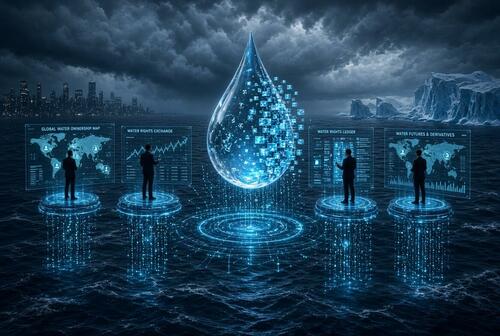
Tokenization and Mapping: The Emerging Financial Architecture of Global Water Resources
Verifiable reports from Goldman Sachs and the UN, alongside real-world AEM mapping in California and emerging blockchain water tokenization projects, illustrate a shift toward digitized, market-oriented water management amid documented scarcity pressures, with implications for liquidity, sustainability, and resource governance.
Recent developments in water management highlight a convergence of financial innovation, advanced geophysical surveying, and institutional reporting that could reshape how water rights and scarcity are addressed worldwide. A May 2026 Goldman Sachs report, 'Securing and Financing the Future of Water,' examines the challenges of pricing, governance, and infrastructure financing, noting that tokenization could enhance liquidity by converting water rights into traceable digital assets on blockchains, enabling credits for conservation or recycling tied to flow meters. Secondary analyses link this to broader real-world asset (RWA) trends and cite examples like UAE pilots for water-backed tokens.
Complementing this, a January 2026 UN University Institute for Water, Environment and Health (UNU-INWEH) flagship report titled 'Global Water Bankruptcy: Living Beyond Our Hydrological Means in the Post-Crisis Era' declares that numerous river basins and aquifers have entered a post-crisis state of chronic depletion and pollution, advocating for transparent accounting, enforceable limits, and centralized management over traditional local rights systems. The report underscores that 70% of major aquifers show signs of irreversible stress.
On the ground, California's Department of Water Resources (DWR) has deployed airborne electromagnetic (AEM) surveys using helicopter-towed sensors to map aquifers statewide, supporting the Sustainable Groundwater Management Act (SGMA). These efforts provide high-resolution data on subsurface water, aiding local agencies in sustainability planning. Parallel academic and industry work explores blockchain platforms like Water Ledger for tokenizing rights via standards such as ERC-3525, aiming for transparent trading and accounting.
Deeper connections emerge between these strands: tokenization could integrate with AEM-derived data for verifiable, auditable credits, potentially linking conservation incentives to capital markets while data centers' projected doubling of water use (per Goldman analyses) amplifies demand for such mechanisms. Geopolitically, this infrastructure positions water as a strategic, financeable asset amid scarcity, raising questions about access equity versus efficiency gains without evidence of centralized 'elite capture' in official documents.
[LIMINAL Analyst]: Digitized water markets and subsurface mapping could improve allocation efficiency and attract private capital to infrastructure, but may concentrate influence among data-rich institutions and jurisdictions, intensifying geopolitical competition over transboundary aquifers and rights.
Sources (5)
- [1]Securing and Financing the Future of Water(https://www.goldmansachs.com/insights/articles/securing-and-financing-the-future-of-water)
- [2]Global Water Bankruptcy(https://unu.edu/inweh/collection/global-water-bankruptcy)
- [3]Airborne Electromagnetic (AEM) Surveys(https://water.ca.gov/programs/sgma/aem)
- [4]Tokenized Water: Digitizing Water Rights and Credits(https://chain.link/article/tokenized-water-rights-credits)
- [5]Tokenization of Water will be on the table soon says Goldman Sachs(https://laraontheblock.com/tokenization-of-water-will-be-on-the-table-soon-says-goldman-sachs/)