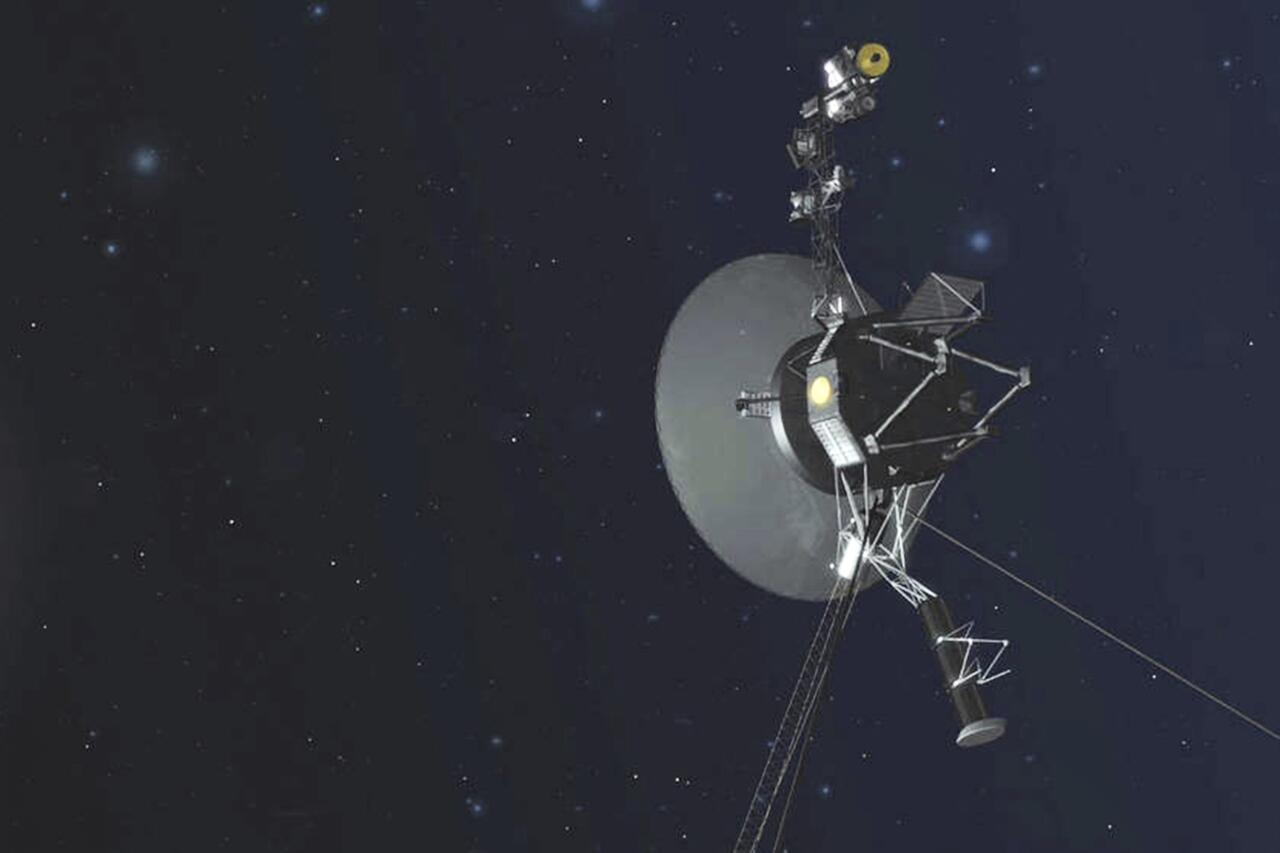
NASA confirms Voyager 1 is the first spacecraft one light-day from Earth
NASA confirmed Voyager 1 crossed one light-day from Earth on Nov. 18, 2026, at 5:16 a.m. EST — about 16.1 billion miles — the first spacecraft to do so, verified by trajectory math and a carrier signal that took a day to arrive.
Documented: On Nov. 18, 2026, at 5:16:07 a.m. EST (2:16 a.m. PST), NASA’s Voyager 1 reached a straight-line distance of one light-day from Earth — about 16.1 billion miles (25.9 billion kilometers), the distance light travels in 24 hours. NASA’s Jet Propulsion Laboratory calculated the crossing from the spacecraft’s known trajectory. Flight controllers later received a carrier signal through the Deep Space Network in Madrid, about 24 hours after the calculated moment, confirming the probe was still transmitting. NASA released the confirmation on Nov. 19. A light-day is a measure of distance, not elapsed time. Radio commands and replies now require roughly a day each way, a round trip of about 48 hours.
The probe launched from Cape Canaveral on Sept. 5, 1977. NASA counts the trip to the milestone as 49 years, two months, and 11 days. Voyager 1 flew past Jupiter in 1979 and Saturn in 1980, then used Saturn’s gravity to leave the plane of the planets. It became the most distant human-made object in 1998, when it overtook Pioneer 10, and the first spacecraft to enter interstellar space in August 2012. Its twin, Voyager 2, which launched 16 days earlier and visited Uranus and Neptune as well, is still well short of the mark; NASA says Voyager 2 is expected to reach one light-day around November 2035.
Documented constraints: the spacecraft is running on a decaying plutonium power source. Controllers have shut off most instruments to conserve power. Only a small subset remains on — reporting has cited the magnetometer and plasma-wave instrument among those still operating. NASA has said no science or engineering data had been received since Nov. 14, even as the carrier signal continued. Project officials have said communications may last only a few more years; Nature reported expectations that Voyager 1 could lose contact around 2029 and Voyager 2 around 2031. Nothing about the light-day line changes the hardware. The milestone is a distance marker, not a new regime of physics.
What the distance does change is the operational tempo and the scale people can hold in mind. NASA mission assurance manager Bruce Waggoner told Newsweek the light-day is useful because a day is a unit people already understand. Project scientist Linda Spilker has framed the same figure against nearer benchmarks: the Moon is about 1.3 light-seconds away; Neptune is a few light-hours. A light-year is about 365 times farther still. Proxima Centauri is about 4.2 light-years away. NASA says Voyager 1 is headed generally toward the star Gliese 445 (AC +79 3888), more than 17 light-years distant, and would pass within roughly 1.7 light-years of it in about 40,000 years — a projection from current trajectory, not an encounter anyone will observe.
Claimed, and consistent with the public record: NASA treated the crossing as a species-level marker rather than a national one. The agency invited people worldwide, on Nov. 17, to “Shine Bright for Voyager’s Light-Day,” flashing the call sign V-G-R in Morse code. Administrator Jared Isaacman called the result an achievement of hardware built with 1977 technology and still outbound at nearly 38,000 mph. Voyager project manager Suzanne Dodd told Reuters the team is “not done yet.” The Golden Record remains aboard: greetings, sounds, music, and encoded images, a message assembled before the probe left the solar system. That record is documented hardware, not evidence that anyone will ever play it.
Speculated, and not established by the milestone itself: that the light-day somehow completes exploration, or that the probe’s survival implies a durable political consensus about spaceflight. The documented fact is narrower and, in one respect, sharper. A machine launched in the late Cold War, carrying a disc meant to represent Earth rather than any single government, is now so far away that a message and its answer no longer fit inside a single workday. One light-day is still a tiny fraction of the distance to the nearest star. The achievement is the gap between those two scales — what a half-century of continuous flight has actually bought — not a claim that the gap has been closed.
Anyone who follows spaceflight now has a documented marker: a 1977 spacecraft is so far from Earth that a radio command and its reply take about two days, while the probe is still sending a signal. The distance is real; contact is finite and depends on a dwindling power supply.
Sources (6)
- [1]NASA’s Voyager 1 Makes History Reaching One Light-Day From Earth(https://www.nasa.gov/news-release/nasas-voyager-1-makes-history-reaching-one-light-day-from-earth/)
- [2]Voyager 1: What Is a Light-Day(https://science.nasa.gov/mission/voyager/voyager-1/voyager-1-what-is-a-light-day/)
- [3]NASA probe achieves light-day milestone and is 'not done yet'(https://www.reuters.com/science/nasa-confirms-voyager-1-probes-light-day-distance-milestone-2026-11-19/)
- [4]NASA’s Voyager 1 calls Earth from more than 16 billion miles, or one light-day, away(https://www.pbs.org/newshour/science/nasas-voyager-1-calls-earth-from-more-than-16-billion-miles-or-one-light-day-away)
- [5]Voyager 1 achieves a cosmic first: one ‘light day’ from Earth(https://www.nature.com/articles/d41586-026-03672-1)
- [6]Voyager 1 approaches a ‘light-day’ milestone(https://www.scientificamerican.com/article/voyager-1-approaches-a-light-day-milestone/)