From Chip Wars to Embodied AI: US-China Robotaxi Race Reshapes Global Technological Supremacy
US and China are shifting AI competition from chips to robotaxis and Physical AI, with Goldman forecasting rapid Chinese fleet growth and substantial US market expansion. This pivot carries major implications for labor displacement, defense applications, urban redesign, and which power captures emerging economic value in embodied intelligence.
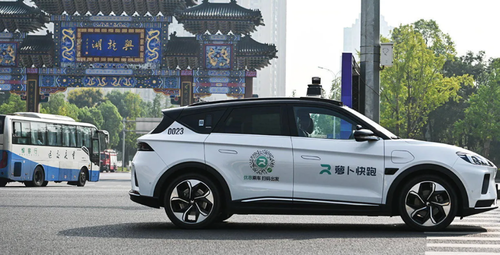
The intensifying competition between the United States and China has pivoted from semiconductor dominance and chip export controls toward robotaxis, autonomous freight, and Physical AI—embodied intelligence integrated into robotics and real-world systems. Goldman Sachs analysts, in recent reports covered across financial media, forecast China's robotaxi fleet expanding from approximately 5,000 vehicles in 2025 to 14,000 by the end of 2026, with further growth to millions by 2035, potentially capturing 36% of ride-sharing vehicles.[1][2] US projections from the same institution point to a domestic robotaxi market exceeding $19 billion by 2030 and reaching $48 billion by 2035, underscoring parallel but distinct scaling paths.[3] Chinese firms like Baidu's Apollo Go, WeRide, and Pony AI are not only accelerating domestic commercialization—achieving city-level break-even in select markets—but expanding overseas into the Middle East, Europe, and Southeast Asia faster than many US counterparts.[4][5] Meanwhile, US leaders such as Waymo continue to scale in domestic cities while Tesla pushes regulatory approvals for its Cybercab. This shift represents far more than transportation disruption. Physical AI, where China is arguably pulling ahead due to its manufacturing scale, hardware ecosystems, and policy focus on integration into robotics and autonomous systems, marks the next frontier of supremacy.[6][7] As detailed in analyses from Eric Schmidt and others, while the US retains edges in foundational models, advanced chips, and simulation software, China's strengths in rapid deployment, cost reduction, and embodied applications—from robotaxis to humanoid robots and delivery drones—could determine control over trillion-dollar markets. Connections often missed include dual-use implications for defense: AI-powered autonomous vehicles tested on highways will translate to battlefield logistics, unmanned combat systems, and swarming tactics, altering military doctrines. On labor, the displacement of millions of drivers (both passenger and freight) could exacerbate inequality or force rapid reskilling, while urban infrastructure faces transformation—reduced parking demands, redesigned roads prioritizing AV efficiency, and smart cities optimized for 24/7 robotaxi fleets. Economically, the winner stands to capture cascading profit pools in mobility-as-a-service, data from physical operations, and AI-driven manufacturing, tilting global power balances. Brookings Institution observers note China's distinct AI strategy emphasizes efficiency, adoption, and physical integration under initiatives like "AI Plus," contrasting with US focus on frontier models.[7] BBC reporting frames this as complementary races: US strengths in "brains" (algorithms) versus China's in "bodies" (hardware embodiment).[8] The ZeroHedge-sourced Goldman insights thus illuminate a decisive phase where technological supremacy extends from data centers into the physical world, with profound ripple effects on societies, economies, and security architectures through 2035 and beyond.
LIMINAL: The pivot to Physical AI and robotaxis will determine 21st-century supremacy by automating labor at massive scale, enabling dual-use defense dominance, and forcing urban reinvention—favoring the side that best integrates hardware scale with intelligent embodiment.
Sources (6)
- [1]Goldman Sachs resets China robotaxi fleet stock forecast(https://www.thestreet.com/investing/stocks/goldman-sachs-resets-china-robotaxi-fleet-forecast-stock-to-buy)
- [2]'Robotaxi has reached a tipping point': Baidu, Nvidia, and Chinese EV makers push ahead(https://www.cnbc.com/2025/11/20/global-robotaxi-race-heats-up-between-us-and-chinese-rivals.html)
- [3]China Could Dominate the Physical AI Future(https://time.com/7382151/china-dominates-the-physical-ai-race/)
- [4]China is running multiple AI races(https://www.brookings.edu/articles/china-is-running-multiple-ai-races/)
- [5]China-U.S. Robotaxi Race Kicks off in U.K.(https://www.wsj.com/tech/china-us-robotaxi-race-kicks-off-in-uk-f005dac2)
- [6]China is winning one AI race, the US another - but either might pull ahead(https://www.bbc.com/news/articles/c145enxln0go)